Elevating core value for international brand building

In 2023, Vietnam brand value increased to 498.13 billion USD to rank 33rd in the Top 121 global national brands. The country’s brand value has grown continuously, by as much as double digits over the past five years.

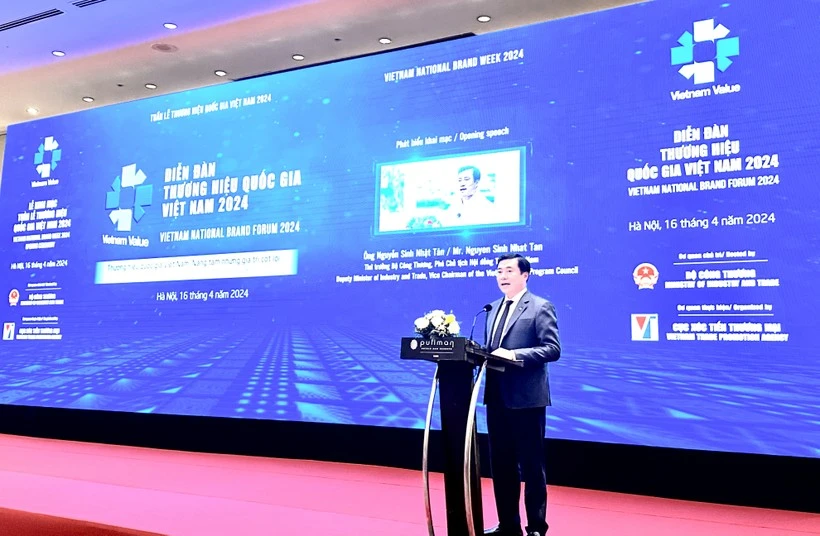
Deputy Minister of Industry and Trade Nguyen Sinh Nhat Tan addresses the National Brand Forum held by the Ministry of Industry and Trade in Hanoi on April 16 (Photo: VietnamPlus)

Hanoi (VNA) - Vietnam has signed a variety of free trade agreements (FTAs) around the world. Partners offer preferential tariffs and market penetration for Vietnamese products. Therefore, to gain a foothold and run smoothly, businesses need to build value in a strong brand, according to the Ministry’s represenatives at the National Brand Forum held in Hanoi on April 16.

Success from brand affirmed

Le Duc Nghia, Chairman of the Board of Directors of the An Cuong Wood Company, said that the market has recovered this year, with various signs of improvement in the export of wood products. The company has won export orders until the end of November and others for domestic delivery until the end of the third quarter of 2024.

With two main markets - the US and Japan respectively accounting for 85% and 15% of export orders, the An Cuong Company is aiming to expand to Canada. In order to gain a foothold and succeed in the market, Nghia said that the company does not want to do outsourcing, so it is very active in participating in fairs abroad and arranging business delegations from the US to visit An Cuong's factory to have direct connections with orders and develop the brand.

According to him, there is good profit in a business exporting its own product, but outsourcing products is not sustainable due to costs. Specifically, the profit will range from 8-10% if a business ships its products abroad. Outsourcing reduces profit margins to 2-3%, or break even in a worst case scenario.

“To succeed, a business should focus more on marketing, and promote brand development,” said Nghia.

Meanwhile, the TH Group operates a green and circular economy with its business model.

Arghya Mandal, General Director of the TH Dairy Joint Stock Company (TH Group), shared that TH’s investment projects focus on applying high tech, science technology and management science, creating agricultural products with breakthrough output and quality, towards sustainable development, beneficial to health.

As of the end of 2023, TH Group had been honoured with the Vietnam National Brand four times in a row with the following criteria: Quality, Innovation, Pioneering Capacity. Most recently, TH has had five product groups recognised as National Brand items, including UHT fresh milk, ice cream, nut milk, purified water and juice milk.

“To truly develop their brand, businesses need to accompany the programme in promotion and communication activities, towards a common goal. This is the development and enhancement of Vietnam National Brand. This is also a way to inspire other businesses to join in," Mandal further said.

National brand building 2.jpg
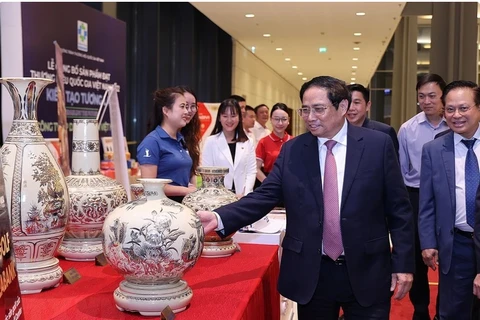
Businesses with products recognised National Brand in 2022 honoured (Photo: VietnamPlus)

Moreover, many small and medium-sized enterprises (SMEs) in the world have succeeded in building brands with core values, contributing to building a national brand, associated with the image of quality products. Dr. Abel D. Alonso from RMIT Vietnam University said that SMEs account for 96% of the total number of businesses, employ 47% of the workforce and contribute 36% of national added value.

Core value elevated

In recent years, Vietnamese businesses have made many advances in building and developing brands, improving the competitiveness of products, attracting investment and developing foreign trade.

Deputy Minister Tan cited a report on the implementation of the Vietnam National Brand Programme 2023 by the Ministry of Industry and Trade showed that Vietnam continued to be a spotlight in the world’s brand development map, posting the fastest growth rate of 102% in the 2019-23 period.

He said that the elevation of core values is not only the acceleration of economic growth but also the building of corporate culture, building of just society and sustainable development.

National brand building 4.jpg
Experts share their views at the forum (Photo: VietnamPlus)

Nguyen Thuong Lang, senior lecturer at the National Economic University, said to build their own brand, SMEs should select products and choose an appropriate way to ensure that their core values are affirmed in the market.

According to Lang, relevant ministries and sectors should create conditions for consumption orientation and promotional programmes, while developing national brands and outstanding products on the market.

To promote core values ​​and contribute to increasing export value in the coming time, Hoang Minh Chien, Deputy Director of the ministry’s Trade Promotion Department, said that ministries, sectors and localities need to raise awareness of stakeholders on the role of building brands and registrating intellectual property protection of Vietnamese branded products.

Chien suggested businesses promote creativity in designing products, invest in technology reform to produce stable and sustainable quality products toward the trend of green and circular economy./.
VNA

See more

The interface of Vietnam's foreign supplier portal for tax registration, declaration and payment by overseas suppliers. (Photo: dientuungdung.vn)

Foreign digital service providers pay nearly 480 million USD in taxes

According to the Department of Taxation, 259 overseas suppliers have registered, declared and paid taxes through the portal. Tax revenue from the group reached 78.1% of the full-year target, surging 119% from a year earlier and making foreign suppliers the fastest-growing source of tax revenue in Vietnam's digital economy.

Ca Mau companies and households use rooftop solar to cut expenses. (Photo: VNA)

Vietnam raises rooftop solar sales cap to 50%, widens direct power deals

Rooftop solar power is entering a new phase of development with a more solid foundation. When integrated with energy storage systems and direct power purchase mechanisms, it not only contributes to supplementing distributed energy sources and reducing pressure on the national power system, but also serves as a driving force for green growth, enhances the competitiveness of the economy, and ensures energy security.

Production of electrical wiring harnesses at Bandai Vietnam Co., Ltd. in the Left Bank Industrial Park, Phu Tho province. (Photo: VNA)

Record FDI Inflows signal strong investor confidence, but absorptive capacity remains key

Vietnam's competitive advantages are evolving. Rather than relying primarily on low labour costs and tax incentives, the country's future competitiveness will increasingly depend on structural and long-term factors, including transparent institutions, policy predictability and an investment environment capable of supporting long-term strategic investors.

Vietnamese Ambassador to the RoK Vu Ho (first, left) and other participants in the conference in Seoul on July 14 (Photo: VNA)

Vietnam, RoK strengthen investment links at Seoul conference

Vietnamese Ambassador to the RoK Vu Ho said bilateral relations are currently enjoying the best conditions, underpinned by what he described as the three key factors of “favourable timing, geographical advantages, and strong public support”.

Electricity generation is monitored at the plant of the Hai Phong Thermal Power Joint Stock Company. (Photo: VNA)

Energy security “shield” must be built in layers: Expert

In an interview recently granted to the Vietnam News Agency, Dr Nguyen Van Tu, General Director of the Vietnam Petroleum Institute (VPI), said petroleum reserves are a critical line of defence, but a genuine energy security “shield” must be built in layers.

Reducing emissions is not only essential for tackling climate change but also brings tangible benefits to farmers and businesses. (Photo: VNA)

Vietnam steps up low-emission farming to support green growth

Vietnam is among the world's leading producers and exporters of agricultural products, including rice, coffee and a wide range of fruits. However, key export markets such as the US, the European Union (EU) and Japan are tightening sustainability requirements for agricultural products, making the transition to low-emission farming increasingly important.

Fresh fruit products of Vietnam are introduced to German customers. (Photo: VNA)

"Live data" paves way for Vietnamese farm exports

Achieving Vietnam's target of more than 74 billion USD in agricultural, forestry and fishery exports in 2026 will require stronger traceability systems, initially focusing on key export commodities, high-value products and major markets such as the EU, the US and China.

An enterprise in the southern province of Dong Thap invests in modern technologies and machinery for production. (Photo: VNA)

Broadening financing channels key to unlocking SME growth

As the private sector takes on a more central role under the Politburo's Resolution No. 68-NQ/TW, experts and business representatives say Vietnam needs a more comprehensive approach to supporting SMEs. This includes improving institutions, making financial support tools more effective and reshaping the financial system to better suit the characteristics of SMEs.

Phase 1 and Phase 2 of the Tan Thuan Wind Power Plant in Tan Thuan commune, Ca Mau province, have a combined installed capacity of 75 MW, comprising 18 wind turbines. (Photo: VNA)

Energy storage unlocks renewable power potential, cuts emissions

Energy transition is not simply about replacing fossil fuels with wind and solar power. It also requires building a sustainable energy ecosystem in which clean power generation, energy storage, smart grids and material recycling chains develop in parallel. Such an integrated approach will improve energy efficiency, further reduce greenhouse gas emissions and help Vietnam achieve green growth and net-zero emissions targets by 2050.

Vietnamese food is increasingly diverse in varieties and packaging, meeting domestic demand. (Photo: VNA)

Government urges vigilance as inflation pressures mount in H2

The Government's inflation target remains within reach despite mounting headwinds. Several forecasts suggest inflation can stay below 4.5% this year if international oil prices continue to retreat. Extending domestic fuel tax incentives through year-end, along with stable electricity prices, healthcare fees and exchange rates, would offer additional relief.

Construction is underway at the Tu Lien Bridge project in Hanoi. (Photo: nhandan.vn)

Public investment drives Hanoi’s growth momentum

In the first half of 2026, Hanoi disbursed 64 trillion VND (2.4 billion USD) in public investment, equivalent to more than 53% of the annual plan assigned by the Prime Minister – the highest mid-year disbursement rate recorded in many years.