Rare bird returns to Tram Chim National Park
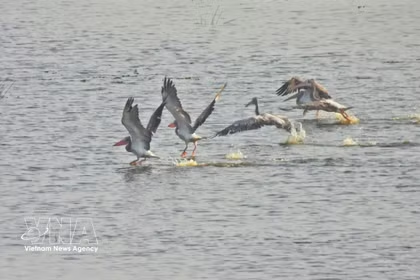
Six spot-billed pelicans were spotted in the strictly protected A1 zone, landing in the wetland area to forage for food.
Six spot-billed pelicans were spotted in the strictly protected A1 zone, landing in the wetland area to forage for food.
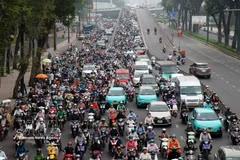
After the two major cities in 2027, the scheme will expand to other cities from July 1, 2028, and to the remaining provinces from July 1, 2030.

Funded by the Multilateral Fund for the Implementation of the Montreal Protocol and implemented through the World Bank (WB) and the United Nations Environment Programme (UNEP), the project aims to help Vietnam meet its international commitments in managing and phasing out controlled substances. It will run from 2026 to 2031 with a total budget of over 13 million USD.

All the four species are classified under Group IB – Vietnam’s highest level of protection for endangered, rare, and precious wildlife, and listed as Endangered (EN) on the IUCN Red List.
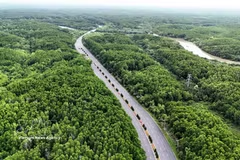
Vietnam’s forest coverage rate remained stable at 42.03% in 2025, with total forest area estimated at 14,971,553 ha, according to the Ministry of Agriculture and Environment (MAE).
Under the theme "Accelerating decarbonisation in agriculture and manufacturing – Unlocking trade and investment opportunities", the forum gathered nearly 200 researchers, experts and businesses involved in policy development, investment, research and innovation. Participants exchanged insights and explored ways to translate the cooperation potential between Vietnam and Australia into practical business opportunities.

Vietnam–Mexico relations have been continously strengthened and developed over more than half a century, particularly in trade, with Mexico currently serving as Vietnam’s second-largest trading partner in Latin America.
The Ministry of Finance has recently released the draft for public feedback, with the decree expected to take effect from July 1. The draft specifies 21 categories of tax-exempt income, adding five, aimed at encouraging individuals working in priority sectors aligned with national development strategies.

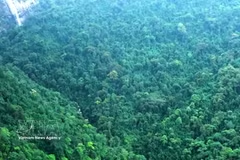
The funding will be reinvested to strengthen the policy system, institutional capacity, and enforcement of forest protection measures.
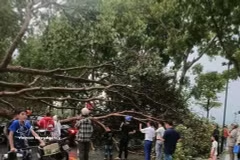
Local authorities have promptly mobilised forces to assist affected residents, provide relief, and help stabilise livelihoods while continuing to assess and compile damage reports.
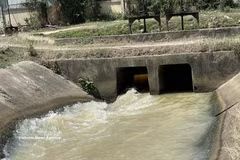
In agriculture and environment, WB-funded projects have made practical contributions to irrigation systems, water resource management and rural water supply, particularly in the Mekong Delta. These efforts have helped ensure water security, dam safety and sustainable development.
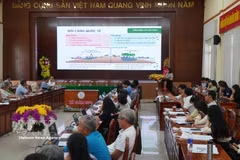
Experts at the workshop described wetlands as the “ecological heart” of the Mekong Delta, playing a vital role in water storage and regulation, climate moderation, carbon sequestration, biodiversity conservation, and livelihoods for millions of people through aquaculture, agriculture, and ecotourism. These ecosystems also help reduce disaster risks and enhance climate resilience.

Several rare marine species have recently been found washed ashore along the coast of Lam Dong province, drawing public attention.
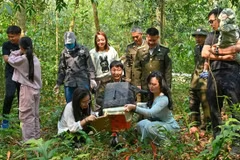
Under the Cuc Phuong Rewilding Action Plan 2026–2035, with a vision to 2050, the initiative aims to transform the park into a natural gene bank capable of supplying wildlife populations to other protected areas nationwide.

In response to World Meteorological Day 2026's theme, Vietnam’s hydrometeorological sector has reaffirmed that weather and climate know no borders, underscoring the importance of maintaining and developing a robust national observation network as part of the global system.
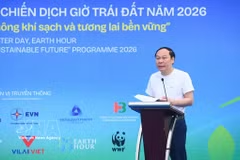
Deputy Minister of Agriculture and Environment Le Cong Thanh underscored that water, climate, and energy are fundamental pillars of sustainable development. In Vietnam, water resources and weather patterns influence every aspect of life, from food and water security to livelihoods, ecosystem stability, and economic growth.
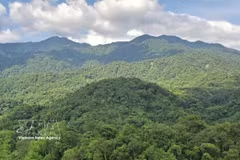
In Vietnam, forests serve as a foundation for livelihoods, water resources, public health, and environmental stability, particularly for ethnic minority communities living in and near forest areas. They also act as a natural buffer against disasters, helping reduce risks linked to climate change.

The campaign comes amid growing concerns over global energy security as ongoing tensions in the Middle East continue to disrupt supply chains. In this context, energy efficiency has been identified as a key solution to ease supply pressure, reduce costs, and enhance economic competitiveness.
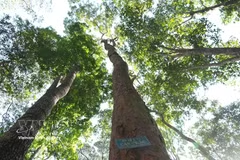
According to Director of the Forestry and Forest Protection Department Tran Quang Bao, forests hold a strategic position in Vietnam’s development. They provide livelihoods for millions of people, particularly ethnic minorities and communities living in mountainous and forested areas, while contributing to environmental protection and disaster prevention.

The Ministry of Agriculture and Environment urged ministries, agencies, local authorities, embassies, and international organisations to hold practical and effective activities aligned with the themes. Suggested activities include displaying eco-friendly banners, posters, and billboards in public spaces, streets, government offices, and other suitable venues to raise public awareness of the events’ importance.
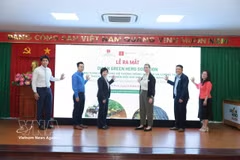
Under the “Green Hero Solution” project, organic food waste will be collected from partner organisations and businesses and processed into compost. The compost will then be used at two Food Bank community gardens, where fresh vegetables will be grown to support disadvantaged households.

Highlighting Vietnam’s close partnership with the two UN agencies, Deputy PM Ha highly appreciated their important contributions to the country’s development over the years, particularly in policy consultation, institutional reform and promoting sustainable development initiatives.

The discovery provides additional scientific data on the region’s flora and suggests that the limestone forest ecosystem in the national park remains well preserved.
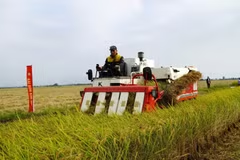
Green growth, circular economy, and low-carbon economy are identified as cross-cutting orientations designed to drive deep structural economic reform; boost productivity, quality, efficiency, and national competitiveness.
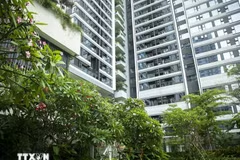
According to the latest announcement from the US Green Building Council (USGBC) and Green Business Certification Inc. (GBCI), Vietnam ranked eighth among countries and territories outside the US in LEED-certified floor area in 2025.
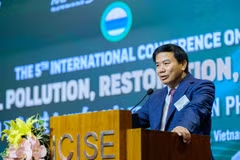
Around 90 scientific papers are being showcased in plenary, parallel, and poster sessions, covering topics like environmental pollution, toxicology, public health, risk assessment, remediation technologies, and environmental management policies.
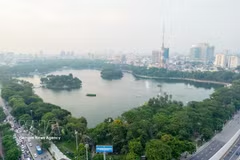
Prime Minister Pham Minh Chinh has issued Directive No. 04/CT-TTg to accelerate the implementation of the scheme on development of urban areas in Vietnam in response to climate change in the 2021-2030 period.
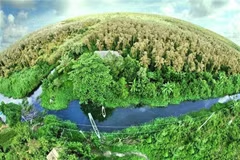
The development of a forest carbon market is opening up significant opportunities for Vietnam’s forestry sector to mobilise new financial resources for forest protection and development, while creating sustainable livelihoods for local communities, particularly in ethnic minority areas.