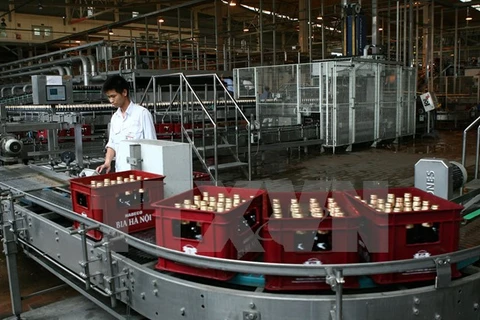
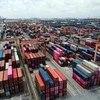
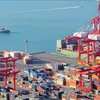
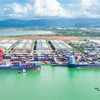
A production chain at the Saigon Alcohol Beer and Beverages Corporation’s plant in Thanh Loc Industrial Zone, Kien Giang province (Source: VNA)
 Nguyen Duy Long from the ministry’s Corporate Finance Department made the statement at a seminar entitled “Equitisation of SOEs from the perspective of foreign investors” held by the National Assembly Economic Committee and the American Chamber of Commerce in Hanoi on September 8.
The seminar aimed to provide opportunities for managers and enterprises at home and abroad to meet and exchange experiences in the divestment of State capital in equitised enterprises.
It is expected to help the Economic Committee advise the National Assembly and recommend legal policies on the management and use of State capital and assets in enterprises.
Long said Vietnam equitised 508 businesses in 2011-15, which had more than 189 trillion VND (8.4 billion USD) of State owned capital. In 2016, the State approved equitisation plans for 58 businesses, six of which were SOEs.
“The system of SOEs has been restructured from 1,500 enterprises in 2010 to about 600 in 2016, mainly operating in key sectors to ensure macro balance for the economy,” said Long.
According to the report, equitisation has helped restructure human resources for firms and society, along with developing the capital market and stock market. It has also changed corporate management, helping raise business efficiency.
However, equitisation in a number of ministries and localities has fallen short of plans. The rate of State capital at equitised companies is still high because the amount of publicly offered shares was low compared with corporate equitisation. In particular, the mechanism of SOE equitisation has revealed several shortcomings which need to be studied and fixed.
At the seminar, participants mentioned things hampering equitisation. Among them, besides some objective reasons, the SOE equitisation process was influenced by global factors and regional economies.
Many participants said several ministries, sectors, localities, economic groups and State corporations have not actively organised equitisation.
Many equitised SOEs, who are meant to list on the stock market, have not yet listed after launching initial public offerings (IPOs). In addition, employees at various levels, sectors and enterprises are still afraid of equitisation and worried about their role after the process, which slows down its progress.
Tran Dinh Thien, director of the Vietnam Institute of Economics, pointed out a paradox of the equitisation process that although 96.5 percent of enterprises have been equitised, only eight percent of State capital was transferred to the private sector.
According to Thien, that is because the proportion of State capital for sale is very limited. “Therefore, private enterprises are excluded from the right to participate in the management, not to mention corporate controlling rights. This is also one of the reasons why private investors, including foreign ones, are not interested in buying SOEs,” said Thien.
Participants said that it was necessary to complete a system of mechanisms and policies for the restructuring of SOEs, to carry out the roadmap for equitisation and divestment of State capital approved by State agencies and to ensure transparency in the restructuring of state enterprises.
Adam Sitkoff, executive director of the American Chamber of Commerce in Hanoi, said that in order to increase the confidence of investors, equitisation and divestment must be transparent and investors must be provided with full information related to the businesses.
Meanwhile, Tony Foster from Freshfields, a law firm in the UK, said that to attract serious and long term investors, they should be able to buy controlling stakes of equitised businesses or divestment of State owned enterprises.
At the seminar, many participants also said that to overcome the shortcomings in the equitisation, the country would need to apply asset assessment methods that suit the market mechanism, ensuring State capital and assets and corporate values are properly assessed.
At the same time, it would be essential to select independent valuation consultants with prestige, encouraging investors to buy shares and contribute capital to enterprises when they carry out equitisation and divestment of State capital. -VNA