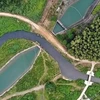
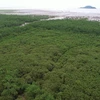
A corner of Dam Bay mangrove forest in Khanh Hoa province. (Photo: VNA)
 Tran Thi Thu Ha, a member of the Vietnamese Academy of Forest Sciences, which falls under the management of the Ministry of Agriculture and Rural Development, said that these payment methodologies could effectively stimulate and harness resources for this vital cause.
According to Ha, the efficacy of such payment schemes for ecosystem services has been proven through their successful implementation in forest ecosystems across Vietnam.
The Forest Protection and Development Fund has been instrumental in deploying the payment for forest environmental services model. This approach has facilitated resource augmentation for the forestry sector, bolstered revenue streams for forests, lightened the fiscal burden on the State, enhanced the effectiveness of forest protection and development efforts, and fostered income and livelihood avenues for communities residing in mountainous regions, explained Ha.
In light of these accomplishments, she emphasised the importance of expanding this payment structure to encompass other ecosystem services. This would drive revenue generation for the conservation and restoration of ecosystems and wildlife species that are currently inadequately supported by the State's budget, she added.
Leveraging the knowledge gained from the application of payment mechanisms for forest environmental services, Vietnam now sets its sight on extending this model to a variety of other ecosystems, such as marine and wetland environments, said Ha.
While the country has initiated similar programmes for these ecosystems, Ha highlighted that comprehensive payment mechanisms for their services remain absent.
To date, Vietnam has incorporated payments for certain ecosystem services. These encompass fees for sightseeing within protected marine and wetland areas, a shared management model for aquatic resources, and the promotion of eco-friendly aquaculture practices within select coastal regions. These efforts have been facilitated through collaborations with international organisations and pertinent sectors, Ha explained.
However, she cautioned that the longevity of many such payment models is threatened due to a lack of a clear legal framework.
Amid this backdrop, environmental specialists have emphasised that the existing State budget is insufficient to meet the pressing needs of biodiversity conservation. They argue that the advent of new financial structures and policies is indispensable to draw additional resources. The active participation of local communities and the business sector is deemed crucial to fortify investment in biodiversity preservation.
It needs mechanisms for certificates and credits for biodiversity, mechanisms for accessing carbon credit markets, mechanisms for debt swaps for nature conservation, biodiversity, green bonds, green credits, and establishment of biodiversity funds such as funds for the conservation and restoration of ecosystems.
Successful policy tool
According to Dao Xuan Lai, who heads the Climate Change and Environment Unit at the United Nations Development Programme (UNDP) in Vietnam, payment for ecosystem services is globally acclaimed as an effective policy instrument for the management of natural resources, utilised with success in several countries worldwide.
Such programmes have been widely implemented across a diverse range of ecosystem services worldwide, encapsulating areas such as biodiversity conservation, watershed services, carbon sequestration, and landscape aesthetics, stated Lai.
He further noted that the collective annual value of ecosystem service payment programmes on a global scale is estimated to exceed a staggering 36 billion USD.
Lai expressed optimism that the launch of initiatives to promote ecosystem services could significantly aid the revival and restoration of biodiversity and ecosystems within Vietnam. He added that these initiatives could also provide tangible contributions towards the fulfilment of biodiversity targets that Vietnam has pledged to achieve under the Global Biodiversity Framework. This framework was launched at the 15th Conference (COP15) of the Parties to the Convention on Biological Diversity.
Nguyen Dinh Tho, Director of the Institute of Strategy and Policy on Natural Resources and Environment, said that as per Clause 1, Article 138 of the Law on Environmental Protection 2020, payment for natural ecosystem services implies that entities or individuals who utilise these services must remunerate those who facilitate environmental and landscape values created by such natural ecosystems.
Tho explained that the funds thus accrued would be utilised to safeguard, sustain, and enhance the natural ecosystems.
Services provided by natural ecosystems that qualify for such payments encompass the environmental aspects of the forest ecosystem in alignment with forestry law, wetland ecosystems utilised for tourism, leisure, and aquaculture; marine ecosystems serving similar purposes; mountain ecosystems, caves, and geo-parks catering to tourism and entertainment; and natural ecosystems which facilitate carbon sequestration and storage.
He further clarified that the law unequivocally prescribes the modus operandi of payment for these natural ecosystem services. Accordingly, entities and individuals exploiting these services are obligated to pay directly to those providing these services, through a contractual agreement between the two parties.
For indirect payment scenarios, entities and individuals availing natural ecosystem services are required to remunerate the service providers via an entrusted model through the provincial environmental protection fund, or the Vietnam Environmental Protection Fund in instances where a provincial fund is unavailable, he noted./.
VNA