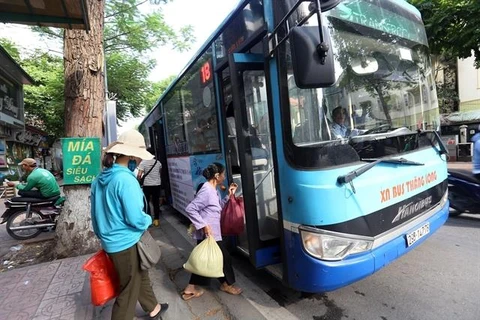
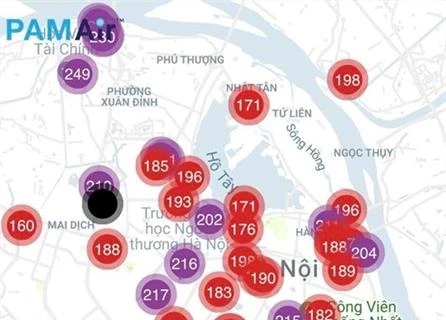
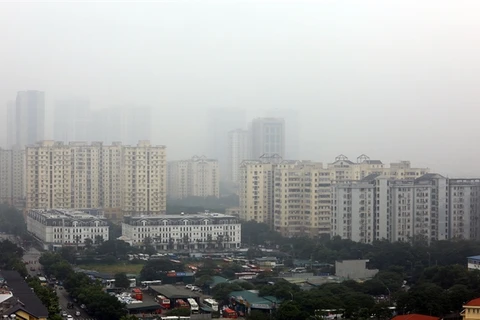
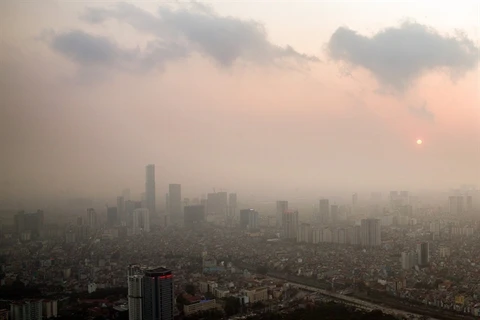
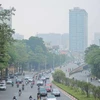
Buildings in Hanoi are covered in fine dust. (Photo: VNA)
 Hanoi (VNA) – Experts gathered at a conference in Hanoi on January 14 to seek ways to improve air quality in the capital city of Vietnam.
The event was jointly organized by the Vietnam Clean Air Network, the Centre of Live and Learn for Environment and Community (Live and Learn), the Hanoi Department of Natural Resources and Environment, the World Bank (WB) and the US Agency for International Development (USAID).
The conference aimed to update activities of domestic and international organisations to support Hanoi’s air quality management. It also offered a chance for experts, scientists and representatives from State management agencies and organisations to discuss action plans for air quality in 2020
Luu Thi Thanh Chi, deputy head of the Hanoi Environmental Protection Department, said to deal with air quality fluctuations, the municipal People’s Committee has taken a wide range of solutions to improve the quality of the environment and the air in particular. Since 2017, Hanoi has installed 10 air monitoring stations, including two fixed ones.
At present, the stations operate stably, transmitting data to the Department of Natural Resources and Environment daily, she said.
Hanoi will invest in additional 33 air monitoring stations and caravans in 2020, she added.
In a policy dialogue held the same day, President of the Vietnam Clean Air Network Hoang Duong Tung said Vietnam does not have enough capable air quality tracking systems to protect people from air pollution.
The country’s economic engine HCM City, despite a recent drastic drop in air quality, does not have a single automatic air quality tracking station.
Hanoi lacks systems which can show comprehensive data on air quality in the city centre and neighbouring provinces.
Vehicles are estimated to contribute 30 to 50 percent of urban emissions. However, as no proper research on pollutants has been published, Vietnam has not developed a priority policy to limit personal vehicles.
From 2019, the country’s fuel tax will rise to the highest level of 4,000 VND (17 US cents) per litre for gasoline and 2,000 VND (8.5 US cent) per litre for diesel. The tax will bring 57.3 trillion VND (2.4 billion USD) each year to the State budget but the money will not go directly to environment protection activities.
Environmental protection accounts for only 1 percent of Vietnam’s State budget expenditure, while air pollution alone cost the country up to 5.64 percent of its GDP in 2018.
Air pollution costs Vietnam from 10.82 billion USD to 13.63 billion USD per year, according to research by the Hanoi-based National University of Economics (NEU).
NEU lecturer Dinh Duc Truong said the soaring air pollution was a market failure.
“Air pollution is an externally negative phenomenon affecting buyer decision process and at the same time increasing production costs. Instead of consuming goods which will improve their living quality, people have to spend more on gadgets to protect themselves from unhealthy air,” he said.
According to Truong, as air is a public good, meaning all individuals have to use it without paying for it, many companies tend to avoid investing into emission treatment systems to reduce expenses, leading to people not gaining enough insight into air quality, emerging hazards and how human health is impacted because of exposure to air pollution.
Only when information is provided in a timely and accurate manner can people perform their supervisory roles and better understand risks, he said.
He recommended accelerating green finance, investing in innovative start-ups and enhancing economic reforms to reduce air pollution.
The 2018 Environmental Performance Index published by Yale University put Vietnam at 132nd place among 180 countries. In terms of air quality, the country stood 159th.
On January 14, Hanoi was once again hit by filthy air with the air quality index at very unhealthy levels./.
VNA