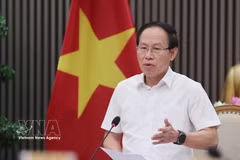
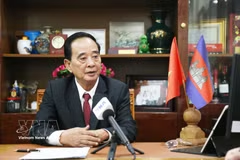
Vu Nhu Thang, head of the Ministry of Finance’s External Relations Department (Source: VNA)
Hanoi (VNA) – The Ministry of Finance will continue completing tariff policies and reforming tariff and customs administrative procedures to support production and business and also improve the competitiveness of the economy.
Meanwhile, the establishing of the ASEAN Economic Community (AEC) since this year would bring opportunities and challenges for Vietnam because the nation must reduce various import taxes to zero for goods imported from members of the AEC by 2018.
Vu Nhu Thang, Head of the Ministry of Finance’s External Relations Department spoke to Bnews, an economic news website of the Vietnam News Agency, about other issues.
* What is your view on tariff liberalisation of ASEAN and also of Vietnam?
Tariff liberalisation in ASEAN has been implemented by the ASEAN Trade in Goods Agreement (ATIGA). This is the first comprehensive agreement of ASEAN to correct trade in goods of the ASEAN community and the agreement has had development based on all commitments in the Common Effective Preferential Tariff (CEPT) under the ASEAN Free Trade Agreement (AFTA).
Under the ATIGA, 98 percent of total tariff lines are reduced to zero and reduction of tariff would be implemented in the short term ending 2018.
So far, six ASEAN countries finished the reduction of tariff to zero in 2010 and four other ASEAN countries, including Vietnam, will complete the tariff reduction in 2018.
According to the commitments, 97 percent of Vietnam’s tariff lines will reduce to zero in 2018 while 3 percent of the remaining tariff lines, including tariff lines for sensitive farming products, products under a list of goods enjoying elimination of tariff reduction and completely knocked down (CKD) units of automobiles, will be taken out of commitments for reducing tariff.
* What are challenges that Vietnam faces in the process of reforming tariff policies?
Establishment of the AEC and going forward to 2025 has required member countries to integrate further in all fields of the economy. Therefore, the countries must complete institutions and policies in a situation with numerous differences in economic development, politic institution and administrative management among those countries.
In the financial field, Vietnam’s Ministry of Finance will continue implementing commitments on reducing import tariffs and basically completing the tariff reduction in 2018. In addition, the ministry will complete reforms in local tariff policies including import and export tariff, value added tax and special consumption tax and also promote reforms in administrative procedures.
For the financial markets, the Ministry of Finance will continue negotiating commitments on financial services to have gradual liberalisation in the insurance, banking and securities fields. It will also implement effectively legal framework for the mutual recognition of accounting and auditing.
* According to the commitments in ATIGA, Vietnam is permitted to delay deadline of tariff reduction of some sensitive goods until 2018. Experts say the relevant state offices have not had much support for local production industries to take advantage of the delay from tariff reduction. What is your opinion?
Vietnam has some goods that have permission to postpone deadline of tariff reduction to zero until 2018. Extension of the duration to maintain this tariff will help local industries gain time to adapt to a gradual tariff reduction schedule and also implement suitable adjustments.
The finance ministry has implemented solutions on complementing tax policies and reforming administrative procedures of tax and customs fields to support local production and business and improve the competitive ability of Vietnam’s economy.
To take advantages of the integration process, together with support from state agencies, the local enterprises must have real competitive ability. They must actively take information from the process of integration to the international economy and have suitable production and business strategies to improve competitive ability of their goods against those from other ASEAN countries.
* When tariff reduces to zero, what will the Ministry of Finance do to support local production and business activities and improve the competitiveness of Vietnamese economy?
To support local production and business activities and improve competitiveness of local economy, the state must take many synchronic solutions, including tax solution.
The ministry has submitted to the government proposals on complementing the legal systems for import and export tax and create a synchronic legal framework to actively integrate into the international economy.
The ministry has also had specific regulations on tax exemption and tax refund of several import and export goods. Of this, Vietnam will focus incentives on machines, equipment, and important material according to fields and areas that need priorities in development and encouragement in development of production, increase of competitive ability for local products and attraction of foreign investment.
For local taxes, the ministry has proposed adding regulations on corporate income tax, special consumption tax, and resource tax to existing regulations to create favourable investment and business environments.
Meanwhile, the ministry has implemented the ASEAN single window mechanism, standardised and publicised 859 administrative procedures managed by the ministry, and also abolished unnecessary procedures.
The ministry has implemented solutions to improve business environment and national competitive ability in 2015 and 2016. Therefore, the time for paying tax for enterprises was reduced by 420 hours, 97 percent of local enterprises have implemented online tax declaration, and 90 percent of local enterprises have registered online tax payment.
In the future, the ministry will continue to implement solutions on complementing tax policies as well tax and customs administrative procedures.-VNA