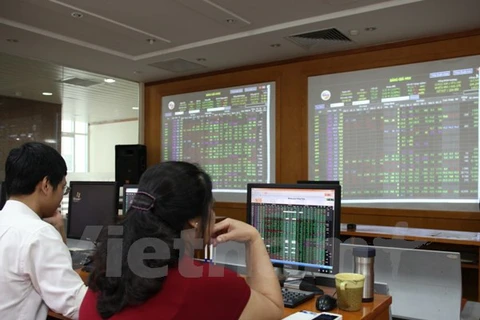
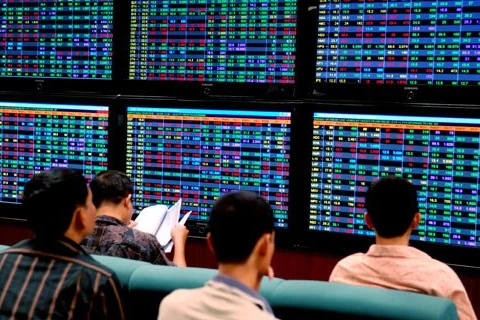
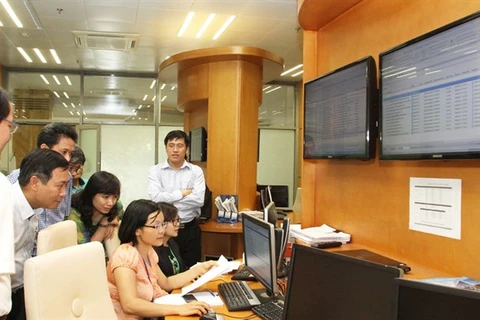
Illustrative image (Photo: VNA)
 Hanoi (VNS/VNA) - Following a global trend of share buybacks, many Vietnamese businesses are now repurchasing their own stocks to stabilise prices.
When companies buy their own stocks, they reduce the total amount of shares on the market, inflating common metrics like earnings per share, which typically boosts the stock price.
While investor confidence, reacting to a worsening economic outlook, has deteriorated, the world's largest economy has still recorded gains thanks to a series of rate cuts by the US Federal Reserve (Fed) and the wave of share buybacks of companies.
The Financial Times quoted data compiled by Howard Silverblatt, senior index analyst for S&P Dow Jones Indices, as saying that last year, companies in the S&P 500 spent a record US$806 billion buying back shares.
“Activity this year has slowed slightly, but remains on track to be one of the most active on record,” the newspaper said, adding that in the third quarter this year, US companies were expected to spend around $170 billion on their own stocks.
In Vietnam, more than 25 enterprises that spent nearly 18.4 trillion VND (791 million USD) on their own stocks in the first nine months of this year, equivalent to 10.4 percent of their total charter capital.
Early this year, the construction conglomerate Cotec Construction Joint Stock Company (CTD) spent 430 billion VND to buy back 2.7 million shares. The value of the shares was equal to 55 percent of the firm’s charter capital.
Low-cost carrier VietJet Air (VJC), Military Bank (MBB), Tien Phong Commercial Joint-Stock Bank (TPB), VNDirect Securities Corporation (VND) and Dien Quang JSC (DQC) have also spent hundreds of billions on their own stocks so far this year.
The amount of money firms spend on their own shares in Q4 is expected to soar as a series of businesses have announced buybacks plans. For example, Vinhomes (VHM) plans to spend 5.6 trillion VND and Vincom Retail will use 1.96 trillion VND.
Companies only repurchase shares when they have strong financial capacity. As in the case of the HVC Technology and Investment JSC (HVH), the firm plans to spend 9.2 billion VND to buy back 500,000 shares, equivalent to 2.5 percent of charter capital. Its leaders said the plan confirmed the firm’s financial capacity and created trust among shareholders.
The price of HVH shares has fallen 37.5 percent from its peak reached in mid-August this year.
Enterprises also plan to repurchase shares with the aim of putting them up for sale at higher prices.
Military Bank (MBB) plans to issue more than 250 million shares this month, including both new shares and 47 million treasury shares the bank bought back in late February for 1.3 trillion VND (56 million USD).
According to the bank, the difference between the buying and selling price could reach over 30 percent.
When a firm repurchases its own stocks, prices can be unpredictable, so it's difficult for the firm to know if it is an effective investment decision.
If the stock price increases or the company itself needs capital, those treasury shares will be offered to the public.
Last month, sugar producer Thanh Thanh Cong - Bien Hoa Joint Stock Company (SBT) transferred 61 million treasury shares to its two board members, Huynh Bich Ngooc and Dang Huynh Uc My.
The company collected 1.14 trillion VND from the sale, 3.6 percent higher than the amount spent to buy back 61 million shares in April 2018.
The Asia Commercial Joint Stock Bank (ACB) last month announced a plan to sell more than 35 million treasury shares to raise capital. The selling price is expected to be 48 percent higher than the price the bank paid for the shares./.
When companies buy their own stocks, they reduce the total amount of shares on the market, inflating common metrics like earnings per share, which typically boosts the stock price.
While investor confidence, reacting to a worsening economic outlook, has deteriorated, the world's largest economy has still recorded gains thanks to a series of rate cuts by the US Federal Reserve (Fed) and the wave of share buybacks of companies.
The Financial Times quoted data compiled by Howard Silverblatt, senior index analyst for S&P Dow Jones Indices, as saying that last year, companies in the S&P 500 spent a record US$806 billion buying back shares.
“Activity this year has slowed slightly, but remains on track to be one of the most active on record,” the newspaper said, adding that in the third quarter this year, US companies were expected to spend around $170 billion on their own stocks.
In Vietnam, more than 25 enterprises that spent nearly 18.4 trillion VND (791 million USD) on their own stocks in the first nine months of this year, equivalent to 10.4 percent of their total charter capital.
Early this year, the construction conglomerate Cotec Construction Joint Stock Company (CTD) spent 430 billion VND to buy back 2.7 million shares. The value of the shares was equal to 55 percent of the firm’s charter capital.
Low-cost carrier VietJet Air (VJC), Military Bank (MBB), Tien Phong Commercial Joint-Stock Bank (TPB), VNDirect Securities Corporation (VND) and Dien Quang JSC (DQC) have also spent hundreds of billions on their own stocks so far this year.
The amount of money firms spend on their own shares in Q4 is expected to soar as a series of businesses have announced buybacks plans. For example, Vinhomes (VHM) plans to spend 5.6 trillion VND and Vincom Retail will use 1.96 trillion VND.
Companies only repurchase shares when they have strong financial capacity. As in the case of the HVC Technology and Investment JSC (HVH), the firm plans to spend 9.2 billion VND to buy back 500,000 shares, equivalent to 2.5 percent of charter capital. Its leaders said the plan confirmed the firm’s financial capacity and created trust among shareholders.
The price of HVH shares has fallen 37.5 percent from its peak reached in mid-August this year.
Enterprises also plan to repurchase shares with the aim of putting them up for sale at higher prices.
Military Bank (MBB) plans to issue more than 250 million shares this month, including both new shares and 47 million treasury shares the bank bought back in late February for 1.3 trillion VND (56 million USD).
According to the bank, the difference between the buying and selling price could reach over 30 percent.
When a firm repurchases its own stocks, prices can be unpredictable, so it's difficult for the firm to know if it is an effective investment decision.
If the stock price increases or the company itself needs capital, those treasury shares will be offered to the public.
Last month, sugar producer Thanh Thanh Cong - Bien Hoa Joint Stock Company (SBT) transferred 61 million treasury shares to its two board members, Huynh Bich Ngooc and Dang Huynh Uc My.
The company collected 1.14 trillion VND from the sale, 3.6 percent higher than the amount spent to buy back 61 million shares in April 2018.
The Asia Commercial Joint Stock Bank (ACB) last month announced a plan to sell more than 35 million treasury shares to raise capital. The selling price is expected to be 48 percent higher than the price the bank paid for the shares./.
VNA