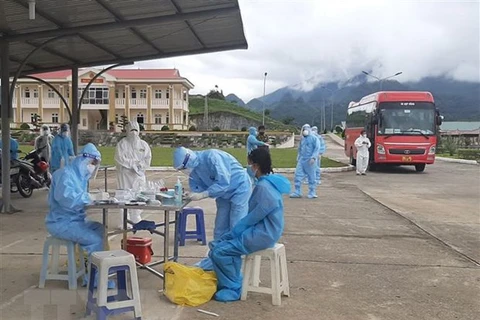
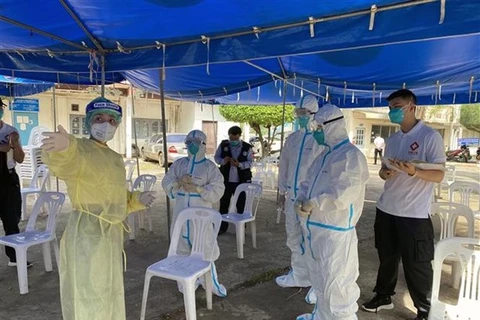
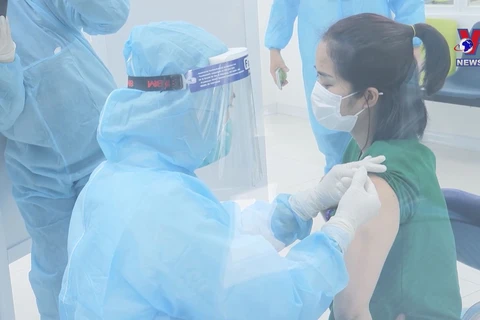
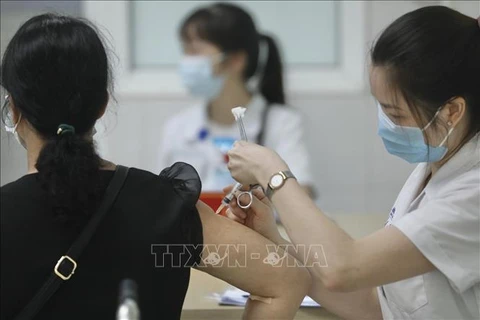
US Homeland Security Investigations and Pfizer Biopharmaceutical provided training for market management force (Photo: VNA)
 Hanoi (VNA) – The first shipment of COVID-19 vaccine produced by Pfizer Biopharmaceutical is likely to arrive in Vietnam in July, according to a representative from the US drug maker.
At the moment, Pfizer is finalizing plans on the transport and supply of COVID-19 vaccine for Vietnam in the third and fourth quarters of 2021, John Paul Pullicino from Pfizer Vietnam said during a training session for Vietnamese market management personnel on verifying Pfizer vaccine authenticity on June 16.
According to him, part of the shipment will arrive in Vietnam in July.
Pfizer has struck a deal with the Vietnamese Government to provide 31 million doses of vaccine for the country. Pfizer vaccine was granted conditional approval for emergency use in the country by the Health Ministry’s Drug Administration on June 12.
“Ensuring the delivery of safe and effective vaccines that meet quality standards is of paramount importance to Pfizer and to the community. In this context, we make sure to supply vaccines through legal and approved sources from governments,” said Paul Pullicino.
At the training session, which was co-hosted by the Ministry of Industry and Trade’s Vietnam Directorate of Market Surveillance, the US Homeland Security Investigations and Pfizer Vietnam, the Pfizer representative stressed that the vaccine is not commercially available in Vietnam yet so any transactions related to it could potentially be counterfeit or unauthorised products.
According to him, there have been instances where counterfeit vaccines are used in some countries. In Vietnam there have been cases where some individuals claim to have access to Pfizer vaccines.
He stressed that Pfizer vaccine is only supplied via bilateral deals with Governments, and up to now, there has been no legitimate private source of the vaccine.
Vanessa Piepenburg, a representative of global security for Pfizer Singapore, said authentic Pfizer vaccine is contained in small colorless glass bottles with a volume of 2ml. Each bottle has six doses. In almost countries, it is labelled Pfizer & BioNTech, except for in Hong Kong, Macau and Taiwan (China) where the label reads Fosun and BioNTech.
Piepenburg affirmed that in the early stages of the pandemic, the pharmaceutical company would only communicate directly with governments and would provide doses of the vaccine through governments’ proposed distribution channels and to the designated vaccination sites. At present, this type of vaccine has yet to be put into commercialisation. Any commercial transactions related to it involve counterfeit. In particular, the vaccine is only transported from Brussels and not in individual doses, she said.
At the training session, representatives of Pfizer committed to having strong systems put in place to help ensure the security of Pfizer products, specifically focusing on building partnerships with anti-counterfeiting alliances and law enforcement forces, proactively monitoring public and underground web sites selling unauthorized vaccine, and applying appropriate security features for product packaging.
Tran Huu Linh, Director General of the General Department of Market Management, emphasized that it is necessary for Pfizer to share information related to the vaccine when recently, the Ministry of Health of Vietnam has issued warnings about fraudulent vaccination against COIVD-19.
"That information helps the market management staff to have the skills to distinguish between fake and genuine vaccines, contributing to serving the inspection and control of the market, and protecting the interests of consumers," said Huu Linh.
The Ministry of Health announced on June 15 that six million more doses of COVID-19 vaccines – half from the UK’s AstraZeneca and half from the US’s Pfizer – will arrive in Vietnam in the third quarter of this year.
Vietnam will receive about 1 million doses of AstraZeneca vaccine via the COVID-19 Vaccines Global Access (COVAX) Facility sometime between late June and early July, said Prof. Dang Duc Anh, Director of the National Institute of Epidemiology and Hygiene (NIHE).
Another shipment of 2 million doses of AstraZeneca vaccine, imported by the Ministry of Health from the UK-based pharmaceutical company through the Vietnam Vaccine JSC (VNVC), is due to arrive in the country by the end of September.
Vietnam has been accelerating its COVID-19 vaccine vaccination efforts. The country targets to secure around 150 million doses this year to inoculate at least 70-80 percent of its population, in order to achieve herd immunity./.