Full-time NA deputies discuss land acquisition, valuation methods

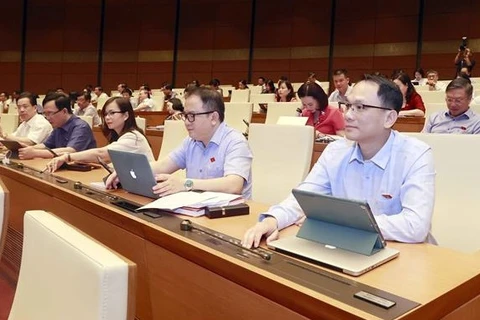
Full-time National Assembly (NA) deputies gave opinions on the amended Land Law during its session on August 30, with a focus on regulations of land acquisition for the purposes of socio-economic development and land valuation methods.
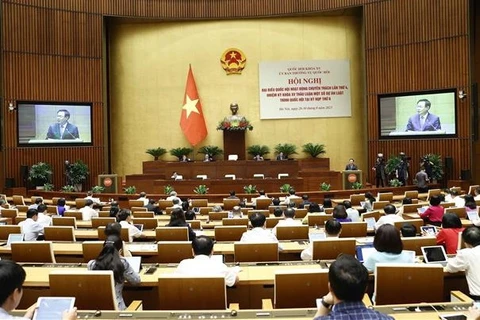
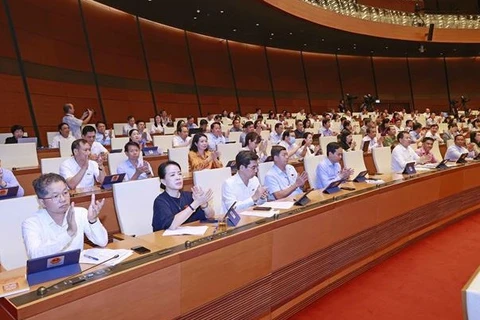
Full-time NA deputies discuss land acquisition, valuation methods ảnh 1An overview of the NA Standing Committee's session discussing the amended Land Law. (Photo: VNA)
Hanoi (VNA) - Full-time National Assembly (NA) deputies gaveopinions on the amended Land Law during its session on August 30, with a focuson regulations of land acquisition for the purposes of socio-economicdevelopment and land valuation methods.

During the conference, Chairman of the NA's Economic Committee Vu Hong Thanhemphasised that this was a significant legislative project with broadregulatory scope and complex, leaving impacts on the lives of citizens andsocio-economic development.

The provisions in the draft amended law were merely preliminary as consensus hadnot yet been reached on the best approach for amending the draft law, he added.

Regarding land acquisition for promoting socio-economic development, manydeputies stated that the provisions listing cases of land acquisition by theState were rigid and did not fully reflect or address various issues.

Thanh argued that listing specific cases of land acquisition for national andpublic interests had the advantage of clarity, ease of monitoring, andpractical application. However, listing overly specific and detailed projectsand cases might fail to provide comprehensive coverage.

During the discussions, some argued that the current approach of listing casesdid not sufficiently demonstrate the necessity of these projects and landacquisition activities in accordance with Resolution No. 54/NQ-CP.

Thanh concurred with cases where the State reclaimed land to regulatediscrepancies in value resulting from changes in planning and infrastructureinvestment, balancing the interests of the State, citizens, investors, andensuring that land use for investment projects generated new revenue for theState budget and overall benefits for society.

For individuals whose land was reclamed, the State would provide compensation,support, and resettlement as stipulated. All options needed further research,clarification, and adjustments to ensure clear, reasonable, and feasibleregulations.

Regarding cases of selecting investors through bidding for projects involvingland use, Thanh explained that the 2013 Bidding Law and the Government DecreeNo. 25/2020/NĐ-CP provide detailed regulations for selecting investors.

However, the current bidding laws primarily applied to projects that use landfor commercial and business purposes. Other projects, whether they involvedland use, were determined by specialised laws.

He said it was essential to clarify the amended Land Law to address cases ofinvestor selection when land was either the primary or secondary asset.

There were several suggestions specifying the methods for determining landprices.

Some opinions argued that the draft law outlined a plan that benefited theState budget but didn't clearly define specific benefits. Some proposed notincluding specific land valuation methods in the draft law while othersdisagreed with the proposal to eliminate the surplus method.

In response to NA deputies’ opinions concerning land prices, the provisionabout selecting the method based on the most beneficial for the State budgetprinciple would be replaced with regulations specifying the applicable casesfor each specific method.

Additionally, the surplus method would be integrated into the comparativemethod instead of the independent land valuation method.

Thanh said the draft law introduced the surplus method as one of the land pricedetermination methods and supplemented corresponding provisions regarding theprinciples and conditions of its application.

However, the conditions for applying this method had been narrowed downcompared to the current regulations. These aspects were being revised andsupplemented in the draft decree amending Government Decree No. 44/2014/NĐ-CPand continued to receive various opinions.

Thanh suggested that the Ministry of Natural Resources and Environment continueto collaborate with relevant agencies to carefully study land pricedetermination methods.

It was essential to provide a comprehensive explanation and clarity regardingthe content, ensuring that the regulations in the law guarantee stability andfeasibility, in accordance with the spirit of Resolution No. 18-NQ/TW, he said./.
VNA
See more

Minister of Foreign Affairs Le Hoai Trung (R) receives Jon M. Huntsman, Vice Chairman and President of Strategic Growth at US-based Mastercard, in Hanoi on September 15. (Photo: baoquocte.vn)

FM Le Hoai Trung receives Mastercard Vice Chairman Jon M. Huntsman

Trung affirmed that Vietnam always attaches importance to its relations with the US and welcomed the stable, positive and increasingly substantive development of bilateral ties, particularly since the two countries established their Comprehensive Strategic Partnership in 2023.

National Assembly President Tran Thanh Man (R) meets with King Maha Vajiralongkorn Phra Vajiraklaochaoyuhua and Queen Suthida Bajrasudhabimalalakshana of Thailand in Hanoi on September 15, 2026. (Photo: VNA)

Top legislator meets with King of Thailand in Hanoi

The top Vietnamese legislator and Thai King said the two countries share many similarities in history, culture and social life, and have favourable conditions for strengthening exchanges and sharing experience. They emphasised that the close bonds between the two peoples are an important foundation for the sustainable development of Vietnam–Thailand cooperation.

Prime Minister Le Minh Hung (R) meets with King of Thailand Maha Vajiralongkorn Phra Vajiraklaochaoyuhua and Queen Suthida Bajrasudhabimalalakshana. (Photo: VNA)

Vietnam, Thailand have ample room to complement and develop together: PM

Welcoming the Thai King and Queen and the Royal delegation to Vietnam on the occasion of the 50th anniversary of bilateral diplomatic ties, Prime Minister Le Minh Hung stressed that the visit was an important event long anticipated and prepared by both sides, contributing to consolidating and deepening Vietnam-Thailand friendship and cooperation, particularly after the two countries upgraded their relations to a Comprehensive Strategic Partnership in 2025.

Vietnamese Ambassador to the Republic of Korea Vu Ho (second from right) chairs the roundtable with nearly 30 Korean semiconductor and electronics companies in Seoul on September 15, 2026. (Photo: VNA)

Embassy seeks to boost Vietnam–RoK cooperation in semiconductors, electronics

Key topics discussed included the stages of the value chain Vietnam should focus on attracting, the requirements Korean companies have for expanding production, opportunities for bilateral cooperation in technology, research and development, and human resources, as well as strategies for Vietnamese firms to strengthen their access to supply chains.

Vietnamese Ambassador to Slovakia Pham Truong Giang (R) and Slovak Minister of Foreign and European Affairs Juraj Blanar said at a recent ceremony in Bratislava marking the 81st National Day of Vietnam. (Photo: VNA)

Slovakia highlights Vietnam’s growing international role

Slovak Minister of Foreign and European Affairs Juraj Blanar emphasised that the elevation of Vietnam-Slovakia relations to a strategic partnership during Slovak Prime Minister Robert Fico’s official visit to Vietnam in April was not merely politically significant, but also reflected the two countries’ long-term commitment to deepening bilateral ties and translating growing political trust into concrete outcomes.

Prime Minister Le Minh Hung attends the opening of the 2026-2027 academic year at the National Defence Academy in Hanoi on September 15. (Photo: VNA)

National Defence Academy must become top military think-tank: PM

The National Defence Academy must track global and regional developments closely, accurately size up partners and rivals, and stay ahead of changes in the international security environment. It should produce practical output, such as strategic forecasts, early warning and policy proposals, and absorb global military advances and technology without copying foreign models outright.

General Secretary of the Communist Party of Vietnam Central Committee and President To Lam speaks at the meeting with the 7th-term Executive Committee of the Vietnam Union of Friendship Organisations (VUFO) on September 15. (Photo: VNA)

VUFO must focus on building networks for mobilising resources: Top leader

General Secretary and President To Lam expressed his confidence that VUFO will truly become a sharp and effective spearhead, proactively building trust, turning trust into resources and, through concrete actions, contributing to the country’s breakthrough development in the new era of national rise

Politburo Member and Permanent Member of the Party Central Committee’s Secretariat Dr Tran Cam Tu delivers a thematic presentation on the Party building on September 15. (Photo: VNA)

Key leader highlights important tasks in Party building

The Party building covers four key areas: political, ideological and ethical work, and organisation and personnel. These areas are closely interconnected and together form a unified whole that determines the Party’s strength and its ability to lead the revolutionary cause.

Lao Deputy Prime Minister and Minister of Foreign Affairs Thongsavanh Phomvihane (right) hosts a reception for Vietnamese Deputy Minister of Foreign Affairs Nguyen Thi Hoang Van in Vientiane on September 14. (Photo: VNA)

Vietnam seeks deeper cooperation with regional countries, partners

Vietnamese Deputy Minister of Foreign Affairs Nguyen Thi Hoang Van held bilateral meetings with Lao, Cambodian and Timor-Leste officials and representatives of the Mines Advisory Group (MAG) in Vientiane on September 14 on the sidelines of the Third Review Conference (3RC) of the Convention on Cluster Munitions 2026 in Vientiane, Laos, to deepen cooperation with regional countries and partners.

Prime Minister Le Minh Hung (first, right) and his Slovak counterpart Robert Fico (first, left) witness the signing of an MoU between the Commission for Standards, Metrology and Quality of Vietnam (STAMEQ) and the Office of Standards, Metrology and Testing (UNMS) of Slovakia in Hanoi on April 13, 2026. (Photo: VNA)

Vietnam-Slovakia strategic partnership ushers in new chapter

With strong political determination, complementary economies and concrete mechanisms of action, the Vietnam-Slovakia strategic partnership is expected to generate substantive progress, particularly in economy, science, technology and innovation, contributing to peace, stability and prosperity in the region and the world.

Vietnamese Ambassador to Algeria Vu Duy Long presents his credentials to Algerian President Abdelmadjid Tebboune on September 14. (Photo: VNA)

Vietnamese ambassador presents credentials to Algerian President

Vietnam and Algeria, despite their geographical distance, share longstanding ties, particularly during their struggles for national independence. Vietnam was among the first countries to establish diplomatic relations with Algeria on October 28, 1962, shortly after Algeria gained independence.

Politburo member and Minister of Foreign Affairs Le Hoai Trung (File Photo: VNA)

Vietnam, India seek stronger Party-to-Party ties

Vietnam and India enjoy a special relationship based on traditional friendship, solidarity, mutual support and high political trust. The elevation of bilateral ties to an Enhanced Comprehensive Strategic Partnership during General Secretary of the Communist Party of Vietnam Central Committee and President To Lam’s visit to India in May 2026 was an important milestone.