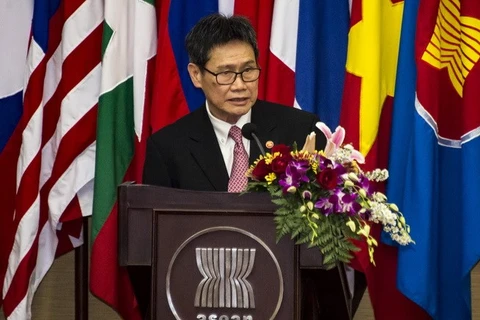
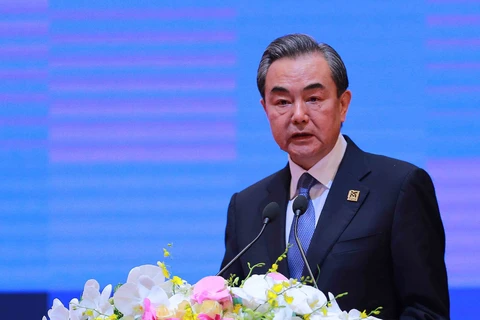
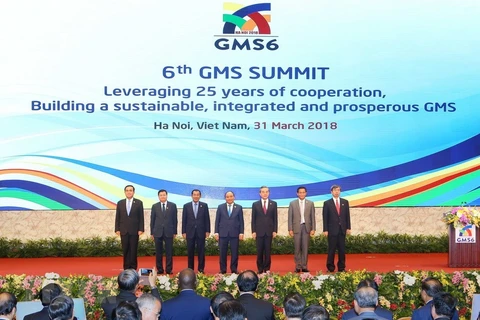
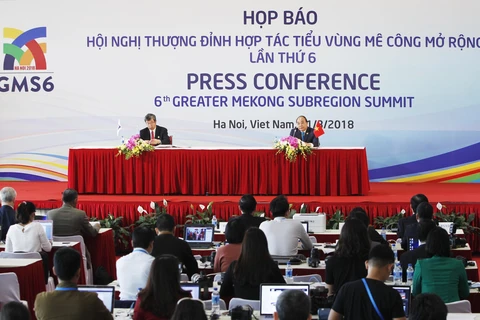
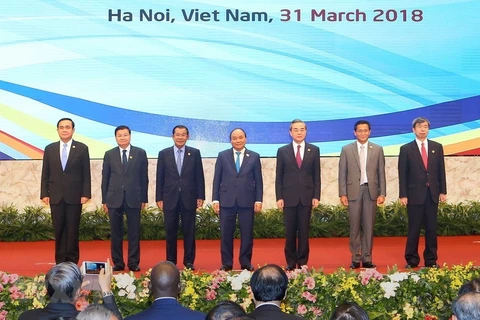
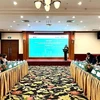
GMS leaders at the sixth GMS Summit (Photo: VNA)
 Hanoi (VNA) – Leaders of the nations in the Greater Mekong Subregion (GMS) delivered their commitments to stronger subregional cooperation at the plenary session of the sixth GMS Summit in Hanoi on March 31.
Right after the opening speech of Vietnamese Prime Minister Nguyen Xuan Phuc, Cambodian Prime Minister Hun Sen highly valued the GMS 25-year cooperation, with numerous achievements in enhancing the region’s competitiveness and building a community of prosperity, peace, and solidarity.
[Sixth Greater Mekong Subregion Summit a success]
The GMS cooperation has supported its members in achieving the millennium development goals, particularly promoting the inclusive and sustainable development and addressing challenges such as water shortage, poor infrastructure and global economic instability.
He suggested the GMS members nations connect with each other more effectively via investment in infrastructure, energy and transport, and agreements on transport facilitation and economic special zones along their borderlines, thus contributing more comprehensively to the regional economy.
The GMS countries need to increase regional technology transfer in building physical and digital infrastructure, thus facilitating investment, free trade and tourism, while promoting regional comprehensive and inclusive development via effectively implementing the GMS’s programmes for a region of integration, peace, prosperity and stability.
State Counsellor of China Wang Yi underlined the cooperation among the six GMS nations over the past 25 years, saying that they share mutual benefits and thus have the responsibility for boosting prosperous development, regional cooperation, and economic growth.
He suggested the GMS nations create new opportunities for development, increase value chain, financial support and cooperation among border areas and industrial parks, while working more closely together to reach common prosperity.
Congratulating the GMS nations on their achievements in implementing the subregion’s action plans and cooperation agreements, Lao Prime Minister Thongloun Sisoulith said Laos pledges and give priorities to establishing a cross-border transport network and an one-stop mechanism in border areas, as well as boosting cooperation in all economic fields, particularly in the subregion’s economic corridors.
The GMS nations need to fully tap their potential via joint development projects, while luring financial resources and ensuring green growth and common prosperity for the whole subregion, the Lao PM said.
He also called on the six nations to increase technology transfer, narrow the development gaps among them, enhance their competitiveness, and boost public-private-partnership as well as business cooperation.
Vice President of Myanmar U Henry Van Thio welcomed the Hanoi Action Plan 2018-2022 as well as the Regional Investment Framework 2022 and the GMS sectoral cooperation strategies.
He called on the GMS countries to ensure financial resources to implement projects, focusing on inspecting their progress annually.
GMS is a mechanism that looks toward action to make itself a better region. To achieve this, the member countries need specific action plans to strengthen multinational cooperation, he said.
Thailand’s Prime Minister Prayut Chan-o-cha hoped the GMS countries will enhance cooperation and develop hi-tech human resources to meet the requirements of the fourth Industrial Revolution as well as promote regional connectivity.
The GMS nations should strongly engage in global supply chain, back small-and-medium-sized enterprises, and increase people-to-people exchanges to build a sustainable subregion, he said.
At the session, the GMS leaders reviewed and ratified three key documents, namely the Joint Statement of the GMS-6, the Hanoi Action Plan 2018 – 2022, and the Regional Investment Framework 2022.-VNA