Government focuses on law-making, institutional improvement: PM

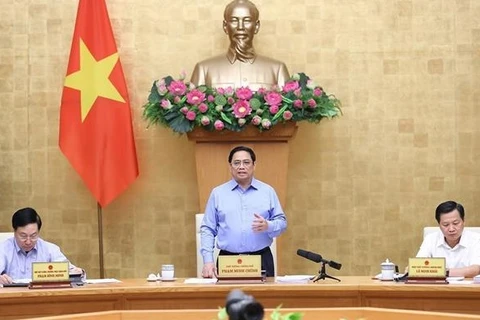
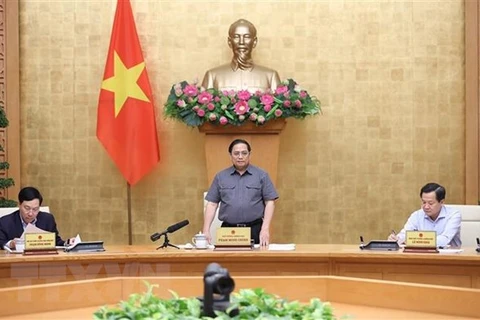
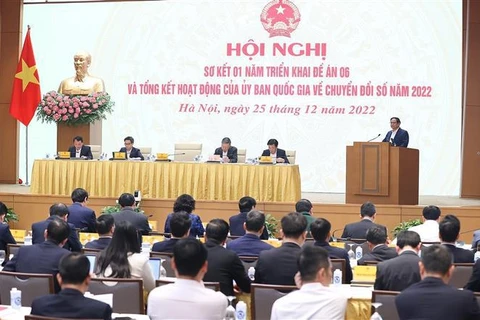
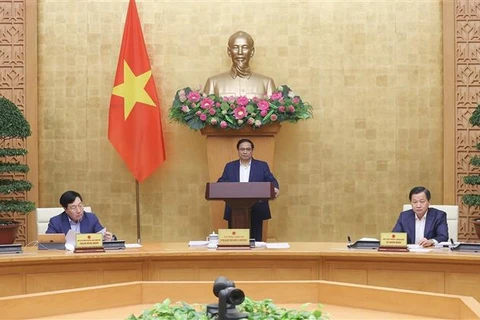
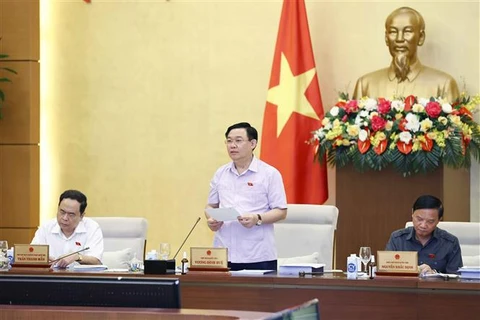
The Government has focused on the implementation of law-making and institutional improvement throughout 2022, said Prime Minister Pham Minh Chinh at the government’s last monthly law-making session this year in Hanoi on December 26.
Government focuses on law-making, institutional improvement: PM ảnh 1Prime Minister Pham Minh Chinh speaks at the event. (Photo: VNA)
Hanoi (VNA) – The Government has focused on the implementation oflaw-making and institutional improvement throughout 2022, said Prime Minister PhamMinh Chinh at the government’s last monthly law-making session this year in Hanoi on December26.

Thesession, chaired by the PM, mulled over the draft Law amending andsupplementing a number of articles of the Law on People's Public Security, andproposes building such laws as the Law amending and supplementing the Law onCredit Institutions; the Law on Citizenship Identification (amended); the Lawon industrial defence, security and industrial mobilisation; and the Law on urban and rural planning.

Listeningto reports and comments, PM Chinh said the law-making work must continue toinstitutionalise and bring the Party's resolutions to life.

Inhis conclusion, the PM informed participants that the Government held nine thematicsessions serving the formulation of laws and policies; and gave opinions on andapproved 40 projects and proposals for law building.

Henoted they are the highest number of sessions, and projects and proposals inrecent years.

Theworks have showed improvements, becoming more professional and ensuringprogress and quality, the Government leader said.

The PMrequested strengthening the role of leaders; tightening discipline; improvingthe capacity to respond to policies, remove obstacles and inadequacies; and promotingrecovery and socio-economic development. It is also necessary to focus on resourcesinvestment and boost the quality of human resources, he added.

PM Chinhemphasised that evaluation is needed for both areas of building and perfectinginstitutions and organising law enforcement. Particular attention should bepaid to policy communications during the law-making process and after the lawis promulgated and put into practice, he said./.
VNA
See more

Professor Carl Thayer of the Australian Defence Force Academy at the University of New South Wales in an interview with the Vietnam News Agency. (Photo: VNA)

ASEAN Future Forum: Vietnam at forefront of advancing ASEAN-centred regional architecture

Thayer observed that Vietnam is increasingly emerging as a regional hub not only for manufacturing but also for diplomacy, supported by an expanding network of international partnerships. In his view, AFF 2026 represents an open and forward-looking agenda in which Vietnam acts as a trailblazer, proposing and advancing new ideas for regional cooperation.

Lao Prime Minister Sonexay Siphandone speaks at the opening session of the third ASEAN Future Forum. (Photo: VNA)

Lao PM Sonexay Siphandone concludes official visit to Vietnam, attendance at AFF 2026

The leaders of the two countries exchanged views and agreed on extremely important contents for bilateral cooperation in the coming period, including concretising the content of the strategic cohesion between Vietnam and Laos in all fields; and continuing efforts to cooperate closely to increase bilateral trade to 10 billion USD in the next five years.

General Secretary of the Communist Party of Vietnam Central Committee and President of Vietnam To Lam speaks at the meeting with heads of delegations, international experts, scholars and representatives of international organisations attending the ASEAN Future Forum 2026 in Hanoi on June 9, 2026. (Photo: VNA)

Top Vietnamese leader’s remarks at reception for participants in ASEAN Future Forum 2026

The measure of success in the coming period should not simply be how many additional documents, mechanisms or action plans ASEAN produces; more importantly, it should be measured by the extent to which ASEAN’s commitments are implemented in practice, what changes they bring about for the region, and what benefits they deliver to people, businesses and each member economy, said the top Vietnamese leader.

Deputy Prime Minister Phan Van Giang (R) welcomes Izumi Nakamitsu, United Nations Under-Secretary-General and High Representative for Disarmament Affairs. (Photo: VNA)

Deputy PM Phan Van Giang receives UN Under-Secretary-General, High Representative for Disarmament Affairs

Against the backdrop of increasingly complicated global political and security developments, the Deputy PM reaffirmed Vietnam’s consistent foreign policy of independence, self-reliance, peace, friendship, cooperation and development. He reiterated the country’s strong support for multilateralism, international law and the central and irreplaceable role of the UN in promoting a peaceful, stable and prosperous world.