Government, partners discuss mangrove afforestation in Mekong Delta

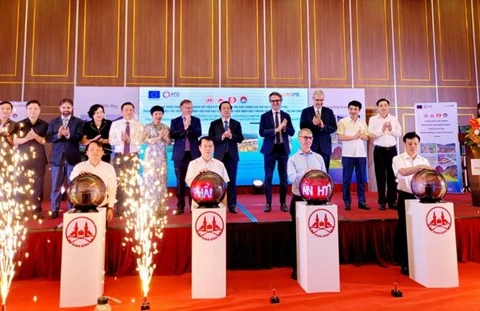
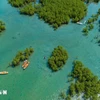
Local authorities and experts from international organisations and partners have discussed measures to increase the mangrove restoration and afforestation in Vietnam’s Mekong Delta region at a workshop in Hanoi.
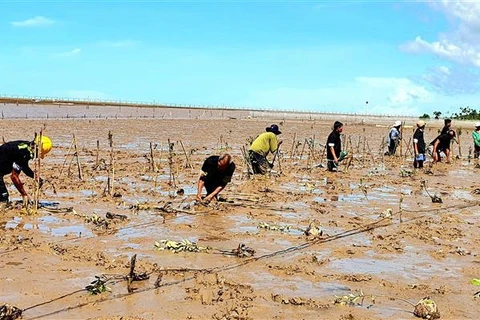
Government, partners discuss mangrove afforestation in Mekong Delta ảnh 1People grow mangroves in Tra Vinh Province in the Mekong Delta region. Mangroves have an important role in climate adaptation. (Photo: VNA)
Hanoi (VNS/VNA) - Local authorities and experts from internationalorganisations and partners have discussed measures to increase the mangroverestoration and afforestation in Vietnam’s Mekong Delta region at a workshop inHanoi.

Speaking at the June 10 workshop, Head of the International Cooperation Department NguyenDo Anh Tuan said the Mekong Delta region iss at the forefront of climate changeadaptation in Vietnam.

The region has strengthened measures to enhance forest management as well asclimate change adaptation and sustainable development with support frominternational partners.

The workshop is expected to raise awareness of mangrove afforestation andprotection for the alignment of planning and implementation of mangroveprojects, Tuan said.

It also aims to facilitate a platform where stakeholders at central and locallevels could discuss smooth, effective and efficient cooperation andcoordination.

Highlighting the importance of the forest in climate change mitigation andadaptation, Paul Bergsma, from the consultancy firm Royal Haskoning DHV, saidmangroves have helped protect the coasts against natural disasters such asstorms while increasing resilience and adaptation to climate change. 

He said: “The success of the approach to mangrove restoration depends mainly onthe sediment supply and stability, tidal hydrology, community participation andland tenure consideration.”

Tran Cong Hung from the Management Board for Forestry Projects said themangrove belt and the coastal zone of the Mekong Delta have been in a seriousstate of degradation.

The degradation has been caused by a range of factors including lack ofsediment, and the land use in the coastal zone pressing the dike seaward, hesaid.

The inadequate water management and overexploitation of groundwater resultingin land subsidence along with the inland shrimp farming have also contributedto the degradation of mangroves in the region, the official said.

The workshop themed 'mangrove afforestation in the Mekong Delta for sustainablecoastal resilience' was co-organised by the Netherlands Embassy, the AsianDevelopment Bank (ADB) and the Ministry of Agriculture and Rural Development(MARD).

It attracted participants from the agriculture ministry and other relevantministries, central government agencies and coastal provinces in the MekongDelta, and representatives from key international partners including theNetherlands Embassy, ADB, World Wide Fund for Nature and International Unionfor Conservation of Nature.

The ADB and the Government of the Netherlands have committed to supporting Vietnamin strengthening the coastal zones of the Mekong Delta and the resilience ofits inhabitants.

The ministry is currently working on a proposal to restore the naturalenvironment and strengthen coastal protection to increase resilience to theimpacts of climate change in the five coastal provinces of Bac Lieu, Soc Trang,Tra Vinh, Ben Tre and Tien Giang during 2023 - 2029.

The project will apply for ABD loans./.
VNA
See more

The German Agency for International Cooperation (GIZ)'s Managing Director Thorsten Schäfer-Gümbel speaks at the working session with the Vietnamese-German University. (Photo: VNA)

Vietnam, Germany step up collaboration on energy transition, green hydrogen

Schäfer-Gümbel praised the strong commitment of Vietnamese partners to sustainable energy goals. He noted that the long-standing development cooperation between Germany and Vietnam is evolving, with energy transition emerging as a strategic area of collaboration in addressing global challenges.

Cat Ba langur is an extremely rare primate species found exclusively in the humid tropical forests of Cat Ba island (Photo: VNA)

Belgian TV spotlight: Vietnam's wild nature reborn

Through the lens of “Le Jardin Extraordinaire”, Vietnam was portrayed not simply as a travel destination but as a still-emerging realm of discovery: a nation whose nature, though heavily wounded in the past, demonstrates extraordinary powers of recovery, quietly upholding its pristine essence against the pressures of time.

The macaque, scientifically known as Macaca arctoides. (Photo: VNA)

Quang Tri receives endangered stump-tailed macaque

The Cam Lo-Dong Ha forest protection unit in the central province of Quang Tri has received a rare stump-tailed macaque, a species listed as endangered, precious and rare in the Vietnam Red Data Book.

At a ceremony to donate 100,000 trees to the Naval Region 4 (Photo: HANE)

Tree planting programme spreads green momentum in islands

The Ho Chi Minh City Association for Conservation of Nature and Environment (HANE) on January 11 announced 10 outstanding green programmes and activities carried out in 2025, including a programme to plant 1 million trees in Vietnam’s island areas.

Lam Dong releases hundreds of wild animals into the wild. (Photo: VNA)

Lam Dong releases hundreds of wild animals back into the wild

According to the Ta Dung National Park Management Board, the park has for years served as a trusted destination for authorities and residents to hand over and release wildlife. Such actions not only contribute to biodiversity conservation but also help reduce illegal hunting and captivity of wild animals.

According to the Hanoi Department of Agriculture and Environment, air quality index (AQI) readings have at times reached poor and very poor levels. (Photo: VNA)

Hanoi targets 20% reduction in PM2.5 levels

Hanoi has affirmed its commitment not to trade environmental protection for economic growth. The city is moving to establish low-emission zones (LEZs) as a core measure to control emissions and promote green, sustainable urban development.

A waste collection area. (Photo: VNA)

Ca Mau approves investment policy for waste-to-energy plant

The waste-to-energy plant is planned for construction in Dat Moi commune, covering a total area of about 20 hectares. It will have a waste treatment capacity of approximately 600 tonnes of household waste per day and a power generation capacity of 6MW.