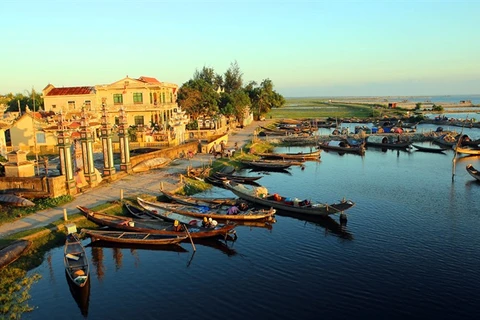
Panoramic view of the Hai Minh fishing village (Photo: VNA)
The fishermen of Hai Minh village are at sea spreading their nets to catch fish and other creatures. In a corner of the village, elderly women carry stuff to sell in the market. Children prepare to go to school.
The peaceful life in the village is a far cry from the bustle of Quy Nhon city, although it takes just 10 minutes of travelling by sea to get there.
Settled on the Phuong Mai peninsula, Hai Minh is still unknown to many people who visit Quy Nhon, but it is an ideal destination for those who enjoy the simplicity and beauty of rural life.
A boat from the Ham Tu Wharf in Quy Nhon city will take about 10 minutes to reach the Hai Minh fishing village. Their little houses are so close to the sea that you can walk directly into one of them from the boat.
The small alleys in the village are lined by lush greenery and lots of fishing nets, coracles, and fishing boats.
As they see us in the distance, the villagers wave and smile at us. Striking up a conversation with them is very easy. They are eager to talk.
“Just a few days ago, we met another group of tourists coming here from Hanoi. Just imagine, they even came here by airplane, paying 1.5 million VND (66 USD) just for the ticket!” exclaimed Nguyen Van Hong, excited about these facts, as he sat on a chair in front of his house, breathing in fresh air from the sea.
An air trip is too luxurious for someone who earns a living catching and selling fish in the local market.
His hard, frugal life has not robbed him of the innocence and sincerity that are writ large in the smiles that light up his face.
“I met them by chance on my way back home after I’d caught a lot of fish. They were happy to see my catch. They wanted me to cook some for them, and I did. We had a lot of fun,” he said, laughing.
Hong doesn’t go to the city very often. Like other villagers, he finds everything he and his family needs in the village itself: market, pagoda, and schools.
But children can only attend primary school in the village. For any “higher education” – secondary school and high school, they would take the boat everyday to the city and back.
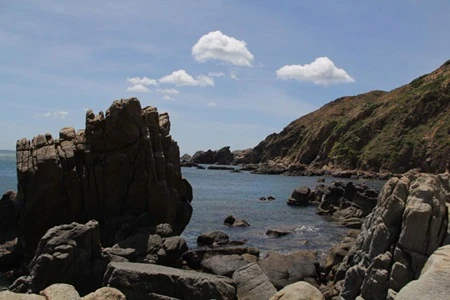
Apart from the sincere and welcoming residents, another big attraction of Hai Minh is its beautiful scenery that every nature lover will thoroughly enjoy.
After walking on a sinuous pathway on a mountainside for about 20 minutes, we reached an oversized statue of 13th century national hero Tran Hung Dao, which can be seen in the distance from the city centre.
This 17m high statue has been erected on a promontory, 40m above sea level, which overlooks the village.
The statue, built in 1972, has been recognised as a historical heritage. It honours the exploits of Tran Hung Dao, who successfully defeated Mongol invaders in Vietnam. He is frequently mentioned as one of the top ten generals in the world’s military history.
Standing at the foot of the imposing statue, we enjoyed the magnificient, panoramic view of the coast, along with the Thi Nai Bridge, the longest sea-crossing bridge in the country, a source of pride for local residents.
Watching the sea dotted with ships close to Hai Minh village, listening to the melodious songs of wind, sea waves, and seagulls landing and flying in apparent abandon, one can easily lose track of time.
Behind the statue, a pathway leads to a beach hidden at the foot of a mountain. The Ran Beach is still unspoilt now, and we can only hope it remains that way.
The Phuoc Mai Lighthouse, built by the French 100 years ago, and the Hang Doi Cave that hosted thousands of bats before 1975 are places worth visiting in the village.
Whenever you visit Quy Nhon, do not hesitate to spend a few hours to visit Hai Minh Village. Experience the friendliness and warmth with which the locals welcome you, and admire Quy Nhon city from another angle.
The best time to visit is from February to August. No risks of storms, just sunshine.-VNA
VNA