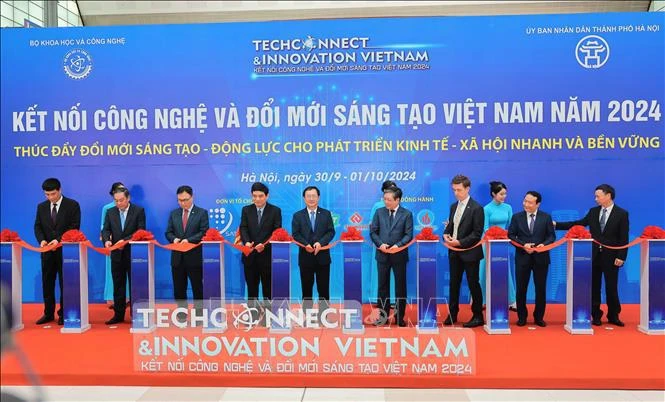
Hanoi (VNA) - The Techconnect and Innovation Vietnam 2024 kicked off in Hanoi on September 30, highlighting innovation promotion as an impetus for fast and sustainable socio-economic development.
The two-day national-level event, held by the Ministry of Science and Technology (MST) and the Hanoi People’s Committee, is expected to attract 2,500 - 3,000 direct participants, and 7,000 - 10,000 others taking part in online from ministries, sectors, localities, enterprises, research institutes, universities, and organisations of Vietnam and other countries.
It features a series of forums on technology management policy; construction, health, and agricultural technologies; high-tech investment promotion. A seminar on the importance of innovation to Hanoi enterprises, a display of technological achievements in 2024, and a conference on technology and innovation application and transfer also form part of the programme.
Domestic and foreign technological advances applied to a wide range of sectors are being showcased at 200 booths at the event, according to the organising board.
In his opening remarks, Minister of Science and Technology Huynh Thanh Dat stressed that science - technology and innovation have been playing a significant role in national socio-economic development. In such crucial sectors as agriculture, construction, health, education, and industry, they are not only the main driver for productivity improvement or sustainable growth, but also help create new business models and enhance the competitiveness of enterprises and the country in the international arena.
The MST hopes to continue receiving coordination from ministries, sectors, localities, enterprises, and scientists nationwide to promote the unanimity on the strategic vision about developing the innovation system, in which enterprises hold the central role, institutes and universities act as strong research bodies, and investment resources, especially from enterprises, for science - technology and innovation are fostered, he continued.
Dat also pointed out the need to reserve appropriate resources for implementing support solutions to encourage enterprises to improve their technology absorption capacity, step up technological innovation, and develop a comprehensive and efficient science - technology market integrating into the world.
Permanent Vice Chairman of the Hanoi People’s Committee Le Hong Son said the city is home to over 70% of the science - technology organisations, universities and research institutes, 82% of the laboratories, and over 65% of the leading scientists nationwide, which is viewed as a particularly important advantage for it to bolster science, technology, and innovation.
Hanoi will keep accompanying enterprises, organisations, and scientists and create the best possible conditions for the development of science, technology, and innovation, the official underlined.
For his part, Ambassador Julien Guerrier, head of the EU Delegation to Vietnam, voiced his belief in the huge potential for closer cooperation between the EU and Vietnam, particularly in such areas as green technology, digital innovation, and sustainable agriculture.
He added the EU and its members are committed to continuing to help Vietnamese people, enterprises, and researchers apply the latest technologies to boost economic growth while ensuring environmental sustainability and social equity.
On this occasion, the MST’s State Agency for Technology Innovation inked memoranda of understanding on cooperation in technology and innovation transfer with Spain’s Centre for the Development of Industrial Technology (CDTI) and the Republic of Korea Smart Manufacturing Office (KOSMO)./.

See more
Digital governance transforms life in border commune of Dong Nai city
A year after adopting the two-tier local administration model, Bu Gia Map, a remote border commune in the southern city of Dong Nai with a significant ethnic minority community, has experienced notable improvements in public administration, making digital public services more accessible to residents and boosting governance efficiency.
Experts recommend risk-based data governance to strengthen legal protection
In the first quarter of 2026, more than 6.9 million accounts were exposed, double the figure recorded in the same period last years. Stolen personal data has frequently been exploited in sophisticated online scams, particularly impersonation schemes targeting victims through fake relatives or acquaintances.
Interactive "Cyber Security Wall" exhibition spreads digital safety awareness in Hanoi
Through a series of display areas, visitors can explore notable scientific and technological achievements of the People's Public Security Force in safeguarding national security in cyberspace. The exhibition also provides information on common forms of online fraud and cyber scams, along with practical guidance on how to identify and prevent them.
Samsung taps Vietnamese talent to strengthen AI, semiconductor workforce
Vietnam has been identified as one of Samsung's key markets for developing high-tech human resources.
Vietnam approves roadmap to build “Make in Vietnam” civil cryptography ecosystem
The initiative aims to establish and perfect mechanisms and policies to encourage greater participation from enterprises, organisations, training institutions and individuals in developing civil cryptography technology.
Experts call for strengthening innovation ecosystem through closer collaboration
According to the State Agency for Technology and Innovation under the Ministry of Science and Technology, Vietnam is now home to nearly 4,000 start-ups and enterprises operating in the fields of science, technology and innovation, supported by a workforce of more than 30,000 highly skilled professionals.
Deputy PM orders nuclear push as atomic energy institute marks 50 years
VINATOM is targeting not just research strength but strategic national entity status, accompanying the country in building a modern nuclear industry.
New decree offers major incentives for high-tech R&D
The decree, which took effect on July 1, gives priority to investment in high-tech R&D, including research into innovative and core technologies; efforts to decode, master and improve high technologies; and the application, testing and refinement of advanced technologies.
Vietnam shapes AI ecosystem following 18-month implementation of Resolution 57
Eighteen months after the launch of Resolution 57, a national AI ecosystem is gradually taking shape, bringing together institutions, data resources, computing infrastructure, technology enterprises, human resources and application markets.
Three strategic technology products expected to deliver breakthroughs in 2026
With strong leadership from the Party and the State, together with the determination of ministries, sectors, and localities, Vietnam will achieve important initial milestones in strategic technology development within this year
Vietnam accelerates STEM workforce development for strategic technologies
Vietnam’s challenge is not merely to train more engineers or scientists, but to cultivate a generation capable of mastering, improving and eventually creating core technologies.
PM urges faster development of national databases, strategic technologies
The PM stressed that ministers must take direct responsibility for the implementation of assigned tasks and ensure the quality and progress of database development.
National digital architecture framework must ensure nationwide interoperability: PM
PM Le Minh Hung stressed that the national digital architecture framework should provide a unified, shared and interoperable architecture for the entire political system, from the central to grassroots levels, while connecting government systems with citizens and businesses.
Vietnam’s digital overhaul starts to deliver: French newswire
Inforadar noted that Vietnam has progressively streamlined its regulatory framework to clear institutional bottlenecks while putting in place mechanisms designed to spur innovation and technology adoption. The process has also pivoted from a resource-heavy approach to one focused on practical results, with stricter monitoring of projects’ progress.
Ho Chi Minh City targets digital transformation for 100,000 SMEs by 2030
The project, jointly launched by the municipal Department of Science and Technology and the Ho Chi Minh City Computer Association (HCA), will be implemented based on the Digital Business Index (DBI), with 200 outstanding enterprises selected as pilot models for wider replication.
Verified subscriber data builds stronger digital shield
As Vietnam accelerates its national digital transformation, every correctly verified mobile subscription builds a more comprehensive and reliable telecom database, laying the groundwork for secure, sustainable digital services and public confidence in the country’s digital ecosystem.
Crop breeding innovation key to boosting agricultural productivity
According to the Plant Production and Protection Department under the Ministry of Agriculture and Environment, improved crop varieties have increased yields by 8–15%, depending on the crop, while enhancing farmers' incomes and supporting the restructuring of the agricultural sector.
Quantum tech seen as strategic pillar for Vietnam’s technological self-reliance
In Vietnam, the Politburo’s Resolution No. 57-NQ/TW identifies science, technology, innovation and digital transformation as breakthrough drivers of national development. In this context, the Prime Minister’s Decision No. 21/2026/QD-TTg has added cybersecurity and quantum technologies to the country’s list of 10 strategic technology groups.
Smart tourism takes hold nationwide
Under the country’s 2026–2030 digital economy and digital society development programme, the sector has been identified as one of the priority ones for accelerating digital transformation to improve governance efficiency, service quality, and visitor experiences.
Vietnam introduces national science funding's risk management framework for the first time
Where a project fails to achieve its intended outcomes, organisations or individuals that have complied with professional procedures, management regulations and transparency requirements may be exempt from administrative liability, and funding will not be reclaimed under current regulations.