Hanoi to build eight railway lines, 18 bridges

Hanoi’s transportation system will get a major facelift by 2030 with a total of 18 bridges across the Red River and eight city railway routes
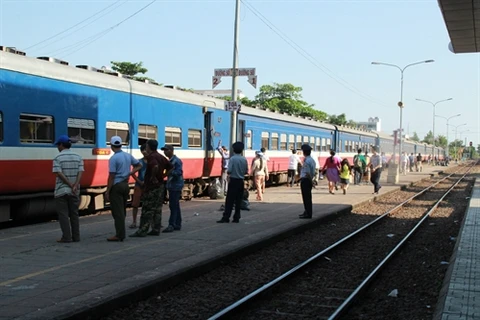
Hanoi to build eight railway lines, 18 bridges ảnh 1A north-south train of Vietnam Railway Authority (Photo: VNRA)

Hanoi (VNA) – Hanoi’s transportation system will get a major facelift by 2030 with a total of 18 bridges across the Red River and eight city railway routes, according to a new mater transport plan unveiled by the city authority on July 30.

Under Hanoi’s Transportation Plan for 2030, with a vision towards 2050, developing public transportation is named the top priority in order to accommodate urbanisation and a booming population, which is expected to reach 7.9 million in 2020 and 9.2 million in 2030.

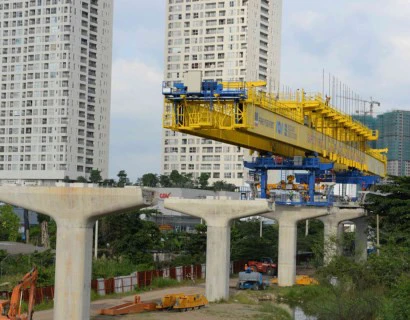
Hanoi will build six new inner city railway routes in addition to the two routes of Cat Linh – Ha Dong and Nhon – Hanoi Railway Station, which are currently under construction. The network is expected to cover a total length of 300 km.

Buses will be another major means of public transport. In addition to developing regular bus services, by 2030, Hanoi aims to have eight Bus Rapid Transit (BRT) routes, a high-quality bus transit system that delivers fast and comfortable services . The first BRT route connecting Kim Ma and Yen Nghia is already being built and expected to start operations at the end of this year.

Inter-provincial coach stations will gradually be moved to the outskirts of the city, beyond Ring Road 3, to ease traffic flow in downtown. They will be connected to downtown via the public transportation system. The current stations, which are located inside the city, like Gia Lam, Giap Bat and My Dinh, will be renovated and upgraded to serve inner city travel, according to the plan.

Vu Van Vien, director of Hanoi’s Department of Transport, said these projects aim to increase the share of public transport in the capital from the current low figure of about 10 percent to 30-35 percent by 2020. The figure is expected to reach 50 percent by 2030, and 70 percent after 2030.

This is in line with a plan announced in June by the city’s leaders, which set a target of limiting the number of individual vehicles by 2020, with a further goal of removing motorbikes from the city’s downtown by 2025 in order to tackle the chronic problems of traffic congestion and accidents.

Under the new master plan, Hanoi will also focus on completing the system of ring roads and elevated roads to ensure better connectivity with inner city roads.

Travelling across the rivers of Hong, Duong, Day and Da will be made easier with more bridges. In particular, 11 more bridges and an underwater tunnel crossing Hong River are being planned, in addition to the current seven bridges. Another five rail bridges will also be constructed across the river, including one to replace the old railway route of Long Bien Bridge. The new bridge and route will be built 75m upstream of Long Bien Bridge.

The plan also aims to create better connections between Hanoi and other provinces through new highways, such as the Hanoi – HCM City Highway, Hanoi – Hoa Binh Highway, Noi Bai – Ha Long Highway, Northeast – National Highway 5 and two inter-regional belts.

The master plan is expected to cost a total of 1.2 quadrillion VND (53.8 billion USD), which will come from various sources like Official Development Assistance (ODA), the national budget and commercial loans.

Speaking at the ceremony to announce the plan on August 30, Deputy Prime Minister Trinh Dinh Dung underscored its significance to not only the city’s socio-economic development, but also the Hong River Delta and the whole northern economic zone.

He said the Government would support Hanoi in carrying out the plan and create favourable policies and conditions for Hanoi to develop rapidly and effectively.

He urged the municipal People’s Committee of Hanoi to set forth detailed plans, including building appropriate policies and financial plans suitable for each period, and mobilising funds from various sources such as enterprises, the national budget or ODA.-VNA
VNA

See more

The “I Love My Fatherland" Journey 2026 kicks off in Nghe An province on May 16. (Photo: VNA)

"I Love My Fatherland” journey features diverse activities

The “I Love My Fatherland” journey will span seven stages across historical and cultural sites and “red addresses” nationwide. There will be a combination of education on traditions, field-based programmes, and digital communications.

At the handover of 33 Chinese nationals who had violated Vietnamese law to Chinese authorities in Quang Ninh on May 15, 2026. (Photo: VNA)

Vietnam hands over 33 law violators to China

Investigations found that the individuals had violated Vietnamese laws relating to illegal entry and unlawful residence in Vietnam. The handover was conducted safely and in compliance with Vietnamese law and international practice.

At the talks between authorities of the northern province of Lang Son and Pingxiang city in the Guangxi Zhuang Autonomous Region of China (Photo: VNA)

Vietnam, China seek to build modern, smart border gates

Authorities of the northern province of Lang Son and Pingxiang city in the Guangxi Zhuang Autonomous Region of China held talks on May 15 at Tan Thanh (Vietnam) – Po Chai (China) clearance point near markers 1090–1091 in Hoang Van Thu commune of Lang Son to promote trade, develop smart border gates and expand cross-border tourism cooperation.

The Vietnam Association for Victims of Agent Orange (VAVA) has carried out various activities to support Agent Orange/dioxin victims. (Photo: VNA)

Over 9.3 billion VND raised for AO/dioxin victims in 2025

VAVA President Lieutenant General Nguyen Huu Chinh said that although the war ended more than 50 years ago, the consequences of toxic chemicals remain severe and long-lasting, with millions of people affected during the war and hundreds of thousands continuing to suffer serious physical impacts in peacetime.

An overview of the meeting (Photo: VNA)

Measures sought to accelerate construction of inter-level boarding schools in border areas

The construction of boarding schools in land border communes is a particularly important political task receiving close attention from the Politburo and Party General Secretary and State President To Lam. The programme not only aims to improve learning conditions for students in border areas, but also carries strategic significance for social welfare, human development, national defence and security, and safeguarding territorial sovereignty.

An overview of the court on May 14 (Photo: VNA)

Man gets life sentence for terrorism, anti-State activities

The People’s Court of Ho Chi Minh City on May 14 handed down life imprisonment to Dao Minh Quan on charges of “terrorism aimed at opposing the people’s administration” and “activities aimed at overthrowing the people’s administration”.

Secretary of the Ho Chi Minh Communist Youth Union Central Committee and VYF President Nguyen Tuong Lam addresses the event (Photo: VNA)

“I love my fatherland” journey 2026 launched

The “I Love My Fatherland” journey will comprise seven stages linked to historical, cultural and revolutionary sites across the country. The journey will begin in Nghe An on May 16 to mark President Ho Chi Minh’s birthday, before continuing through Hue city, Tuyen Quang–Lung Cu Flag Tower, Dien Bien, Khanh Hoa, Ca Mau and Ho Chi Minh City, and concluding in Hanoi in October.

Students in the Mekong Delta city of Can Tho are honoured for their outstanding performance in startup activities. (Photo: VNA)

Education ministry targets five digital technology incubators at universities

A key target under the new plan is the establishment of five digital technology incubators, or Deeptech Hubs, at universities and research institutes with strong potential. The education ministry also plans to launch a training programme for 1,000 outstanding technology entrepreneurs and develop criteria for selecting and supporting startup ecosystems within educational institutions.

At the equipment handover ceremony for the Narcotics Targeting Centre of Vietnam Customs. (Photo: cand.com.vn)

Vietnam Customs expands capacity to tackle cross-border narcotics crime

Established in November 2025, the NTC comprises six officers from the Anti-Smuggling Investigation Sub-Department specialising in surveillance, intelligence collection and information analysis. The centre is tasked with strengthening customs capacity in risk assessment and drug crime targeting, helping authorities detect and prevent illicit cross-border trafficking of narcotics and other dangerous substances at an early stage.