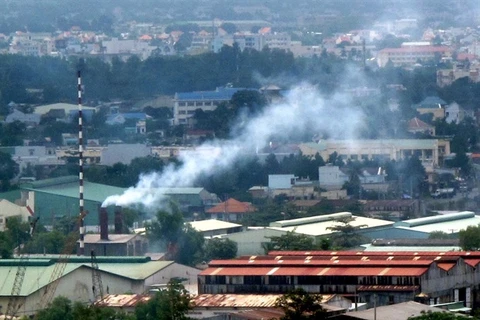
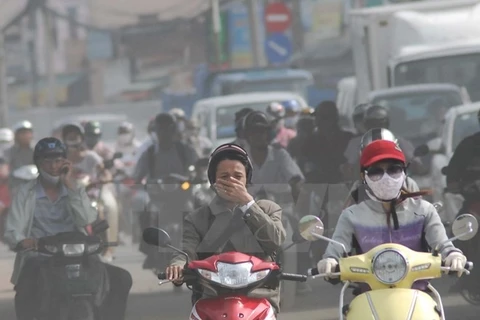
Home karaoke can be a joy to some, but many others consider it a nightmare as the singing can be deafening and last for hours, disturbing people's daily lives. (Photo: vntintuc.net)
 The apps will help wards and communes to promptly handle noise pollution in residential areas. The source of the noise is often from karaoke singing, both at bars and at homes.
Phan Dinh An, Chairman of the People’s Committee of Ward 6, Go Vap district, said local authorities currently have no means to measure the volume level of the noise. He said the city should require local authorities to use specific software or apps to measure the noise level.
Nguyen Thanh Phong, Chairman of the HCM City People's Committee, said prevention and control of noise violations was important to maintain security and ensure tranquillity for residents.
The chairman directed the Department of Natural Resources and Environment to take responsibility and coordinate with the city’s Department of Public Security to urgently research and propose solutions to the problem.
Solutions include a new law, enforcement of the law, education, and mass mobilisation. These solutions must be submitted to the chairman of the People's Committee by the end of the month.
The city department will deal with noise pollution in two phases. In the first stage, the department will focus on dissemination of information about the law. The second stage will be checking and handling violations.
The city has told communes and wards to hand out administrative penalties related to noise violations and increase fines. In addition, they should not restrict the time to handle violations, and should adjust their noise regulations.
Vo Van Hoan,Vice Chairman of the city’s People's Committee, said that noise pollution had become an urgent problem in the city.
"It is impossible to accept the use of high-powered loudspeakers in residential areas, restaurants, shops and others," Hoan said.
According to the Department of Natural Resources and Environment, karaoke noise comes from both street karaoke and households.
Noise in general arises from many sources: karaoke parlours that are not soundproofed well, shops selling audio devices, entertainment venues, vendors, restaurants, portable speakers in public places, and those who sing karaoke at home.
Over the last two years, the city sanctioned 141 cases of noise pollution violations in 17 districts, collecting over 818 million VND (40,000 USD), according to the department.
Earlier, at a meeting with the chairman of the People's Committee of wards, communes and towns on February 26, Phong said that he had received a lot of feedback about karaoke singing at home.
It is common to hear karaoke in almost every neighbourhood in Vietnam since many people prefer to show off in the comfort of their homes instead of a karaoke parlour. This type of activity often takes place during parties, but an actual occasion is not necessary.
While home karaoke can be a joy to some, others consider it a nightmare as the singing can be deafening and last for hours, even until late at night.
Last October, a man in southern Dong Nai province was stabbed to death by his neighbour for singing karaoke loudly until near midnight. Similar incidents have been reported./.
VNA