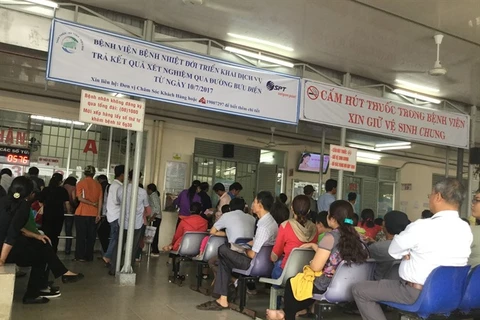
People use health insurance in medical check-up and treatment (Source: VNA)
 Hanoi (VNA) - Vietnam Social Security (VSS) recorded some 13,100 patients undergoing check-ups more than 50 times, with the total cost of 645 billion VND (28.3 million USD) paid by its health insurance fund, in the first 10 months of 2017.
Besides some special cases, the data showed abnormal signs in health insurance participation.
Duong Duc Tuan, Director of the Northern Centre for Health Insurance and Multidisciplinary Payment, said health insurance abuse by undergoing several check-ups at different hospitals was getting popular, increasing medical service costs and create negative consequences for the health insurance fund.
He cited the example of 53-year-old M.B.N. from Ho Chi Minh City’s District 12. From January to October 23, 2017, the patient underwent 231 medical examinations at more than 10 different hospitals, with the cost of 129 million VND (5,680 USD) covered by the health insurance fund.
“She went to hospital almost everyday. On some days, she had 2-3 check-ups at different hospitals,” Tuan added.
M.B.N’s medical expenses are fully funded by social security. However, she is not the sole case as the inspection system found several other patients undergoing up to 200 check-ups in 10 months.
“Some people consider undergoing check-ups paid by the health insurance fund their “job.” We are conducting investigations into these cases,” Tuan said.
In September, a patient in HCM City had to pay back 9 million VND (400 USD) to HCM City Social Security for abusing the health insurance fund.-VNA
Besides some special cases, the data showed abnormal signs in health insurance participation.
Duong Duc Tuan, Director of the Northern Centre for Health Insurance and Multidisciplinary Payment, said health insurance abuse by undergoing several check-ups at different hospitals was getting popular, increasing medical service costs and create negative consequences for the health insurance fund.
He cited the example of 53-year-old M.B.N. from Ho Chi Minh City’s District 12. From January to October 23, 2017, the patient underwent 231 medical examinations at more than 10 different hospitals, with the cost of 129 million VND (5,680 USD) covered by the health insurance fund.
“She went to hospital almost everyday. On some days, she had 2-3 check-ups at different hospitals,” Tuan added.
M.B.N’s medical expenses are fully funded by social security. However, she is not the sole case as the inspection system found several other patients undergoing up to 200 check-ups in 10 months.
“Some people consider undergoing check-ups paid by the health insurance fund their “job.” We are conducting investigations into these cases,” Tuan said.
In September, a patient in HCM City had to pay back 9 million VND (400 USD) to HCM City Social Security for abusing the health insurance fund.-VNA
VNA