Platform DK1/12 on the southern continental shelf of Vietnam. DK1 platforms are the country's offshore economic, scientific, and technical service stations (Photo: VNA)
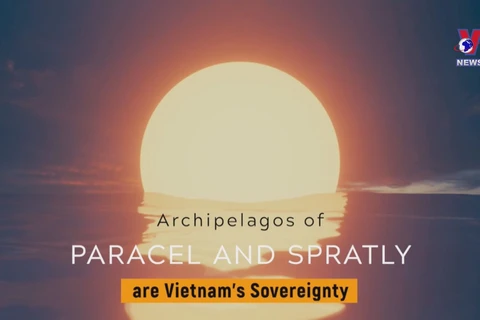
 Hanoi (VNA) - “The State of Vietnam was the first state in history to exercise its sovereignty over the two archipelagos of Hoang Sa (Paracel) and Truong Sa (Spratly) since they were ownerless pieces of land, at least since the 17th century. Vietnam has sufficient historical evidence that has legal value to testify to its sovereignty over Hoang Sa and Truong Sa,” Dr Tran Cong Truc, former head of the Government’s Boundary Committee, has said.
Many countries and international scientists have recognised historical and legal evidence of Vietnam’s sovereignty over Hoang Sa and Truong Sa which show that the State of Vietnam was the first state in history to possess and exercise its sovereignty over these two chains of islands since they were ownerless pieces of land, at least since the 17th century. And Vietnam’s possession and exercise of sovereignty over the two archipelagos are clear, continuous, and peaceful, and in conformity with the current “acquisition of territory” principle - the principle of effective occupation - of Public International Law.
Over the course of three centuries, from the 17th to late 19th century, as the State of Dai Viet (a former name of Vietnam), three different dynasties performed the sacred mission of possessing and exercising sovereignty over Hoang Sa and Truong Sa.
The Hoang Sa Flotilla, established by the State to manage, protect, and exploit the two archipelagos, is a typical example. The flotilla and the Bac Hai Flotilla, established later and also led by the leader of the Hoang Sa Flotilla, worked under the order of seven lords, from the time of Lord Nguyen Phuc Lan and his son Lord Nguyen Phuc Tan in the 17th century until the Tay Son Uprising (1771 - 1802), without encountering any disputes or resistance.
 A close look at Platform DK1/19 (Photo: VNA)
 Truc pointed out important evidence for the feudal state of Vietnam’s actual and effective management over these chains of islands, which is the designation of the then Hoang Sa (consisting of Hoang Sa and Truong Sa archipelagos) as an administrative unit of the State at that time.
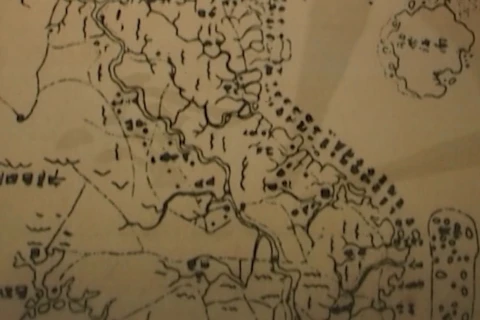
During the reign of the Nguyen lords, Hoang Sa was part of Thua tuyen Quang Nam or Quang Nghia (Ngai), an administrative unit equivalent to a province, in today’s central region, as seen in “Toan tap Thien Nam Tu chi Lo do thu” (Handbook of the South’s Road Map) or “Phu bien Tap luc” (Miscellaneous Records of Border Pacification) by Le Qui Don (1726 - 1784). In the Tay Son era, Quang Nghia was renamed Hoa Nghia. In the Nguyen Dynasty (1802 - 1945), Hoang Sa belonged to Quang Ngai province.
After that, as the representative of the State of Vietnam in terms of diplomacy under the 1884 Patenotre Treaty, the French colonial administration conducted the protection and management of the two archipelagos in line with then legal procedures.
In 1938, Emperor Bao Dai of the Nguyen Dynasty decided to separate Hoang Sa from Quang Ngai and merge it into Thua Thien province.
During the period Vietnam was temporarily divided into north and south, as the Hoang Sa and Truong Sa archipelagos are located to the south of the 17th parallel - the provisional demarcation line between the two regions under the 1954 Geneva Accords, the regime in South Vietnam, as the one with the legal status in international relations, continued to safeguard and manage these archipelagos from 1954 to 1975.
The regime in South Vietnam continually exercised Vietnam’s sovereignty over Hoang Sa and Truong Sa via State administrative documents as well as actual activities.
For example, on October 20, 1956, the administration of the Republic of Vietnam issued a decree renaming southern provinces and put Truong Sa archipelago under then Phuoc Tuy province. On July 13, 1961, the Republic of Vietnam merged Hoang Sa into Quang Nam province. On September 6, 1973, Truong Sa was merged into Phuoc Hai commune of Dat Do district, Phuoc Tuy province.
 Platform DK1/10 (Photo: VNA)
 From April 13 to 28, 1975, forces of the People’s Liberation Army of South Vietnam under the leadership of the Provisional Revolutionary Government of the Republic of South Vietnam took over the islands guarded by troops of the Republic of Vietnam and deployed personnel to defend some other islands and sites in the Truong Sa archipelago.
After the south was completely liberated, on July 2, 1976, at the first session of the 6th-tenure National Assembly (1976 - 1981), the legislature decided to rename the country the Socialist Republic of Vietnam, which has continued to manage and safeguard the country’s sovereignty over Hoang Sa and Truong Sa.
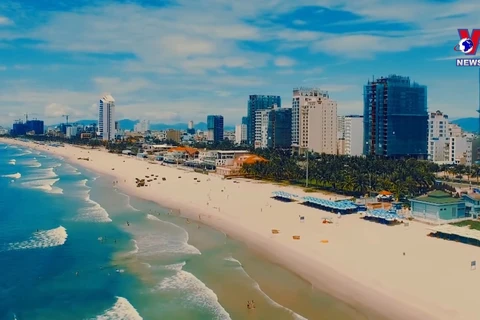
In 1982, Vietnam established Hoang Sa and Truong Sa districts, with the former now subordinate to Da Nang city and the latter to Khanh Hoa province. Truong Sa district is comprised of several administrative units, such as Truong Sa township (consisting of Truong Sa Lon (Big Truong Sa) Island and its vicinity), Song Tu Tay commune (consisting of Song Tu Tay Island and its vicinity), and Sinh Ton commune (consisting of Sinh Ton Island and its vicinity).
Truc affirmed that Vietnam has sufficient historical evidence that has legal value to testify to and safeguard its sovereignty over Hoang Sa and Truong Sa archipelagos over different periods in history.
Vietnam’s consistent policy is “very clear”: persistently and resolutely protecting its territorial integrity, national sovereignty, rights, and legitimate interests, he said.
The country takes every possible measure to guarantee its territorial integrity, national sovereignty, rights, and legitimate interests but still has the responsibility for maintaining regional peace, stability, and cooperation. In other words, it will settle related issues by peaceful means, according to Truc./.