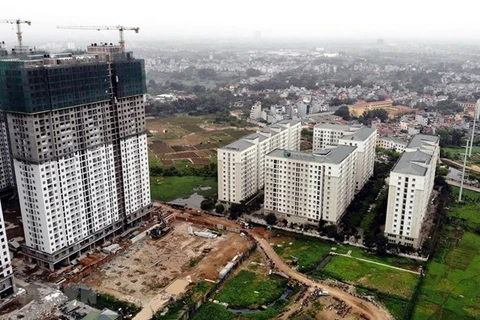
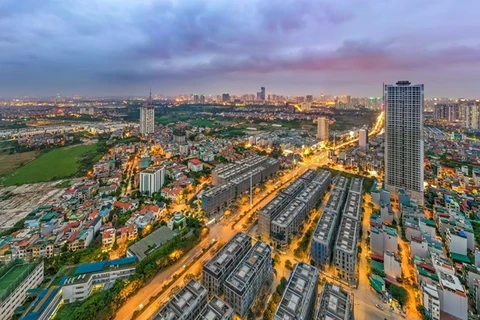
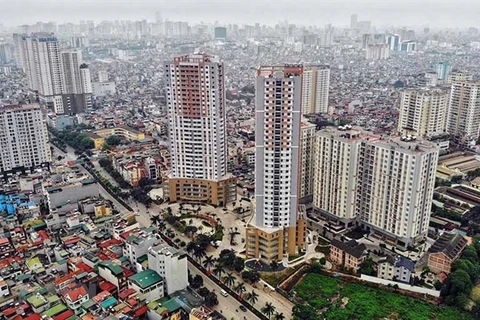
Apartment buildings in Hoang Mai district, Hanoi. Mid-end apartments remained the most popular products offering to the Hanoi market in the second quarter of this year. (Photo: VNA)
 This, according to the Ministry of Construction, is because of a lack of new supply due to the COVID-19 pandemic.
The ministry said in the second quarter, housing prices in Hanoi and Ho Chi Minh City continued to increase by 2-7 percent quarter on quarter due to the low new supply, while many localities saw a slight rise of 3 percent.
House prices in Hai Phong, Binh Duong and Dong Nai increased by 5-9 percent quarter on quarter.
Rental prices for serviced apartments and offices continued to fall at a rate of between 1-3 percent. In some big cities, rental prices for retail space decreased by 10-30 percent quarter on quarter.
Regarding the land plot segment, the ministry said that at the beginning of the year, there was ‘price fever’ in some localities nationwide. To solve this, the ministry asked the localities to strengthen the management and control of the local real estate market.
So far, the land plot market has been basically controlled and gradually stabilised with a price reduction of about 10-20 percent compared to the busier, previous period. However, this segment has still seen a low volume of transactions.
The ministry also said that Vietnam’s property market is experiencing a shortage of social housing and low-priced commercial housing and does not have enough information relating to the real estate market.
Nguyen Van Dinh, permanent vice chairman and general secretary of the Vietnam Real Estate Brokers Association, said at present, the property market had seen a reduction of transactions but still attracted more investment from remittances and profit of securities investment.
In addition, many economic sectors in Vietnam reduced production activities due to the pandemic, so investors had also moved capital into the real estate market to look for better opportunities.
Banks had cut deposit interest rates so depositors withdrew their money to pour into the real estate market, Dinh said.
The high demand of investment but low supply increased property prices, he said, which was the main reason for the price fever in the first quarter, especially for land plots.
Hanoi housing market
According to the CBRE Vietnam report on Hanoi property market in the first half of 2021, there were approximately 7,900 condominium units launched in Hanoi, up 10 percent year on year.
Although there were some negative impacts from waves of COVID-19 on Hanoi residential market in the first half of the year, the increase in new launches showed a recovery of sales activities and adaptation of both developers and buyers to the new market situation, compared to the previous year when Vietnam witnessed the first waves of COVID-19, CBRE said.
Mid-end apartments remained the most popular products accounting for 79 percent of total new launches during the first half of this year. In terms of location, the West and the East led the market with relative equal shares of around 39 percent during the first six months of 2021.
In terms of sales performance, positive market sentiment continued as sold units surpassed new launches in the first half. The sold condominium volume in the first six months of 2021 was 8,100 units up by 20 percent year on year.
In the second quarter of the year, the average primary price of Hanoi market was recorded at 1,472 USD per sq.m (net of VAT and maintenance fee), up by 7 percent year on year and 1 percent quarter on quarter. In the secondary market, the selling price as of the second quarter averaged at 1,180 USD per sq.m, up by 4 percent year on year.
Recently completed mid-end projects in convenient locations with improved connectivity in Hai Ba Trung and Bac Tu Liem districts have been those that witnessed the strongest growth over the past year. Selected projects recorded an annual pricing growth of 8-9 percent.
Although this growth rate is higher compared to previous years, it is still lower than level of HCM City’s, which witnessed projects with pricing growth of 10-15 percent per year.
Moving forward, the level of the new launches is expected to hover around 21,000 – 24,000 units in 2021, while sold units are expected to stay at positive level surpassing the new launch, CBRE said.
The forecast new launch and sold units during 2021 is higher than that of 2020, but still lower than pre-COVID-19 level. It is anticipated that the level of new launch in Hanoi in 2021-22 will be higher than that of HCM City by 25-30 percent.
The primary price in the next two years is expected to grow at 4-6 percent per annual, higher than previous year level of 3 percent thanks to improving infrastructure system and lower supply volume (as compared to pre COVID-19 level).
“We expect that not only developers from the South are heading North for new development opportunities, but individual buyers, especially investors, from Southern provinces will start to look for new opportunities in Hanoi and Northern provinces as supply constraints continue to be an issue in HCM City,” said Nguyen Hoai An, Director of Hanoi Branch, CBRE Vietnam.
Concerning the Hanoi market in the first half of this year, Do Thu Hang, of Savills Hanoi also said: “The strong infrastructure development narrows the price gap between urban and surrounding areas. The inner-city zoning plan has the goal of reducing the area’s population, it confirms the decentralisation while creating conditions for renovation, and upgrading, as well as creating high-end products.”
The average primary villa price was up 10 percent quarter on quarter and 3 percent year on year, while townhouses increased 11 percent quarter on quarter and 16 percent year on year. High demand for primary areas with imbalanced supply, plus upcoming infrastructure completions have driven escalations, according to Savills.
Matthew Powell, Director, Savills Hanoi, added: “Globally, rural and decentralised property has seen strong demand. This is a direct response from the COVID surge to move from high density cities as we take advantage of the flexibility that Work From Home (WFH) offers.
“Hanoi is decentralising, however less from these international trends, and more from price and infrastructure drivers.
“We do expect to see greater interest in landed properties, provided prices remain within reach.”/.
VNA