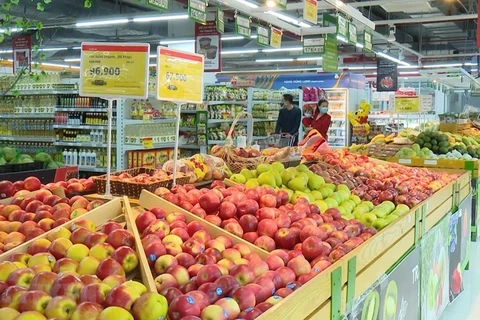
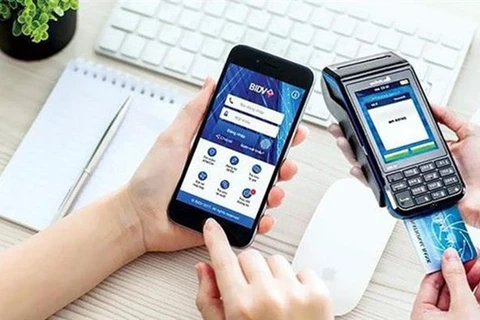
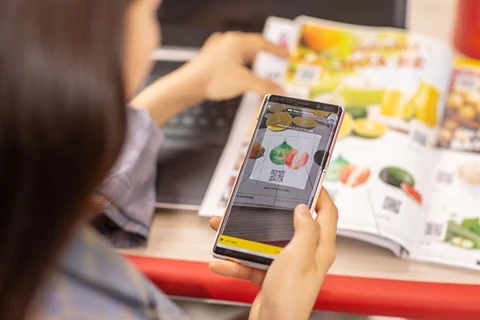
Illustrative image (Photo: VNA)
 Hanoi (VNS/VNA) - Non-cash payment activities have developed strongly in recent years with many payment services such as digital banks and e-wallets.
A new trend of developing payment services on mobile devices, called mobile money, is also being implemented.
Many economists have said that competition between e-wallets and mobile money might not happen as each payment method has different goals and market share.
Economist Can Van Luc said customers of each payment method were quite different.
Mobile money will mainly focus on those who already have phone numbers. The customers of this payment method are everywhere including in rural, urban, remote and mountainous areas.
Mobile money and e-wallets have the same purpose of creating a community which uses cashless payment.
However, mobile money helps people using mobile accounts to transfer money and pay goods with small value quickly, so its payments have limited value compared to e-wallets.
On the flipside, economist Nguyen Tri Hieu thinks mobile money will soon compete with e-wallets.
Mobile money was a form similar to e-wallets, he said. With mobile money, people can open an account on a mobile phone for non-cash payment without bank accounts.
The economist assessed that mobile money would be especially helpful in remote areas, where people did not have bank accounts.
The Payment Department under the State Bank of Vietnam (SBV) said the mobile money pilot project was being built with an estimated payment limit of 10 million VND per month (430 USD) for an identified account.
Meanwhile, in accordance with Circular 23/2019/TT-NHNN, the total limit of transactions via a personal e-wallet of one customer was up to 100 million VND per month.
Statistics of the department also showed payments via mobile phone channels including mobile banking and e-wallets as of the end of April increased by 189 percent in volume and 166.1 percent in value compared to the same period last year.
By the end of 2018, as many as 90 countries were accepting mobile money with up to 900 million users.
The transaction value reached 1.3 billion USD a day with an annual growth rate of 20 percent.
In Asia, the growth rate was 31 percent. In many countries, half of the population uses mobile money.
In Vietnam, Prime Minister Nguyen Xuan Phuc recently approved the mobile money pilot project, allowing the use of telecommunication accounts to pay for small-value goods and services.
The State Bank of Vietnam is also seeking comments for a draft decree regulating non-cash payments which would allow mobile money users not to link with bank accounts but be able to top-up or withdraw cash directly at telecommunication stores.
Telecommunication businesses such as Viettel, MobiFone and VNPT have said they were ready to prepare all necessary conditions to provide mobile money services as soon as it was licensed./.
A new trend of developing payment services on mobile devices, called mobile money, is also being implemented.
Many economists have said that competition between e-wallets and mobile money might not happen as each payment method has different goals and market share.
Economist Can Van Luc said customers of each payment method were quite different.
Mobile money will mainly focus on those who already have phone numbers. The customers of this payment method are everywhere including in rural, urban, remote and mountainous areas.
Mobile money and e-wallets have the same purpose of creating a community which uses cashless payment.
However, mobile money helps people using mobile accounts to transfer money and pay goods with small value quickly, so its payments have limited value compared to e-wallets.
On the flipside, economist Nguyen Tri Hieu thinks mobile money will soon compete with e-wallets.
Mobile money was a form similar to e-wallets, he said. With mobile money, people can open an account on a mobile phone for non-cash payment without bank accounts.
The economist assessed that mobile money would be especially helpful in remote areas, where people did not have bank accounts.
The Payment Department under the State Bank of Vietnam (SBV) said the mobile money pilot project was being built with an estimated payment limit of 10 million VND per month (430 USD) for an identified account.
Meanwhile, in accordance with Circular 23/2019/TT-NHNN, the total limit of transactions via a personal e-wallet of one customer was up to 100 million VND per month.
Statistics of the department also showed payments via mobile phone channels including mobile banking and e-wallets as of the end of April increased by 189 percent in volume and 166.1 percent in value compared to the same period last year.
By the end of 2018, as many as 90 countries were accepting mobile money with up to 900 million users.
The transaction value reached 1.3 billion USD a day with an annual growth rate of 20 percent.
In Asia, the growth rate was 31 percent. In many countries, half of the population uses mobile money.
In Vietnam, Prime Minister Nguyen Xuan Phuc recently approved the mobile money pilot project, allowing the use of telecommunication accounts to pay for small-value goods and services.
The State Bank of Vietnam is also seeking comments for a draft decree regulating non-cash payments which would allow mobile money users not to link with bank accounts but be able to top-up or withdraw cash directly at telecommunication stores.
Telecommunication businesses such as Viettel, MobiFone and VNPT have said they were ready to prepare all necessary conditions to provide mobile money services as soon as it was licensed./.
VNA