Hurdles keep private sector from achieving preeminent status: experts

The private sector, despite being considered the driving force of the economy, has yet to achieve a breakthrough due to many reasons, experts said.
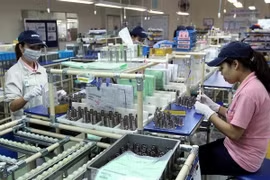
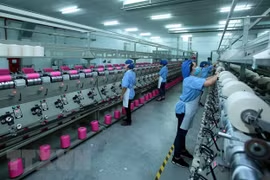
Hurdles keep private sector from achieving preeminent status: experts ảnh 1A factory in HCM City. The private sector plays an important role but in Vietnam they are still subject to many risks and difficulties. (Photo: VNA)

HCM City (VNS/VNA) - The private sector, despite being considered the driving force of the economy, has yet to achieve a breakthrough due to many reasons, experts said.

They were speaking at the Vietnam Economic Conference held in Ho Chi Minh City recently and attended by executives representing more than 300 local and foreign businesses.

Asked about the reasons, 54 percent of attendees said cumbersome administrative procedures, 26 percent said inability to access capital and 21 per cent blame difficulty in accessing the market.

Vu Tien Loc, Chairman of the Vietnam Chamber of Commerce and Industry, said administrative procedures are such a major obstacle that most business households do not want to become companies.

Dr Huynh The Du, public policy lecturer at Fulbright University, said the private sector receives the least priority, with policies prioritising State-owned and foreign firms over it.

The private sector, excluding household and individual businesses, only accounts for 10 percent of the GDP.

There are more than 700,000 private companies in the country, of which 96 per cent are small and medium-sized enterprises and 2 percent each are super-small and large enterprises.

Loc said it is time to include household and individual businesses and foreign-owned companies in which case the private sector accounts for 61 percent of GDP.

Even for developed economies such as the US, Japan and Europe, small and micro enterprises are the backbone, and Vietnam is not an exception, he pointed out.

To strengthen the role of the private sector in the economy, institutional reform is needed to safeguard companies’ rights and ensure the consistency of the system, he said.

Le Thi Nam Phuong, Deputy Chairwoman of the Vietnamese Young Entrepreneurs Council, said many regulations are interpreted differently in each locality, causing difficulties for businesses.  

So the Government also needs to be transparent in the decentralisation of the functions of ministries and localities, she said.
Du said policies need to minimise risks and create a better business environment to motivate the private sector to develop. — VNS/VNA
VNA
See more

Deputy Prime Minister Nguyen Van Thang meets with Martin Sommer, head of the IMF’s Article IV consultation mission team to Vietnam, in Hanoi on November 13, 2026. (Photo: VNA)

IMF sees positive growth prospects for Vietnam, urges cautious monetary policy

Martin Sommer, head of the IMF’s Article IV consultation mission team to Vietnam, noted that inflation risks in Vietnam remain under control, but several factors could add to price pressures. He therefore called for cautious monetary policy management and readiness to respond promptly if inflationary pressures increased.

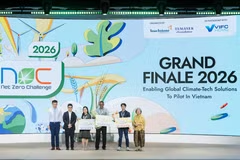
Representatives of the three first-prize-winning startups receive their awards at the event. (Photo: SGGP)

Seven green-tech startups secure 770,000 USD at Net Zero Challenge 2026

In its fourth year, the competition attracted more than 1,100 applications from 80 countries and territories, making it the most competitive edition since its launch in 2023. Nine finalists presented solutions in three categories, namely renewable energy and carbon removal; food systems and sustainable agriculture; and circular economy and waste management.

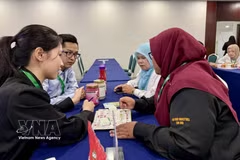
Vietnamese and Malaysian businesses connect at the event (Photo: VNA)

Vietnam, Malaysia connect businesses to boost bilateral trade cooperation

It centred on a business-to-business (B2B) matchmaking session, bringing Vietnamese and Malaysian companies together to discuss import-export needs, seek partners and explore cooperation. Vietnamese businesses aimed to connect with Malaysian importers, distributors and retailers, while expanding access for their products to Malaysia and other markets.

Visitors browse traditional Southern Vietnamese checked scarves on display at the Vietnam-Cambodia Trade Fair. (Photo: VNA)

Vietnam-Cambodia trade fair opens in An Giang

The fair features 150 booths representing 200 businesses, cooperatives, household businesses and production and trading establishments from both countries. The exhibition space is arranged into 10 zones showcasing products from Vietnamese localities and three zones featuring Cambodian products, creating opportunities for businesses from the two countries to promote their products, seek partners and expand markets.

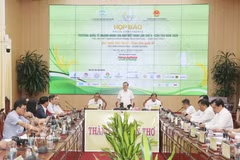
An overview of the press conference to announce the organisation of the second Vietnam International Rice Festival - Can Tho 2026. (Photo: VNA)

Festival to chart new course for rice industry

The second Vietnam International Rice Festival - Can Tho 2026 will take place from November 22 to 25, showcasing the achievements and potential of Vietnam’s rice industry while promoting Can Tho’s image, cultural identity and people, as well as the distinctive river culture of the Mekong Delta.

Japanese business representatives review Ho Chi Minh City’s investment project portfolio at the conference. (Photo: VNA)

Vietnam remains attractive destination for Japanese businesses

Fukai Akihiko, President and Representative Director at Gunma Bank and head of a business delegation from Japan’s Gunma prefecture, said cooperation between Gunma and Vietnam has continued to expand in recent years. Around 15,000 Vietnamese people currently live in Gunma, forming the largest foreign community in the prefecture.

A panoramic view of the site designated for the Ninh Thuan 1 nuclear power plant in Phuoc Dinh commune, Khanh Hoa province. (Photo published by VNA)

Vietnam to access MBIR reactor research capabilities, gradually master nuclear technology

As Vietnam develops its nuclear science and technology and prepares the necessary conditions in terms of human resources, research capacity, safety systems and technical infrastructure, participation in international research programmes and access to MBIR will enable the country to conduct experiments supporting its programme for the peaceful use of atomic energy.