IMF forecasts Vietnam's economic growth to reach 6.1 % in 2024

The Executive Board of the International Monetary Fund (IMF) concluded the 2024 Article IV Consultation with Vietnam.

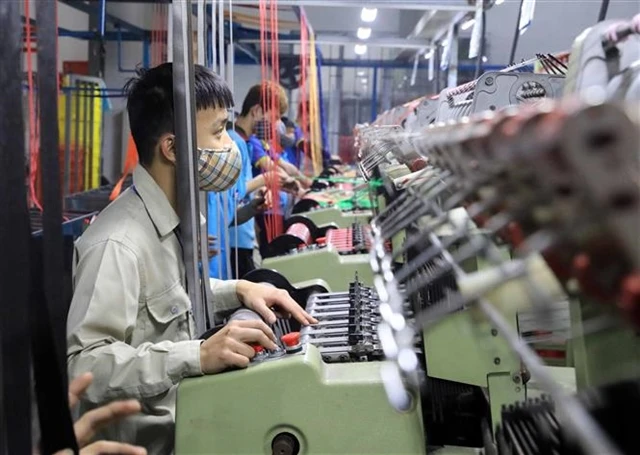
Workers during a working shift at a packaging factory in the northern province of Hung Yen. (Photo: VNA)

Hanoi (VNS/VNA) - The Executive Board of the International Monetary Fund (IMF) concluded the 2024 Article IV Consultation with Vietnam.

According to their report, economic growth is projected to recover to 6.1% in 2024, supported by continued strong external demand, resilient foreign direct investment and accommodative policies.

Domestic demand growth is expected to recover gradually as corporates navigate through high debt levels while the real estate sector will only fully recover over the medium term.

Inflation is expected to hover around the State Bank of Vietnam (SBV)’s target of 4-4.5% this year.

“Inflation picked up in 2024, driven mainly by rising food prices, though core inflation remained relatively low and stable,” the IMF stated.

“The external current account posted a large surplus in 2023, at 5.8% of GDP, mainly reflecting a significant contraction in imports.”

The IMF's executive directors commended the Vietnamese authorities’ swift actions to maintain macro-financial stability after the economic recovery from the pandemic faced domestic and external headwinds.

However, it noted that downside risks remain elevated.

Exports, a key driver for Vietnam’s economy, could weaken if global growth disappoints, global geopolitical tensions persist or trade disputes intensify. Given easy monetary conditions, if exchange rate pressures were to persist for longer, it could lead to a larger pass-through to domestic inflation.

“Persistent weakness in the real estate sector and corporate bond market could weigh more than expected on banks’ ability to expand credit, hurting economic growth and undermining financial stability,” the report highlighted.

Given these challenges, further efforts are required to safeguard macro-financial stability and deepen reforms to address vulnerabilities and ensure robust, green and inclusive growth over the medium term.

The IMF's directors noted that fiscal policy should take the lead in supporting economic activity if needed. In this context, they welcomed the authorities’ plans to speed up the implementation of public investment, which will require tackling bottlenecks and stressed the importance of expanding social safety nets to support the most vulnerable. They also recommended strengthening the fiscal framework and budget process and increasing revenue mobilisation over the medium term to support the ambitious development agenda.

According to the IMF, the authorities have effectively contained inflation risks. However, they stressed that monetary policy should continue to be cautious under a complex environment and limited policy space.

The IMF's directors also acknowledged the authorities’ swift actions to contain risks in the real estate and corporate bond market but urged more decisive action to tackle remaining vulnerabilities. This includes strengthening the insolvency framework, bolstering institutions and increasing transparency in the corporate bond market.

In addition, Vietnam has also made structural and climate reforms to achieve sustainable, green and inclusive growth. Accelerating the transition to upper-middle income status will require further efforts to improve the business environment, step up critical infrastructure and invest in human capital.

The latest Power Development Plan and the planned Emissions Trading System can help achieve Vietnam’s climate goals and promote energy security, according to the IMF's directors./.
VNA

See more

Vinachem affirms its position as a leading chemical enterprise at the Autumn Fair 2025 (Photo: VNA)

Vietnamese enterprises renew growth model to move up global value chains

The resolution identifies enterprises as the centre of the renewal process, urging them to shift from cost-based competition to productivity, technology, quality and market responsiveness; from operating independently to joining industrial ecosystems; and from participating in value chains to mastering and eventually leading them.

Key export sectors such as textiles – garments, footwear and furniture, along with many signature products of Da Nang, have strong potential to expand their markets through online export channels. (Photo: VNA)

Da Nang seeks to boost online exports

To help businesses go global, Da Nang is shifting from supporting individual online activities to developing an integrated ecosystem covering products, branding, platforms, payments, logistics, legal issues and market information. This is also part of the city’s e-commerce development orientation for 2026-2030, which identifies e-commerce as an important component of the digital economy.

Deputy Minister of Foreign Affairs Le Thi Thu Hang receives Rolf Mutzenich, a member of the Foreign Affairs Committee of the German Bundestag, in Hanoi on August 18. (Photo: baoquocte.vn)

Vietnam welcomes German firms’ expansion

Vietnam welcomes and stands ready to create favourable conditions for German businesses to expand their investment and operations in the country, particularly in infrastructure, smart seaports, renewable energy, high-speed railways, science and technology, and high-quality human resource training.

Khanh Hoa province has the largest sheep population in Vietnam, with around 100,000 individuals. (Photo: VNA)

Khanh Hoa province explores Halal ecosystem development

Khanh Hoa aims to estabish itself as a Halal-friendly destination while supporting businesses in expanding export markets, attracting strategic partners and investors, and drawing projects from countries with strong Halal logistics, tourism, manufacturing, processing and agriculture sectors.

The proportion of Vietnamese goods remains high at supermarkets. (Photo: VNA)

Vietnamese brands win over domestic consumers to go global

Amid increasingly fierce global competition, the goal is no longer simply to increase domestic consumption of Vietnamese goods, but to develop strong Vietnamese brands capable of winning consumers through quality, innovation and added value, thereby creating a stepping stone for expansion into international markets.

Illustrative image (Photo: VNA)

Automated VAT refunds to be rolled out from December

As of August 11, VAT refunds rose 32% from a year earlier, reaching 64.4% of the full-year estimate. Tax authorities issued 11,627 refund decisions totaling 111.726 trillion VND (4.26 billion USD), up 9% by volume. The payouts improved cash flow for companies and supported production, trade and exports.

ST25 rice is the centrepiece of the Vietnam Goods Week at Selgros. (Photo: VNA)

ST25 rice officially enters Selgros wholesale supermarket chain in Germany

The placement of ST25 rice on Selgros shelves not only creates an additional opportunity for German consumers to access Vietnamese rice products, but also contributes to efforts to increase the added value of Vietnamese agricultural products by shifting the focus from volume to quality, branding and value.

Trains on the elevated section of the Cau Giay – Nhon route in Hanoi provide convenient transportation for local residents. (Photo: VNA)

Multimodal connectivity to drive Vietnam’s transport infrastructure

Under the proposed approach, roads would serve mainly as connectors and for first- and last-mile transport; railways would handle large volumes over long distances; maritime transport would serve import and export cargo; inland waterways would carry large volumes at low cost; and air transport would focus on fast delivery and high-value goods.