Indian Communist Party leader highlights CPV leadership in Vietnam’s development

The Communist Party of Vietnam (CPV) has affirmed its essential role in the country’s development process, said General Secretary of the Communist Party of India (CPI) Doraisamy Raja.

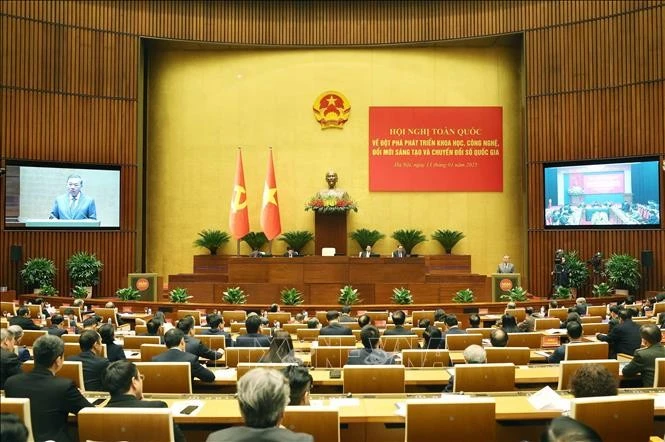
On January 13, 2025, Party General Secretary To Lam, also the head of the Central Steering Committee for the Development of Science, Technology, Innovation and Digital Transformation, delivers a keynote speech at the national conference on implementing the Politburo's Resolution No. 57-NQ/TW on breakthroughs in these key areas. (Photo: VNA)

New Delhi (VNA) – The Communist Party of Vietnam (CPV) has affirmed its essential role in the country’s development process, said General Secretary of the Communist Party of India (CPI) Doraisamy Raja in an interview granted to the Vietnam News Agency in New Delhi given the CPV’s approaching 95th anniversary (February 3).

He noted that the CPV’s establishment addressed major challenges Vietnam faced under colonial oppression, providing ideological and organisational foundations for the national liberation movement. Introducing Marxism-Leninism to Vietnam, the Party linked the country’s struggle for independence with the global communist movement, shaping a scientific and systematic revolutionary approach that united workers and farmers against imperialism and feudalism.

According to him, in the early 1940s, under the leadership of President Ho Chi Minh, the CPV adapted to changing circumstances by forming the Viet Minh Front in 1941, bringing together patriotic forces. This strategic move expanded and strengthened the national liberation movement. By taking advantage of global developments during World War II, the Party mobilised the masses, established armed resistance, and secured liberated zones. These efforts culminated in the successful August Revolution of 1945, leading to Vietnam’s declaration of independence and the establishment of the Democratic Republic of Vietnam.

The CPI leader underscored that Vietnam’s victories in the resistance wars against French colonialism and American imperialism reflected the CPV’s strategic vision, mass mobilisation capabilities, and unwavering commitment to national liberation and socialism. He stressed that the Party’s revolutionary leadership has endured because of its ideological clarity, adaptability, and deep connection with the people – factors that have not only ensured past triumphs but continue to guide Vietnam’s progress and sovereignty today.

Raja assessed that Vietnam’s Doi moi (Renewal) policy marked a transformative period in the country’s modern history by shifting from a centrally planned economy to a socialist-oriented market economy. The CPV’s leadership in this transition was characterised by its strategic vision, adaptability, and unwavering commitment to socialism, national development, and public welfare. He noted that the Party’s decision to implement Doi moi reflected a profound understanding of Vietnam’s socio-economic conditions and global trends.

He also credited the CPV’s leadership with maintaining political stability, which has been crucial to Vietnam’s successful reforms. The Party’s focus on national unity and consensus-building has enabled it to navigate complex socio-economic challenges while avoiding pitfalls such as division or social unrest.

Regarding Vietnam’s ongoing fight against corruption and efforts to streamline the administrative system, Raja stressed their importance in maintaining the Party’s leadership role and ensuring sustainable national development. He noted that they not only protect the CPV’s credibility and legitimacy but also drive economic and social progress, reinforcing a socialist state that genuinely serves the people. By holding senior officials accountable and ensuring that no one is above the law, the CPV has strengthened public trust in its leadership, he said.

Looking ahead, Raja affirmed that Vietnam’s ambitious national development goals are achievable, reflecting a clear vision for sustainable growth, global integration, and improved living standards. He said the CPV’s ability to tackle challenges such as economic inequality, climate change, and geopolitical tensions will be crucial in realising the country’s aspirations and cementing its status as a respected and influential nation on the global stage./.
VNA

See more

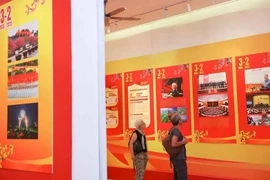
Delegates cut the ribbon to open the exhibition (Photo: VNA)

ASEAN, Japan advance cooperation through future-oriented initiatives

Over the 45 years since its establishment, the ASEAN - Japan Centre (AJC) has served as a bridge connecting ASEAN and Japan. Through its work in promoting trade, investment, tourism, and people-to-people exchanges, the centre has helped strengthen economic linkages while fostering deeper mutual understanding between people from ASEAN member states and Japan.

Suvarnabhumi Airport in Thailand's Bangkok. (Illustrative photo: VNA)

Thailand accelerates aviation infrastructure modernisation

Thailand is accelerating infrastructure modernisation and the application of digital technologies in air traffic management to improve safety, reduce flight delays, save fuel and advance its goal of becoming a world-class aviation hub.

Customers make payments at a restaurant in Kuala Lumpur, Malaysia. (Illustrative photo: VNA)

Malaysia targets top 10 in Global Peace Index

Over the last 13 years, the Malaysian government has invested 723 million MYR (over 180 million USD) in the security of the Eastern Sabah Security Zone (ESSZONE. As a result, the country now has much better control over security and has ensured safe passage in its territorial waters.

Politburo member and President of the National Assembly of Laos Xaysomphone Phomvihane passes away at 11:18 on August 8. (Photo: VNA)

Special communiqué on passing of Lao National Assembly President

To honour Comrade Xaysomphone Phomvihane’s contributions and express deepest condolences over his passing, the LPRP Central Committee, the National Assembly, the Government and the Lao Front for National Development have decided to declare a five-day national mourning period from August 9 to 13 at the National Convention Centre.

Lao National Assembly President Xaysomphone Phomvihane passes away at 70. (Photo: VNA)

Lao National Assembly President passes away

Comrade Xaysomphone Phomvihane was one of the core leaders of the LPRP Central Committee, a person of great knowledge, capability, and astuteness, with extensive leadership experience across local administrations and multiple sectors.

Officials and diplomats at the ceremony marking ASEAN's 59th anniversary in Jakarta, Indonesia, on August 8 (Photo: VNA)

ASEAN turns 59, vows unity and firm central role

ASEAN Secretary-General Kao Kim Hourn said nearly six decades of dialogue, mutual respect and a drive to find common ground have forged the strength that carried the bloc through crises and kept regional peace and stability intact.

Cambodia steps up efforts to protect endangered wildlife

Cambodia steps up efforts to protect endangered wildlife

Conservation experts emphasise that protecting the Giant Ibis is of paramount importance and urge the public to prevent illegal land clearing, end wildlife trafficking and poisoning, and decline the consumption or keeping of wild animals.

Cambodia, RoK expand “Peace Village” initiative for rural development

Cambodia, RoK expand “Peace Village” initiative for rural development

The Peace Village Project is part of the Cambodia-RoK Strategic Partnership. In its second phase, the project is being implemented in 30 villages across three northwestern provinces that were heavily affected by war and landmines, with the aim of transforming them into areas of peace, sustainable development and shared prosperity.

A view of the meeting between Indonesian President Prabowo Subianto and 150 researchers from the National Research and Innovation Agency (BRIN) on August 6 (Photo: VNA)

Indonesia sees technology mastery as key to national progress

Addressing a meeting with 150 researchers from the National Research and Innovation Agency (BRIN) on August 6, Indonesian President Prabowo Subianto affirmed that mastery of science and technology is essential for accelerating national development and enhancing Indonesia's global competitiveness.

Cambodia eyes higher value-added manufacturing

Cambodia eyes higher value-added manufacturing

Cambodian Deputy Prime Minister Sun Chanthol urged the private sector to work closely with the government in preparing for the next phase of industrial development by moving upstream into higher value‑added manufacturing and strengthening supply chain capabilities.

Malaysia steps up drive to build world-class startup ecosystem

Malaysia steps up drive to build world-class startup ecosystem

For KL20 2026, four new priority areas have been added, aligning with Malaysia's 13th Malaysia Plan (2026–2030), which seeks to increase economic complexity, strengthen high-value industries and expand domestic production of value-added goods and services.

Thai Prime Minister Anutin Charnvirakul (front, right) and Myanmar President Min Aung Hlaing (front, left) at their meeting in Bangkok on August 6, 2026 (Photo: Kyodo/VNA)

Thailand, Myanmar jointly tackle cross-border pollution

Speaking at the signing ceremony, Thai Minister of Natural Resources and Environment Suchart Chomklin described the TOR signing as an important milestone in bilateral environmental cooperation, saying it would enhance water resource management, protect ecosystems and improve life quality for those living in border areas.