Straddling the so-called Pacific ‘ring of fire’, Indonesia, an archipelago of high tectonic activity, is regularly hit by earthquakes. (Photo: AFP/VNA)
Jakarta (VNA) – Director of the IndonesianAgency for Meteorology, Climatology and Geophysics (BMKG) Dwikorita Karnawati haswarned of a potential tsunami from subsequent aftershocks following a 6.2-magnitudeearthquake striking Majene city, West Sulawesi province, in the early hours of January15.
The epicentre of the quake was six kilometres northeastof Majene, at a depth of 10 kilometres.
In an online press conference, Karnawati said the aftershocks could be as strong, or stronger, thanthis morning's quake.
She has advised residents in the area to steer clear of highbuildings and beaches because the follow up quake had the potential oftriggering a tsunami or landslide.
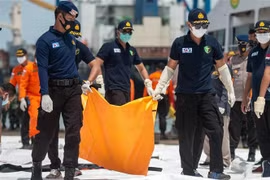
It was reported that at least 34 people have been killed andhundreds of other injured while more were feared buried in the ruins. InMajene, rescue workers are trying to reach more than a dozen patients and stafftrapped beneath the rubble of a hospital that was flattened by the quake.
Thousands of people have been displaced following thequake which damaged at least 60 houses.
The disaster mitigation agency said a hotel and theoffice of the West Sulawesi governor were also severely damaged, and electricitysupplies were also down. Some roads and bridges were also damaged slowing downthe rescue operations.
Straddling the so-called Pacific ‘ring of fire’,Indonesia, an archipelago of high tectonic activity, is regularly hit byearthquakes.
In 2018, a devastating 6.2 magnitude quake and tsunamistruck the city of Palu, further north in Sulawesi, killing thousands ofpeople./.