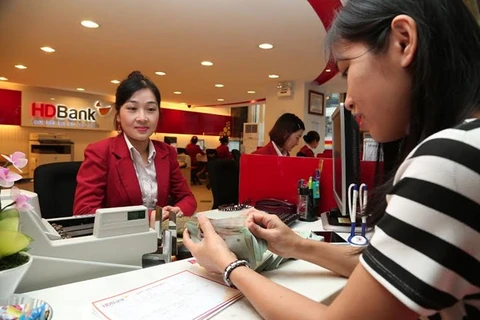
Customers at a branch of the Prudential insurance company in Hanoi (Photo thebank.vn)
 Hanoi (VNS/VNA) - Touting it as a win-win deal for everyone, banks and insurance companies in Vietnam are promoting the “bancassurance” model to exploit a market with huge untapped potential.
Globally, the co-operation between commercial banks and insurance companies to supply banks’ clients with insurance policies is already an established trend. It is seen as creating a professional, convenient and reliable sales channel for insurance policies.
A number of large banks in Vietnam have been entering deals with insurance companies, offering insurance products or insurance benefits to the banks’ customers, with both sides taking their share of commissions.
With such a partnership, insurance companies can take advantage of commercial banks’ large number of clients and nationwide networks, while customers only need to visit a single point of sale and contact at their preferred banks to gain access to a full range of insurance services.
For the majority of Vietnamese banks and insurance companies engaging in bancassurance, the average service charge for banks is 20 to 30 percent of the value of an insurance policy.
Normally, both sides sign exclusive distribution agreements for five to 15 or 20 years, rather than shorter, non-exclusive co-operation deals.
For example, the Sai Gon Thuong Tin Commercial Joint Stock Bank (Sacombank) and the Dai-ichi Life Insurance Company Limited (Dai-ichi life) signed a 20-year co-operation agreement early September, while the Vietnam Technological and Commercial Joint Stock Bank (Techcombank) and Manufacturers Life Insurance Company (Manulife) signed a 15-year bancassurance deal later the same month.
Bank representatives explained the exclusive collaborations saying they needed more cohesive co-operation in order to focus on development, while insurance companies said they were confident the partnership will prove beneficial.
Nguyen Le Quoc Anh, Techcombank’s general director, said that in 2016 alone, the total amount of insurance premiums paid via the bank’s accounts was roughly 520 billion VND (23.1 million USD), but by co-operating exclusively with Manulife, Techcombank plans to increase this figure to 10 trillion VND (445.4 million USD) in just five years.
He added that by signing the agreement with Manulife, the bank aimed to double its bancassurance growth to about 40 percent.
Manulife’s insurance products of will be sold through Techcombank’s distribution channel of 300 branch offices, making them the two largest shareholders of the bancassurance market in Vietnam.
While representatives from Sacombank did not mention the specific number of insurance policies they hope to secure in future, the bank expects income from their share in insurance premiums to account for 15 to 20 percent of its services, helping create a solid, long-term financial foundation and support for a more favourable post-merger restructuring plan.
In August 2017, the Vietnam Joint Stock Commercial Bank for Industry and Trade (VietinBank) also entered into a co-operation deal with Aviva Vietnam Life Insurance Company Limited (Aviva), while both Vietnam Maritime Commercial Joint Stock Bank (Maritime Bank) and Vietnam International Commercial Joint Stock Bank (VIB) are cross-selling exclusive insurance products for Prudential Financial Inc (Prudential).
Both newly established and well known banks are signing long-term and exclusive agreements with insurance companies as an important part of their retail operations.
Seeing strong growth opportunities, insurance companies are stepping up investments and capitalisation to increase their financial capacity, develop new distribution channels, and enhance technology adoption in customer service towards increasing their market share.
There are about 50 insurers in Vietnam, offering a wide variety of products ranging from asset protection to life insurance. However, only 0.7 percent of the total population is reported to have bought any form of life insurance policies, and the bancassurance sector accounts for just 6 percent of the market.
Nevertheless, as general incomes, living standards and education levels increase, especially among the urban middle class, customers are likely to be more interested in the benefits that insurance companies bring to the table.
Chung Ba Phuong, Techcombank’s head of Insurance Division, said that in the first six months of 2017, the life insurance payouts in Vietnam topped 7.2 trillion VND (320 million USD), showing that the insurance sector is thriving.
As of this year’s third quarter, the life insurance market has continued to maintain a high and stable growth rate, with revenues increasing by nearly 34 percent over the same period in 2016, he said.
In 2016, Manulife increased its capital from 975 billion VND to 1.82 trillion VND (43.4 million USD to 81 million USD), while Dai-ichi went from 1.14 trillion VND to 1.76 trillion VND (50.7 million USD to 78.3 million USD).
Paul Nguyen, general director of Manulife in Vietnam, said bancassurance is among the most valuable market in the region.
He said bancassurance accounts for over 40 percent of the insurance business in Indonesia and Thailand, and even up to 70 percent in more developed countries, becoming the main insurance distribution channel. Meanwhile, in Vietnam, the corresponding contribution was just 10 percent at the end of 2016.
Therefore, Paul Nguyen said, he believes that the insurance market in Vietnam will continue to grow strongly in the next few years; and exclusive cooperation with the banking network would help insurers significantly improve their profitability from the service sector.-VNA
VNA