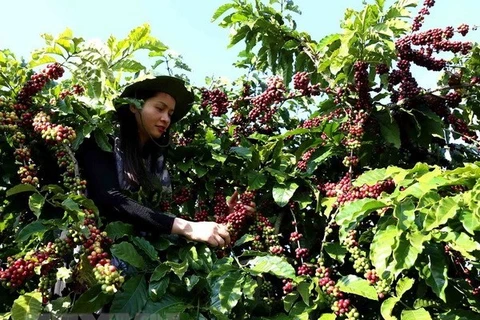
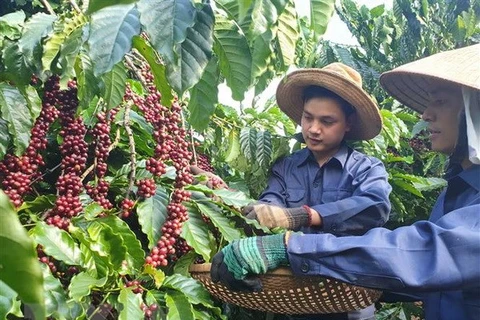
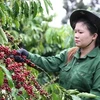
Numerous challenges are facing the export of Vietnamese coffee, which has continually declined in both volume and value since the beginning of this year. (Photo: hanoimoi.com.vn)
 Hanoi (VNA) – Numerous challenges are facing the export of Vietnamese coffee, which has continually declined in both volume and value since the beginning of this year.
In the first four months of 2019, 629,000 tonnes of coffee worth 1.1 billion USD was shipped abroad, down 13.4 percent in volume and 22.5 percent in value year-on-year.
The export is forecast to continue the downtrend in May as domestic and global coffee prices are still falling, according to the Agro Processing and Market Development Department under the Ministry of Agriculture and Rural Development.
The department’s Acting Director Nguyen Quoc Toan said domestic coffee prices are currently below 30,000 VND (1.28 USD) per kg – the lowest in a decade. Prices in international markets have also dropped by 500 USD per tonne to 1,295 USD per tonne since the start of May.
He explained that global coffee prices have been affected by US-China trade relations, which has subsequently dragged down prices in many countries, including Vietnam.
Additionally, coffee exports have also faced fierce competition from other rivals.
Secretary-General of the Vietnam Coffee-Cocoa Association Nguyen Viet Vinh said over the last four months, coffee exports to the US fell by 19.8 percent, and 13 percent for those to Germany. Vietnamese coffee now has to compete with Brazilian and Colombian products in these two traditional markets.
Coffee exports to many other destinations have also been declining sharply, including India (down 33.7 percent), Algeria (25.2 percent), France (14 percent), Japan (12.5 percent), and the Republic of Korea (11.2 percent).
Minister of Agriculture and Rural Development Nguyen Xuan Cuong partly attributed the decrease to the limited quality of Vietnamese coffee, a lack of diverse products, and the sector’s inactive response to market fluctuations.
He said the coffee sector needs to change its production mode, adding that amid droughts decreasing crops and therefore coffee output, it is now urgent to apply technology in production so as to ensure product quality.
Meanwhile, Vietnam should also develop specialty products for export, said Chairman Thai Nhu Hiep of the Vinh Hiep Co. Ltd – a coffee processor and exporter in the Central Highlands province of Gia Lai.
Hiep noted that specialty products make up about 2 percent of the global coffee output, but their added value is five to 10 times higher than that of normal ones. There are many regions producing such quality coffee in Vietnam.
Minister Cuong said in the time ahead, new-generation free trade agreements like the Comprehensive and Progressive Agreement for Trans-Pacific Partnership (CPTPP) and the EU-Vietnam Free Trade Agreement (EVFTA) will open up numerous new chances for Vietnamese coffee thanks to tariff cuts, especially those for processed coffee.
Vietnamese businesses should make use of these opportunities to improve the quality of their coffee, diversify products, and focus on processed coffee with high value to expand the market and give this strategic commodity the recognition it deserves, the official added. –VNA
In the first four months of 2019, 629,000 tonnes of coffee worth 1.1 billion USD was shipped abroad, down 13.4 percent in volume and 22.5 percent in value year-on-year.
The export is forecast to continue the downtrend in May as domestic and global coffee prices are still falling, according to the Agro Processing and Market Development Department under the Ministry of Agriculture and Rural Development.
The department’s Acting Director Nguyen Quoc Toan said domestic coffee prices are currently below 30,000 VND (1.28 USD) per kg – the lowest in a decade. Prices in international markets have also dropped by 500 USD per tonne to 1,295 USD per tonne since the start of May.
He explained that global coffee prices have been affected by US-China trade relations, which has subsequently dragged down prices in many countries, including Vietnam.
Additionally, coffee exports have also faced fierce competition from other rivals.
Secretary-General of the Vietnam Coffee-Cocoa Association Nguyen Viet Vinh said over the last four months, coffee exports to the US fell by 19.8 percent, and 13 percent for those to Germany. Vietnamese coffee now has to compete with Brazilian and Colombian products in these two traditional markets.
Coffee exports to many other destinations have also been declining sharply, including India (down 33.7 percent), Algeria (25.2 percent), France (14 percent), Japan (12.5 percent), and the Republic of Korea (11.2 percent).
Minister of Agriculture and Rural Development Nguyen Xuan Cuong partly attributed the decrease to the limited quality of Vietnamese coffee, a lack of diverse products, and the sector’s inactive response to market fluctuations.
He said the coffee sector needs to change its production mode, adding that amid droughts decreasing crops and therefore coffee output, it is now urgent to apply technology in production so as to ensure product quality.
Meanwhile, Vietnam should also develop specialty products for export, said Chairman Thai Nhu Hiep of the Vinh Hiep Co. Ltd – a coffee processor and exporter in the Central Highlands province of Gia Lai.
Hiep noted that specialty products make up about 2 percent of the global coffee output, but their added value is five to 10 times higher than that of normal ones. There are many regions producing such quality coffee in Vietnam.
Minister Cuong said in the time ahead, new-generation free trade agreements like the Comprehensive and Progressive Agreement for Trans-Pacific Partnership (CPTPP) and the EU-Vietnam Free Trade Agreement (EVFTA) will open up numerous new chances for Vietnamese coffee thanks to tariff cuts, especially those for processed coffee.
Vietnamese businesses should make use of these opportunities to improve the quality of their coffee, diversify products, and focus on processed coffee with high value to expand the market and give this strategic commodity the recognition it deserves, the official added. –VNA
VNA