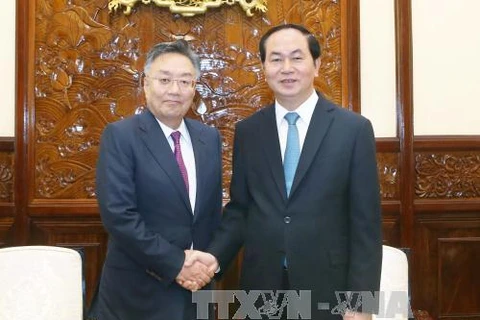
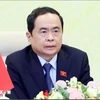
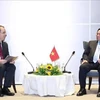
President Tran Dai Quang (R) Managing Executive Officer and Regional Chief Executive Officer of ASEAN at the corporation Shoji Kuwayama (Photo: VNA)
Hanoi (VNA) – Japan’s Marubeni Corporation is seeking investment opportunities in coal exports, gas production, renewable energy usage and waste water treatment in Vietnam.
Managing Executive Officer and Regional Chief Executive Officer of ASEAN at the corporation Shoji Kuwayama made the statement at a meeting with President Tran Dai Quang in Hanoi on August 10.
He said his group specilises in developing energy resources and infrastructure, processing farm produce and seafood, and producing garment product for export.
Regarding Vietnam as a key market, the group opened its branches in Hanoi and Ho Chi Minh City in 1991, he said, adding that it has engaged in 11 energy development projects in Vietnam, with the first build a thermal power plant in the Mekong Delta city of Can Tho in 1975.
Apart from business and investment activities, the corporation has also paid attention to social issues, proven by the establishment of a scholarship fund in 1994 to support students in some Vietnamese localities, he told the President.
President Tran Dai Quang highly valued Marubeni Corporation for conducting effective investment in Vietnam since the early 1990s as well as its remarkable contributions to the country’s economic development.
He also hailed the group for reinforcing the economic ties between Vietnam and Japan via energy and thermal power projects, and activities to support children and develop education in Vietnam over the past few years.
The President called on Japanese businesses to increase investment in Vietnam, especially prioritising key areas under Vietnam’s industrialisation strategy, developing high-quality infrastructure, energy, support industry and agriculture, promoting technological transfer, and supporting human resources training.
There is still large room for the two countries to boost economic cooperation in the coming time, he said, adding that the establishment of the ASEAN Community as well as the signing of the Trans-Pacific Partnership (TPP) Agreement and the engagement in negotiations for the Regional Comprehensive Economic Partnership (RCEP) will bring enormous opportunities for bilateral collaboration in economy.
He highlighted Japan as the biggest provider of official development assistance (ODA), the second largest investor and the fourth biggest trade partner of Vietnam .
The success of foreign investors is also the success of Vietnam, the State leader said, adding that the country will push ahead with measures to improve its legal framework and policy to create a stable and more favourable business climate for overseas companies, including those from Japan.
Vietnam is also coordinating with Japan in implementing the sixth phase of their joint initiative to improve the investment environment in Vietnam in 2016, he noted.
He said he hopes Marubeni Corporation will optimise new opportunities and promote its role as a leading trade company in Japan to continue with effective operation in Vietnam, contributing to the country’s socio-economic development.-VNA