Joint efforts called to boost women’s leadership rate to 50 percent

Vice President Dang Thi Ngoc Thinh has voiced her hope that with joint efforts, one day, there won’t be any barriers and bias against women, and female leaders in businesses and economic organisations will make up 50 percent and even higher of the total number.
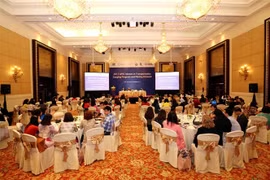
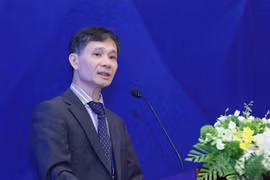
Joint efforts called to boost women’s leadership rate to 50 percent ảnh 1Vice President Dang Thi Ngoc Thinh delivers a keynote speech at the 2017 APEC Public-Private Dialogue on Women and the Economy (Photo: VNA)

Thua Thien-Hue (VNA) –
Vice President Dang ThiNgoc Thinh has voiced her hope that with joint efforts, one day, there won’t beany barriers and bias against women, and female leaders in businesses andeconomic organisations will make up 50 percent and even higher of the total number.

She made the remark while delivering a keynote speech at the2017 APEC Public-Private Dialogue on Women and the Economy, entitled “Women Entrepreneurs Forum: She Means Business”,in Hue city, the central province of Thua Thien-Hue, on September 28.

In Vietnam, women account for 48 percent of the workforceand play a very important role in the economy, she noted, citing the WorldEconomic Forum’s Global Gender Gap Report 2016 as showing that the SoutheastAsian nation ranked 65th among 144 countries in terms of gender gapand 33rd in terms of women’s economic participation and opportunity.
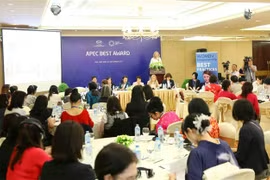
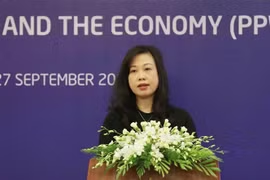
Joint efforts called to boost women’s leadership rate to 50 percent ảnh 2Vice President Dang Thi Ngoc Thinh (Photo: VNA)

The rate of women serving as business directors or owners inVietnam is estimated at 25 percent, and enterprises run by them play anincreasingly important role in the local economy.

According to the General Statistics Office of Vietnam, about1.2 million people of working age were unemployed in 2016, accounting for some2.3 percent of the workforce.  Theunemployment rate among women was higher than among men.

Vice President Thinh called on all people in the society,both men and women and in both the public and private sectors, to gain fullunderstanding of women’s capacity and role. They need to support women tocontribute to the national economy, the country and the whole society.

Each economy should build and perfect their legal system ongender equality so as to create a legal foundation and agencies forimplementing women empowerment measures. On that basis, businesses and economicorganisations can design strategies and support policies to encourage women’sengagement in economic, financial and social spheres, she said.

She also underscored that only women themselves can decidewhat they need to do to meet growing economic demand amid the changing world.“Women must always be aware of, accept and dare to overcome difficulties andchallenges to move forwards.”

In her address, LakshmiPuri, UN Assistant Secretary-General and Deputy Executive Director of UN-Women,urged the APEC member economies to do more to empower women and girls inevery way so that they realise their own potential, and the APEC membereconomies in turn should take full advantage of women power and the vastreservoir of capabilities they represent.
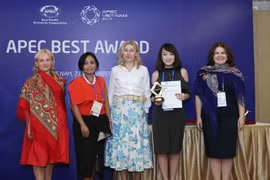
Joint efforts called to boost women’s leadership rate to 50 percent ảnh 3Lakshmi Puri, UN Assistant Secretary-General and Deputy Executive Director of UN-Women (Photo: VNA)

“Women’s economic empowerment is the right and smartinvestment and also an indispensable one,” she stressed, noting that it is atthe heart of the 2030 Agenda for Sustainable Development, which recognises thatwomen’s full and equal participation in the economy as a vital step towardachieving sustainable development.

APEC member economies individually and as a grand trade,investment, business and economic cooperation partnership must and is poised tocontribute vitally to a Planet 50-50 by 2030 and this is the determination thisforum should demonstrate and inspire.

She quoted Vietnam’s late President Ho Chi Minh as saying that: “With their heartfelt efforts, our women – bothyoung and old – have built and woven the country of Vietnam to make it evenmore beautiful”.

Lakshmi Puri added:“Women bring not only heartfeltefforts and poetic beauty for nation building but amazing productive capacityand talent for remarkable results for economic prosperity of countries, ofregions and the world. And they can do even greater when empowered and enabled!”

During the APEC public-private dialogue, participantsdiscussed women’s economic, financial and social inclusion, women entrepreneursin a changing global market, promotion of women’s entrepreneurship in thedigital age, and building of a vision for women’s economic empowerment forAsia-Pacific and beyond.
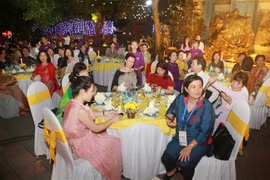
Joint efforts called to boost women’s leadership rate to 50 percent ảnh 4Delegates take photo at the event (Photo: VNA)

The event was also attended by theWorld Bank's Vice President for the East Asia and Pacific Region Victoria Kwakwa,Chairman of the Vietnam Chamber of Commerce and Industry Vu Tien Loc, and about600 delegates from APEC economies.

The APECpublic-private dialogue was part of the ongoing2017 APEC Women and the Economy Forum, themed “Enhancing women’s economicinclusion and empowerment in the changing world”, in Hue city. It was part of aseries of activities throughout the APEC Year 2017 in Vietnam.

Established in 1989, the 21-economyAPEC’s primary goal is to support sustainable economic growth andprosperity in the Asia-Pacific region.-VNA
VNA
See more

ASEAN Secretary-General Kao Kim Hourn announces the outcomes of the 49th ASEAN Summit and related meetings at the ASEAN headquarters in Jakarta, Indonesia, on November 18, 2026. (Photo: VNA)

49th ASEAN Summit highlights action-oriented regional cooperation

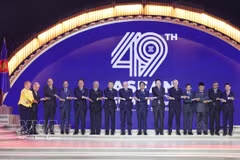
As 2026 marks the first year of implementing the ASEAN Community Vision 2045, leaders underlined the bloc's solidarity and centrality as well as closer coordination among the three community pillars in response to global economic uncertainties and security challenges, with priorities including digital transformation, AI application, energy security and supply chain resilience.

ASEAN Secretary-General Kao Kim Hourn (Photo: VNA)

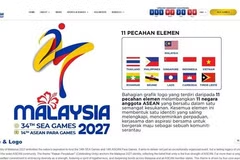
Growing together: 11 nations, one ASEAN home

The new emblem signals an ASEAN that is growing more inclusive while holding to its founding principles of building a peaceful, stable, dynamic region based on equality and cooperation. Its colours come from member states’ national emblems, reflecting diversity inside a single community.

An overview of the dialogue between ASEAN leaders and the ASEAN Business Advisory Council (ASEAN-BAC) in Manila on November 15 (Photo: VNA)

Vietnam puts forward priorities to advance ASEAN cooperation

Appreciating ASEAN-BAC’s report and recommendations, Deputy Minister of Foreign Affairs Dang Hoang Giang, head of Vietnam’s ASEAN Senior Officials’ Meeting (SOM) delegation, called for simplifying procedures, reducing costs, accelerating digitalisation, upgrading the ASEAN Single Window (ASW) and effectively implementing the ASEAN Digital Economy Framework Agreement (DEFA) to make the regional market more accessible.

ASEAN signs Digital Economy Framework Agreement

ASEAN signs Digital Economy Framework Agreement

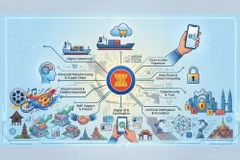
The Digital Economy Framework Agreement (DEFA), the bloc’s first standalone and legally binding digital economy agreement, establishes common rules covering digital trade, cross-border data flows, electronic payments, cyber security and artificial intelligence (AI).

Minister Counsellor Nguyen Hai Luu, Deputy Permanent Representative of Vietnam to the UN, speaks at the discussion on November 12, 2026. (Photo: VNA)

Vietnam supports peace, reconstruction efforts in Gaza: diplomat

Minister Counsellor Nguyen Hai Luu, Deputy Permanent Representative of Vietnam to the UN, expressed deep concern over the dire humanitarian situation in Gaza, particularly as recent heavy rains and flooding have worsened living conditions for residents.

Thailand diversifies oil sources to ensure energy security

Thailand diversifies oil sources to ensure energy security

Although the diversification of oil import sources has helped reduce the risk of domestic oil shortage, it has not immediately reduced energy costs because import prices depend on market mechanisms, transportation costs, foreign exchange rates and the terms of oil contracts.

ST Telemedia Global Data Centres (Thailand), an affiliate of Singapore Telecom, is developing three data cehtres in Thailand including this facility on Rama IX Road in Bangkok. (Photo: bangkokpost)

Thailand tightens regulations on data centres

The new rules focus on controlling investment scale, electricity and water consumption, environmental impacts, and preventing investors from reserving resource quotas beyond their actual needs.

A road is under construction in Dong Nai city, Vietnam. (Photo: VNA)

ADB: Southeast Asia needs 7.1 trillion USD in infrastructure investment by 2040

ADB estimates that the region will need an average of 476 billion USD in infrastructure investment annually during 2026–2040, equivalent to 8.7% of GDP. However, at current investment levels, government budget resources would cover only around 45% of this demand, leaving an annual financing gap of 264 billion USD.

Kyodo News publishes an article titled “Sculptures by Japanese, Vietnamese artists on display in Yokohama,” (Screenshot photo)

Japanese media widely cover top Vietnamese leader ’s visit

Japanese media have continued extensive coverage of General Secretary of the Communist Party of Vietnam (CPV) Central Committee and President To Lam’s activities in Japan, highlighting his meetings with representatives of leading financial institutions at the Tokyo Stock Exchange, witnessing of cooperation agreement signing and participation in cultural exchanges.