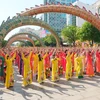
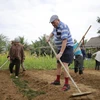
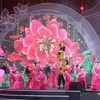
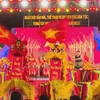
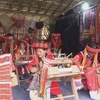
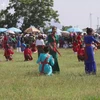
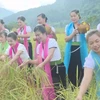
People offer incense at the grave of Lady Thu Bon during the festival. (Photo: VietnamPlus)
 Hanoi (VNA) – The Lady Thu Bon Festival bears the imprint of local religious life, expressing the desire for prosperity and praying for a bountiful harvest, favourable weather, and peace for the village.
From the 10th to the 12th day of the second lunar month, villagers in the upper reaches of Thu Bon River in Nong Son district and the lower reaches in Duy Son district of the central province of Quang Nam hold the festival simultaneously.
The festival has been observed for generations. It began in ancient times, when Vietnamese people in the Thanh Nghe region of Dai Viet set foot on a new land in the 14th century (Dai Viet means Great Viet, the former name of Vietnam from 1054 to 1400 and 1428 to 1804).
The Vietnamese community that resides along the Thu Bon River in Quang Nam celebrate the Lady Thu Bon Worshipping under the influence of Champa culture. This is reflected in the fact that the water procession originates from the Cham culture in Vietnam.
Riverside villages of Thu Bon, Phuong Ranh, Dai Buong and Trung Phuoc in the two districts of Duy Xuyen and Nong Son of Quang Nam all celebrate the festival. The most prominent festival is the one that takes place in Thu Bon village of Duy Tan commune, Duy Xuyen district. It is home to the largest place of worship and the birthplace of the legend.
Various editions of the legend
The legend of Lady Thu Bon is told in many different ways, resulting in various versions in the modern-day lexicon. Some versions describe her as a beautiful princess of King May. Still others say she is a majestic Cham female general, or a Vietnamese female general under the Le dynasty.
In all of these legends, whether she is a princess or female general, a Vietnamese or Cham person, the common thread is that she died in battle. Her body then floated on Thu Bon River and was buried by the people there. Since then, she has been worshipped by locals and has appeared to help in times of tribulation, natural disasters, epidemics and poverty.
Another legend suggests that in the past, Thu Bon village had a wealthy family that had a beautiful daughter with long hair. However, she did not cry but smiled when she was born. When she was five years old, the girl was able to treat people inflicted with different diseases.
As she grew up, she became more and more beautiful. But she refused to get married, instead devoting her life to saving people. She treated diseases with effective surgical and herbal methods, curing many people suffering from incurable diseases. She took no credit for saving lives. At the age of 50, she was honoured as a saviour.
There are many legends of Lady Thu Bon, but all of them depict the beauty of a multi-talented and virtuous woman who is a symbol of the country's desire for health and peace.
Her burial ceremony was held in accordance with the instruction that only flowers and leaves are used as she was ceremoniously laid to rest at the communal house of Thu Bon village. The ceremony lasted for seven days and seven nights. On one evening during the week-long ceremony, locals smelled the fragrance of plumeria flowers in the village. The coffin lid was opened, and the inside was filled with a variety of white plumeria flowers. No one knows what happened to her corpse and the leaves and flowers that were used for the burial ceremony.
Ever since then, when drought and floods occurred, or local people suffered from hunger and poverty, the Goddess would help crops recover. Local people built a large place of worship to honour her. The yard here features many plumeria and banyan trees and a grand ceremony is organized annually to pay tribute.
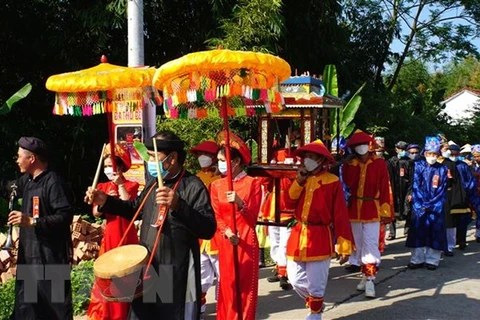
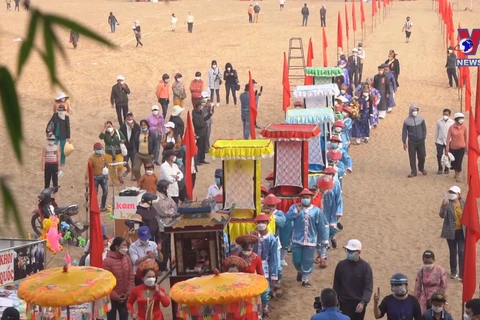
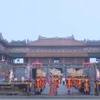
 The organising committee of the traditional Lady Thu Bon festival 2022 re-enacted a procession for King Minh Mang’s decree which honours the Goddess to her burial site.
(Photo: VietnamPlus)
The procession in the festival is held in two parts, with the first one being held in the afternoon and the second one in the early morning of the next day. The parade starts at the upper reaches of Thu Bon River and proceeds to the Goddess’s place of worship.
Singing and sporting events such as boat racing, football and volleyball are also part of the festival. The deeply entrenched societal beliefs that the festival represents are inherent in the fact that the festival is now recognised as a national intangible cultural heritage of Vietnam (March 2022)./.
 Local people cook up a dish from fish caught from Thu Bon river to serve festival-goers. (Photo: VietnamPlus)