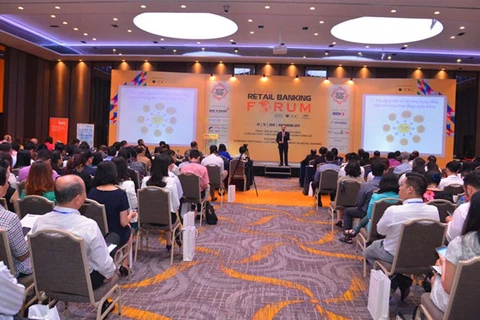
Legal framework on data management in need to boost digital economy

A workshop on Cross-border Data Flows took place in Hanoi on May 3 to discuss the importance of data access and sharing and the need to develop a legal framework on data management to boost the growth of digital economy.
Legal framework on data management in need to boost digital economy ảnh 1A workshop on Cross-border Data Flows took place in Hanoi on May 3. (Photo: VNA)

Hanoi (VNA) – A workshop onCross-border Data Flows took place in Hanoi on May 3 to discuss the importanceof data access and sharing and the need to develop a legal framework on datamanagement to boost the growth of digital economy.

The event was co-held by the CentralInstitute for Economic Management (CIEM) and the Asia Cloud ComputingAssociation (ACCA).

Delegates talked about the prospects ofVietnam’s economy in the fourth Industrial Revolution (Industry 4.0) and thedevelopment of digital platforms for e-commerce, e-services and infrastructurefor cyber-security. They also outlined Vietnam’s opportunities and challengesin effectively forming a management system of new digital tools in business.

Speaking at the event, ACCA ExecutiveDirector Lim May Ann announced a report on “Cross-Border Data Flows: A Reviewof the Regulatory Enablers, Blockers, and Key Sectoral Opportunities in FiveAsian Economies: India, Indonesia, Japan, the Philippines and Vietnam.” Thereport provides an overview of the current policies on data management in thesenations and their impacts on the economic growth at large and the developmentof small- and medium-size enterprises.

It takes an investigative look at theway the five Asian economies are aggressively transitioning to more digitallyenabled economies. While there are similarities in the drivers of thesetransitions, there are also significant differences in the approaches being adopted.

The Philippines, for example, has noexplicit “digital economy” policy, whereas India has become “Digital India” andJapan is striving to be the “World’s Most Advanced IT Nation.” Conversely, thePhilippines has no explicit cross-border data flow restrictions and was thefirst Southeast Asian country to formally adopt a “Cloud First” approach.

Vietnam today is among countries withhigh numbers of Internet users, estimated to account for over 50 percent of thepopulation; and the Internet access rates in the country are on a par withothers in the region, said former Standing Deputy Minister of Post andTelecommunications Mai Liem Truc. These have significant impacts on thecountry’s digital economy, he noted.

According to the ACCA, Vietnam holdshuge potentials to expand the digital economy but the country’s legalenvironment for cross-border data flows is not as open as compared to otherfour nations. The ACCA cited a number of provisions of the Law on NetworkInformation and Security, which require cooperation with the government andfacilitate State agencies in carrying out “technical measures” when necessary,which imply allowing the Government to access encrypted information that couldundermine users and personal privacy in Vietnam.

Secondly, Decree 72/2013/ND-CP onManagement, Provision and Use of Internet Services and Online Informationrequires IT companies to establish at least one server inside the country to “servethe inspection, storage, and provision of information at the request ofcompetent state management agencies”. At the same time, CircularNo.38/2016/TT-BTTTT, one of the documents guiding the implementation of Decree72, also contains detailed regulations on the cross-border provision of publicinformation. Certain providers of such content are required to implementcontent restrictions related to national and social security.

Thirdly, the country has got tougher ontaxation of the digital economy with stricter regulations for taxing incomederived from Vietnam by digital companies from social media, accommodation andride sharing sectors.

Lim May Ann suggested that theGovernment of Vietnam should adopt a more cautious approach to ensure thatbuilding a safe cyber environment does not inadvertently restrict and hamperthe potential of the digital economy and the entire economy at large.-VNA
VNA
See more

At a port in Ho Chi Minh City (Photo: VNA)

Multi-channel capital mobilisation needed to achieve double-digit growth

The Ministry of Finance estimates development investment for 2026-2030 at a minimum of 38.5 quadrillion VND (1.48 trillion USD), or about 40% of GDP. The state budget is expected to provide only about 20%, or more than 7.7 quadrillion VND, leaving over 80%, or more than 30 quadrillion VND, to be raised from the broader economy. That makes expanding capital mobilisation channels beyond bank credit essential.

An aerial view of the Nhieu Loc – Thi Nghe area in Ho Chi Minh City. The southern metropolis is home to the Vietnam International Financial Centre. (Photo: VNA)

Vietnam International Financial Centre launches membership registration system

Integrated into the official Vietnam International Financial Centre portal at vifc.gov.vn, the online system for registering and recognising members provides a unified online service channel through which investors, organisations and businesses can complete procedures related to membership, from new registration and recognition to information updates and termination of membership.

At a tax office in Hung Yen province (Photo: VNA)

Finance ministry moves to cut business costs, spur growth

Tax policy is among the solutions with the most direct impact on companies. Rather than prioritising near-term revenue collection, fiscal policy is being run to help them preserve cash flow, expand production and build more sustainable revenue sources.

In the Kim Long Motor Hue factory (Photo: VNA)

Hue courts capital to turn industrial zones into growth engine

The economic and industrial zones in Hue city host more than 200 active investment projects worth over 152 trillion VND (5.84 billion USD), with 139 already operational. Since the start of 2026, they have generated about 32 trillion VND, contributed 4.2 trillion VND to the state budget and brought in 730 million USD in exports, while employing more than 46,000 workers.

An overview of a meeting between Politburo member and Secretary of the Hanoi Party Committee Tran Duc Thang and representatives of Saint Petersburg businesses. (Photo: VNA)

Saint Petersburg’s metro expertise valuable for Vietnam

As Hanoi implements its master plan with a 100-year vision, in which metro lines are identified as the backbone of the capital city’s transport network, Secretary of the municipal Party Committee Tran Duc Thang met with representatives from several Saint Petersburg companies specialising in urban rail development.

An art performance at 2026 Dak Lak Durian Festival. (Photo: VNA)

Dak Lak Durian Festival seeks to elevate Vietnam’s agricultural brand globally

Dak Lak has about 41,000ha of durian, with this year’s output estimated at nearly 500,000 tonnes. The province has 280 growing-area codes covering around 7,500ha, along with 41 packing facilities approved for export. In 2025, Dak Lak’s durian sector contributed about 1.1 billion USD to the country’s export turnover.

Delegates cut the ribbon to inaugurate the Ho Chi Minh City-Shenzhen direct air route. Photo: baodautu.vn

Vietravel Airlines launches direct Ho Chi Minh City-Shenzhen route

Vietravel Airlines' new route connects Tan Son Nhat International Airport (SGN) in Ho Chi Minh City with Shenzhen Bao'an International Airport (SZX), meeting growing demand for travel between the two markets for investment, trade, tourism and visiting relatives.

Thanks to digital transformation among local officials, Tam Dao commune of Phu Tho province has achieved an almost 100% on-time rate for processing administrative applications, helping improve public services for residents. (Photo: VNA)

Institutional reform fuels private sector's growth in Phu Tho province

The private sector is increasingly emerging as a key growth engine of the economy. To unleash its potential and ensure sustainable development, the northern province of Phu Tho is stepping up institutional and administrative reforms to cut costs, shorten procedures, and build a more transparent, business-friendly investment climate.