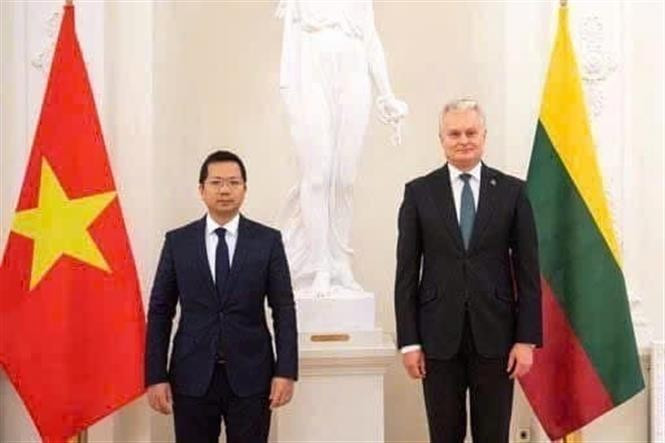
Lithuanian President’s Vietnam visit expected to open new chapter in bilateral ties: Ambassador

With the foundation of solid friendship, political goodwill from both sides and the need for mutual development, Vietnam - Lithuania relations will continue to flourish strongly, substantially and comprehensively in the coming time.

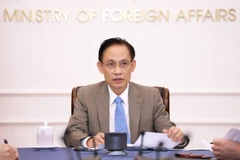
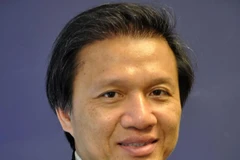
Vietnamese Ambassador to Poland and Lithuania Ha Hoang Hai (left). (Photo: published VNA)

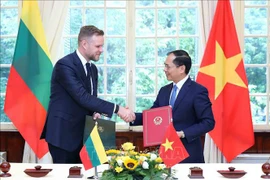
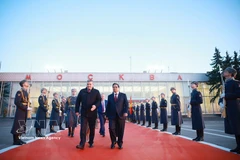
Hanoi (VNA) – The official visit to Vietnam by Lithuanian President Gitanas Nauseda and his spouse from June 11-12 will open a new chapter in the bilateral relations in a rapidly changing international context with many intertwisted opportunities and challenges, Vietnamese Ambassador to Poland and Lithuania Ha Hoang Hai has said.

Speaking to the Vietnam News Agency (VNA)'s correspondent ahead the visit, Hai said this is the first high-level visit by a Lithuanian head of state to Vietnam in many years, demonstrating the two countries' appreciation for the traditional friendship and multifaceted cooperation between Vietnam and Lithuania.

The ambassador described the Vietnam-Lithuania relationship as a traditional friendship built and nurtured over the past three decades, since the two countries officially established diplomatic relations on March 18, 1992. The outstanding characteristics of this relationship are political trust, goodwill for cooperation and high complementarity between the two economies despite differences in scale and geography.

Vietnam always considers Lithuania a sincere friend and partner in the Central Eastern European region, while Lithuania highly appreciates Vietnam's increasing role in Southeast Asia and in the Association of Southeast Asian Nations (ASEAN).

The two countries share many similarities in their visions of sustainable development, international integration, digital transformation and adaptation to global challenges such as climate change, energy security or supply chains.

In terms of politics and diplomacy, Vietnam and Lithuania have maintained coordination at multilateral forums such as the United Nations, the Asia-Europe Meeting (ASEM) and ASEAN-European Union. Lithuania always supports important agreements between Vietnam and the EU such as the EU - Vietnam Free Trade Agreement (EVFTA) and the EU - Vietnam Investment Protection Agreement (EVIPA), creating an important legal and commercial foundation for expanding economic and investment cooperation between the two sides.

In addition, the Vietnamese community in Lithuania, although not large in number, has always integrated well, preserved its cultural identity and made positive contributions to the local society. This is a lively and effective bridge of friendship between the people of the two countries, contributing to enhancing mutual understanding and deepening the bilateral relations.

The focuses of the visit will be talks and meetings between President Nauseda and leaders of the Party, State, Government and National Assembly of Vietnam. This is an opportunity for the two sides to assess the overall bilateral relationship, exchange strategic visions on regional and international issues of mutual concern, and propose new cooperation orientations in line with the development conditions of the two countries in the coming period.

The visit is expected to witness the signing of a number of cooperation documents in potential areas such as trade - investment, education - training, high-tech agriculture, healthcare, clean energy and digital transformation. In addition, investment promotion activities, a business forum and community connections between the two sides will also be organised to create practical conditions for more substantial and sustainable economic - trade cooperation.

Hai believed that the visit will contribute to strengthening political trust and promoting strategic connectivity between Vietnam and Lithuania, especially within the framework of ASEAN - EU cooperation.

The two countries have all the conditions to develop a more substantive, effective and comprehensive partnership, on the basis of complementary interests, mutual respect and the goal of sustainable development, the diplomat said.

Regarding potential for further cooperation, Hai said that Vietnam and Lithuania have many promising areas of cooperation, especially when the two economies are highly complementary and are both moving towards sustainable development models, green transition and digital transformation.

According to the ambassador, the two nations can boost partnerships in the fields of economy - trade - investment, digital transformation, innovation, financial technology, education – training, science and technology, high-tech agriculture, healthcare - pharmaceuticals, environmental protection, tourism - culture and high-quality labour. These areas not only bring economic efficiency but also contribute to enriching the foundation of people-to-people exchanges, and enhancing mutual understanding and connection between the two nations.

With the foundation of solid friendship, political goodwill from both sides and the need for mutual development, Vietnam - Lithuania relations will continue to flourish strongly, substantially and comprehensively in the coming time, he emphasised./.

VNA

See more

All members of the NA Standing Committee present at the session vote in favour of resolutions on administrative unit standards and urban classification. (Photo: VNA)

Resolutions on urban classification and administrative unit standards approved

The draft resolution streamlines urban classification around three key areas - role and socio-economic conditions, urbanisation level, and infrastructure development. It also integrates green, smart, climate-resilient, and digital transformation requirements, while promoting decentralisation in urban management.

Prime Minister Pham Minh speaks at the working session. (Photo: VNA)

PM requests development of modern, hi-tech, dual-use defence industry

In 2026, the entire military must focus on building a revolutionary, regular, elite, and modern force; strictly implementing the Party Central Committee’s directives on Party building and rectification; flexibly, substantively, and effectively conducting defence diplomacy; and promoting self-reliance and resilience in the defence industry, logistics, and technical operations.

☕ Afternoon briefing on December 24

☕ Afternoon briefing on December 24

Outstanding domestic and international events of 2025 selected by the VNA, the Christmas atmosphere in Vietnam, and a seminar aimed at exploring cooperation opportunities between Vietnam and Russia in the digital era are among news highlights on December 24.

The closing of the 13th Party Central Committee's 15th plenum on December 23 (Photo: VNA)

📝OP-ED: Party Congress personnel: No room for rumours!

As Vietnam stands on the threshold of a promising new development phase brimming with opportunities and high expectations, staying alert to fake news, rumours, and baseless accusations is not merely a voice of rationality but a civic duty towards the nation’s future.

☀️ Morning digest on December 24

☀️ Morning digest on December 24

The PM's demand for coordinated efforts to repair infrastructure and restore livelihoods following storms and floods in the central region; the establishment of the Central Steering Committee for People’s Air Defence; and the phone talks between the Vietnamese and French foreign ministers are among news highlights on December 23 evening.

Deputy Chief of the General Staff of the Vietnam People’s Army Sen. Lieut. Gen Phung Sy Tan presents a souvenir to Gen. Phorn Nara, Secretary General of the National Authority for the Prohibition of Chemical, Nuclear, Biological and Radiological Weapons of Cambodia (CBRNE) in Hanoi on December 23 (Photo: qdnd.vn)

Military official hosts Cambodian chemical weapons authority chief

The success of the second Vietnam - Cambodia border defence friendship exchange in November has contributed to the practical and effective cooperation among the two countries’ armies, local authorities, and border communities, for a borderline of peace, friendship, stability, cooperation, and development.

Vietnamese Minister of Foreign Affairs Le Hoai Trung at the phone talks with French Minister for Europe and Foreign Affairs Jean-Noël Barrot on December 23 (Photo: VNA)

Vietnamese, French foreign ministers hold phone talks

France wishes to increase cooperation with Vietnam in such strategic sectors as energy, transport, and aerospace, while continuing to work closely with Vietnam to promote multilateralism and tackle global challenges, said French Minister for Europe and Foreign Affairs Jean-Noël Barrot.

Party General Secretary To Lam delivers remarks at the closing session of the 15th plenum of the 13th Party Central Committee in Hanoi on December 23 (Photo: VNA)

Announcement on 15th plenum of 13th Party Central Committee

The 15th plenum of the 13th Party Central Committee was held in Hanoi from December 22 to 23. The Party Central Committee agreed to adopt the report of the 13th Party Central Committee to be submitted to the 14th National Party Congress on personnel for the 14th Party Central Committee.

An overview of the closing session of the 15th plenum of the 13th Party Central Committee on the morning of December 23. (Photo: VNA)

Party Central Committee’s 15th plenum wraps up

The implementation of the 1991 Party Platform and its revised and supplemented version in 2011 has reaffirmed the correctness, creativity, and appropriateness of the Party’s "Doi moi" (renewal) path, as well as the inevitability of Vietnam’s socialist-oriented development, which is in line with national realities and global trends, said the Party leader.

The Vesak Day 2025 Celebration in Hue city (Photo: VNA)

📝OP-ED: “Freedom of Religion” not subject to politicisation

It is not difficult to recognise the report’s outdated tone, built on unsubstantiated arguments, entrenched prejudice, and imposed interpretations regarding the freedom of religion in Vietnam. This is also not the first time the organisation’s conclusions have exposed clear shortcomings in objectivity and methodology, raising questions about political motivations behind what is presented as a human rights assessment.