Love market passionate legend of Ha Giang Karst Plateau

Khau Vai love market, also known as Phong Luu market, is held annually in the karst plateau on the 27th day of the third lunar month. For more than a century, it has conserved cultural and traditional values of ethnic groups in the northern mountainous province of Ha Giang.
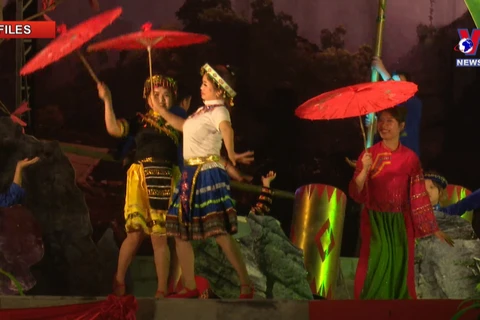
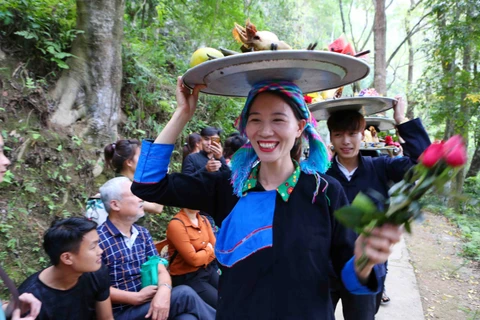
Love market passionate legend of Ha Giang Karst Plateau ảnh 1Adolescents go to Khau Vai (Phong Luu) love market. (Photo: VNA)

Hanoi (VNA) - Khau Vai love market, also known as Phong Luu market, is held annually in the karst plateau on the 27th day of the third lunar month. For more than a century, it has conserved cultural and traditional values of ethnic groups in the northern mountainous province of Ha Giang.

The origin of Khau Vai love market

The market originates from a legend featuring a young man named Ba of Nung ethnic group and a young woman named Ut of Giay group. They were so in love but neither belonged to the same ethnic group nor had similar customs. In addition, Ba came from a poor family while Ut was the daughter of the head of the clan. Their love was forbidden as a result of the mismatch in familial background.

They fled to Khau Vai mountain, aiming to settle there.

However, their families began attacking each other in disagreement.

Knowing the situation, they could not help but break up and return to their respective families so as to fulfil their responsibilities. They promised to see each other each year in Khau Vai for just one day, which was the 27th day of the third lunar month to ease their longing for each other. After that one day, they would return to their daily lives. 

Near the end of their lives, the couple came to the place and passed away together in each other’s embrace. This date marks their fateful reunion, and also the last day of their lives.

Afterwards, villagers set up shrines dedicated to those two to honour their love. They also chose the date to hold a meeting place for lovers who could not be together.

The ‘market’ is to help former lovers who parted due to various reasons, to meet and talk to each other after years or separation.

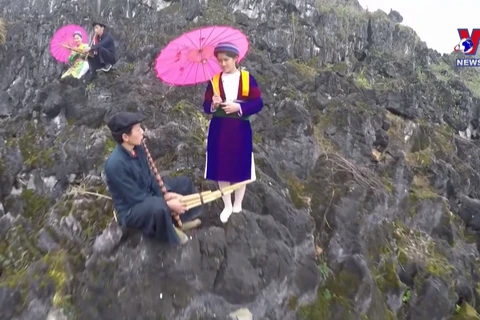
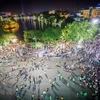
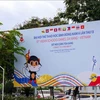
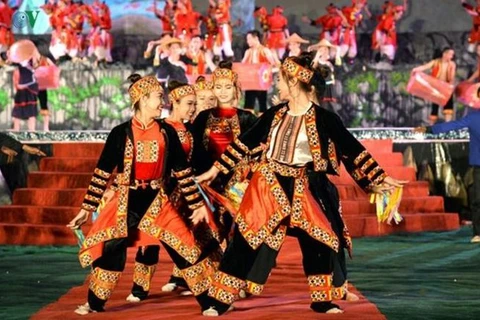
Love market passionate legend of Ha Giang Karst Plateau ảnh 2People come to Khau Vai market. (Photo: VNA)

Local people believe that those unsuccessful love stories form part of each person’s past. Spouses respect their partners’ past and spiritual lives.

As it honours pure love, Khau Vai market is now viewed as a festival and tourism product of sorts that can attract visitors to take in the lore.

On the 27th day of the third lunar month each year, ethnic people will wear their best clothes to Khau Vai market.

A ritual will be held to honour the ancestors who were village founders, as well as faithful love. The village elders typically host the event and ritual proceedings.

Musical performances, folk games and a beauty pageant will also be held, together with booths showcasing handicraft products and specialties of Ha Giang province so that visitors can buy them as souvenirs after their trips.

National intangible cultural heritage

Vice Chairman of the Ha Giang People’s Committee Tran Duc Quy said that Khau Vai market conserves traditional cultural values and at the same time honours pure and true love, thereby contributing to maintaining moral and virtues.

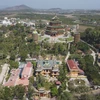
Love market passionate legend of Ha Giang Karst Plateau ảnh 3Young people travel to Tu San canyon, which is viewed as among the most spectacular tourist destinations in Dong Van Karst Plateau in Ha Giang province. (Photo: VNA)

The Ministry of Culture, Sports and Tourism recently issued Decision No. 1952/QD-BVHTTDL on listing Khau Vai market in the commune of the same name in Meo Vac district, Ha Giang province as a national intangible cultural heritage.

After two years of suspension due to the COVID-19 pandemic, the festival is set to take place on April 25-27 (from the 25th to 27th days of the third lunar month) in Meo Vac district, themed ‘Market of Love Songs’.

The opening ceremony and an event to receive the title of national intangible cultural heritage will be held on April 26 evening. 

Cultural exchange and musical activities at the event include panoply of dances to the sound of bronze drums, traditional instruments and others of numerous ethnic groups in the locality such as Mong, Nung, Giay, and Lo Lo.

During the three-day event, visitors may pay a visit to stalls introducing local specialties and typical dishes of Ha Giang province. They may also take part in a series of sightseeing activities to fields of buckwheat flower, Ma Pi Leng trekking route, a culture-tourism community village of Mong ethnic people in Pa Vi Ha hamlet, a boat tour on Nho Que 1 reservoir, among many other sites to see.

Deputy Director of the Ha Giang Department of Culture, Sports and Tourism Trieu Thi Tinh affirmed that the re-enactment of the event at the provincial level aims to create a highlight for Ha Giang tourism. The event contributes to current efforts made to help the sector recover once the COVID-19 pandemic in the province is brought under control./.
VNA

See more

An Ao Dai show held in Prague, the Czech Republic, in May 2026 (Photo: VNA)

Vietnam culture, cuisine showcased in Czech Republic

The festival featured more than 20 booths offering traditional Vietnamese dishes, including "pho" and spring rolls, alongside activities promoting Ao Dai (Vietnamese traditonal long dress). One of the highlights was the presentation of complimentary Ao Dai to Czech residents and international visitors.

The Nguyen Dynasty (1802-1945) imperial throne, a recognised national treasure of Vietnam, officially returns to public display at Thai Hoa Palace in Hue Imperial Citadel on June 4 (Photo: VNA)

Nguyen Dynasty throne returns to Hue Imperial Citadel after restoration

The throne has been reinstated at its original central position inside Thai Hoa Palace, the ceremonial heart of the former imperial court. Its return has attracted significant interest from visitors and heritage enthusiasts eager to see one of Vietnam’s most important royal artefacts back on display.

People join the “Ho Van Lantern Festival Night” programme at the special national relic site of the Van Mieu–Quoc Tu Giam (Temple of Literature) in Hanoi. (Photo: VNA)

Night-time economy drives growth of Hanoi’s cultural industries

Under the Politburo’s Resolution No. 80-NQ/TW on the development of Vietnamese culture, Hanoi has been given fresh opportunities to leverage its cultural, historical, tourism and creative assets. The city’s recently approved project on developing the night-time economy for 2026–2030, with a vision to 2045, is expected to create momentum for cultural industry growth while enhancing Hanoi’s standing as a creative and modern city with a distinctive identity.

Efforts made to preserve, promote values of Non Nuoc Cao Bang Global Geopark

Efforts made to preserve, promote values of Non Nuoc Cao Bang Global Geopark

First recognised by UNESCO on April 12, 2018, the Non Nuoc Cao Bang Global Geopark in the northern province of Cao Bang is a land shaped by more than 500 million years of geological history. Covering over 3,683 sq.km and encompassing all or part of 36 communes and wards, the geopark is home to numerous scenic landscapes, as well as historical and cultural sites of exceptional value.

Scenic views of Da Nang featured in the film "Love in Vietnam" (Photo: VNA)

Da Nang Asian Film Festival 2026 set to launch with expanded international focus

Through this coordinated effort, Da Nang aims to establish DANAFF not only as an annual film event but also as a distinctive cultural landmark, helping position the city as a reputable destination for regional film and cultural events and enhancing its international profile, Vice Chairwoman of the municipal People’s Committee Nguyen Thi Anh Thi, said.

Co Bo Temple in Thanh Hoa province (Photo: nhandan.vn)

Thanh Hoa taps spiritual heritage to boost cultural tourism

Experts have called for stronger implementation of heritage management regulations under the Cultural Heritage Law, clearer responsibilities for site management boards and stricter action against activities that distort cultural traditions.

Ambassador Do Hung Viet, Vietnam's Permanent Representative to the United Nations, and his spouse introduce Vietnamese dishes to visitors at the 2026 UN International Bazaar in New York on June 3. (Photo: VNA)

Vietnam leaves strong impression at 2026 UN International Bazaar

A wide range of traditional handicrafts reflecting Vietnam’s rich cultural heritage, including ceramics, lacquerware, silk products, brocade textiles and other items, attracted considerable attention from visitors. Many products sold out early in the day.

Former political prisoner Le Tu Cam is moved as she views a portrait of herself, digitally restored from archival photographs and crafted from lotus leaves, on display at the Con Dao Museum. (Photo: VNA)

Digital innovation breathes new life into Vietnam’s museums

Technology is similarly enriching exhibitions at the Vietnam Women’s Museum in Hanoi. Wartime letters, a typewriter and other artefacts linked to former Vice President Nguyen Thi Binh have been digitally integrated with collections held at the War Remnants Museum in Ho Chi Minh City. Through projection mapping, 3D displays and a virtual reality recreation of the Paris Peace Agreement, visitors can engage more deeply with the life and achievements of one of Vietnam’s most prominent diplomats.

At the award ceremony of the Da Nang Asian Film Festival 2025. (Photo: VNA)

Da Nang Asian Film Festival 2026: Bridging Asia and the world

The festival is expected to bring together around 900 artists, producers and film professionals from Vietnam and abroad, including more than 200 international guests. This marks the largest edition since DANAFF was first launched in 2023, highlighting its growing appeal within the film industry.