Ly Son Island looks to economic development through tourism

Ly Son island district, 30km off the coast of central Quang Ngai province, will give prioirity to tourism when allocating resources for socio-economic development, said Dang Tan Thanh, Vice Chairman of the Ly Son People’s Committee in an interview with the Vietnam News Agency.
Ly Son Island looks to economic development through tourism ảnh 1Parachutes fly over the top of Ly Son volcano (Photo: VNA)

Hanoi (VNA) - Ly Son island district, 30km off the coast of central Quang Ngai province, will give prioirity to tourism when allocating resources for socio-economic development, said Dang Tan Thanh, Vice Chairman of the Ly Son People’s Committee in an interview with the Vietnam News Agency.

According to Thanh, the local economic structure is shifting towards sustainability and a larger proportion of the trade - service sector. The tourism sector has been earmarked for breakthrough development, becoming a key economic sector in Ly Son.

The district has targeted to raise the share of the tourism-service sector in the local economy to 60%, while agriculture will account for 30-35%, and industry-handicraft the remaining 5-10%. The authorities plan to focus on completing the district's development master plan, which will serve as the basis to attract investment over the next five years.

To this end, the locality has built a new central market, and developed diverse and affordable homestay network, dining, and transport services meeting the demand of both locals and tourists to the island.

It is now making efforts to tap its tourism potential by conserving local relics, creating spiritual tourism products, promoting historical and scenic sites as well as protecting the environment with the construction of a waste treatment plant.

Ly Son Island looks to economic development through tourism ảnh 2A corner of Ly Son (Photo: VNA)

Ly Son Islands, which were naturally formed over millions of years, are an outpost of the country’s defence and security in the East Sea. They have cemented the country’s sovereignty on the sea and islands including Truong Sa (Spratly) and Hoang Sa (Paracel) archipelagos.

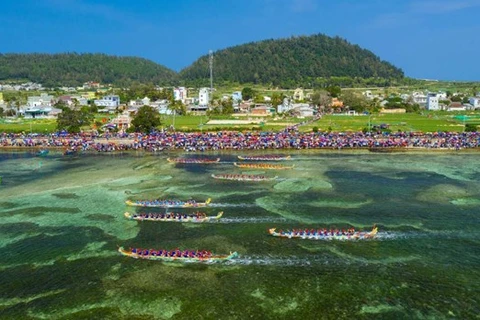
The islands still hold the annual “Le khao le the linh Hoang Sa” (Feast and Commemoration Festival for Hoang Sa Soldiers), recognised as an intangible cultural heritage, that has been observed for hundreds of years by local fishing families.

The festival pays tribute to local men who enlisted in the Hoang Sa Flotilla. This group was organised to patrol the Hoang Sa and Truong Sa archipelagos in order to mine resources and defend the nation's sovereignty over the territorial waters.

Centuries-old houses are still preserved on the islands, as is Am Linh Pagoda, built to worship the souls of sailors who died during long, regular patrols of Hoang Sa and Truong Sa islands in the Nguyen Dynasty (in the 17th century)./.

VNA

See more

At Thung Nham ecological tourism site in Ninh Binh province. (Photo: VNA)

Vietnam’s tourism defies fuel price shock with record Q1 “hat-trick”

According to data released by the National Statistics Office, foreign arrivals in March reached nearly 2.1 million, up 1.3% year-on-year. In total, Vietnam welcomed an estimated 6.76 million foreign tourists in the first quarter, a more than 12% jump from the same period in 2025 and the highest Q1 figure ever recorded.

Visitors scan QR codes at Km0 Ha Giang to access tourism information. (Photo: VNA)

Technology powers tourism growth in mountainous province

Last year, Tuyen Quang welcomed over 3.9 million visitors, and is aiming to attract around 4.1 million arrivals, including around 600,000 foreigners, this year. Tourism continues to be identified as a key economic sector, with development oriented toward sustainability, green growth, and enhanced competitiveness through digitalisation.

Tourists enjoy a rickshaw tour of Hoi An Ancient Town, Da Nang city. (Photo: VNA)

ITE HCMC 2026 to promote Vietnam’s tourism on global map

With its large scale, the ITE HCMC 2026 aims to promote tourism cooperation between Vietnam and priority markets such as Northeast Asia, Western Europe, North America, Southeast Asia, and Oceania while also boosting visitor arrivals from the Indian market

The organisers of VITM 2026 honour sponsors. ( Photo: VNA)

VITM 2026 boosts tourism demand ahead of peak season

According to the organisers, around 4,500 representatives from Vietnamese and international tourism enterprises attended the event, generating more than 25,000 business meetings and partnership exchanges. Approximately 15,000 discounted tours and travel products were offered to visitors.

Traditional dragon procession held on the river in Ninh Binh. (Photo: VNA)

Cultural heritage drives sustainable tourism growth in Ninh Binh

In the first two months of 2026, Ninh Binh welcomed over 5.4 million visitors, up 9.9% year-on-year, generating nearly 5.84 trillion VND (221 million USD) in tourism revenue, up 15.9%. During the 2026 Lunar New Year holiday alone, the province received 2.38 million visitors, an 81.4% increase from the previous year, ranking second nationwide.

Outstanding individuals and firms honoured at VITM 2026 (Photo: VNA)

Outstanding individuals, firms honoured at Vietnam International Travel Mart 2026

In 2025, Vietnam’s tourism sector recorded its highest-ever number of visitors, welcoming more than 21.5 million international arrivals, up more than 20% from 2024, and serving over 135.5 million domestic travellers. Tourism revenue also surpassed 1 quadrillion VND (nearly 38 billion USD). The sector has become a bright spot of the economy, with Vietnam ranking among the world’s fastest-growing tourism destinations.

The Ba Trieu Temple in Thanh Hoa province (Photo: VNA)

Thanh Hoa taps digital transformation to boost heritage tourism

With 28 nationally-recognised intangible cultural heritage elements, Thanh Hoa province has prioritised integrating conservation with tourism development. Digital transformation, in particular, is seen as a crucial bridge connecting tradition with innovation, helping heritage sites become more accessible and engaging.

Pristine white-sand beach on Cu Lao Cham Island, Da Nang city, is a magnet for visitors. (Photo: VNA)

Vietnam – a safe destination amid global uncertainties

Despite global tourism headwinds linked to geopolitical conflicts, transport disruptions and surging travel expenses, Vietnam’s tourism sector has sustained strong growth, underscoring the destination’s resilience and rising international profile.

A border guard at the Mong Cai International Border Gate processes exit procedures for passengers at the Bac Luan 1 border gate in Quang Ninh province. (Photo: VNA)

Vietnam, China promote AI application in cross-border tourism cooperation

During the programme, participants will attend intensive courses delivered by AI technology experts, China–ASEAN policy researchers, and tourism specialists. The curriculum focuses on the application of big data in tourism policy planning, the development of cross-border tourism products, and the building of joint tourism brands.

The sea area off the southern coast of Phu Quoc Island. (Photo: VNA)

UK newspaper praises Phu Quoc’s unspoilt charm amid tourism boom

Phu Quoc is positioned as a compelling alternative – even a potential rival to Phuket – for travellers seeking authenticity in Southeast Asia. Its appeal lies not only in scenic beauty and fresh seafood, but also in the harmonious coexistence of modern tourism and enduring local culture.

At an elevation of 1,700 metres above sea level, the summit of Pu Luong is increasingly emerging as an ideal destination for trekking - a form of adventure tourism that combines hiking with nature exploration and physical as well as mental endurance. (Photo: VNA)

Vietnam eyes becoming region’s leading tourism destination

Vietnam has in recent years undergone a notable transformation in its tourism development strategy, placing a strong emphasis on nature-based and eco-tourism. This shift is not merely aligned with global trends, but represents a necessary step towards safeguarding valuable natural resources, while appealing to a growing segment of environmentally conscious travellers.