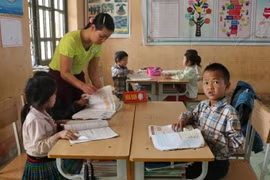
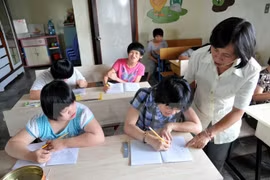
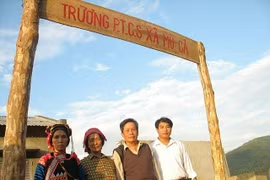
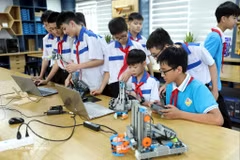
A class in Tri Le commune (Source: VNA)
Nghe An (VNA) - Since itsestablishment in 1982, no female teacher has worked at a primary school in thecentral province of Nghe An because the working conditions are very difficult.The dedication of male teachers saves the day, Minh Duc reports.
The Tri Le 4 Primary School is an educationalinstitution like no other in the country.
Thirty-five years since its establishment in thecentral province of Nghe An, it does not have single female teacher. To saythat this is highly unusual, especially for a primary school in a rural area,would be an understatement.
But the reason is very simple. The conditionsare too difficult for women to manage.
Located in Tri Le commune, the school has 44 maleteachers aged 24 to 60, who take turns teaching classes in six villages. Thevillage schools, are located near the residential areas of locals, mainlymembers of Mong ethnic group.
From the commune’s centre to the schools, theteachers have to ride around 40km on motorbikes, of which just 10km are paved.The rest of the way is a muddy path that comes very slippery on rainy days.They always go in group to help each other on the way.
On rainy days, they have to carry the bikes toovercome the slippery parts. It is normal that many slip and fall, despitebeing careful.
What is heartening and amazing is that despitethe hardships, the teachers encourage each other and continue teaching to theirbeloved students.
The Huoi Moi 2 School in the hamlet of the samename has perhaps the worst conditions in Tri Le commune. It has 60 studentsfrom the first to the fifth grade. Mong kids from 10 different mountainvillages, some located 10km away wake up at 4am and traverse mountain paths andwade through streams to get to school.
“The distance is not long, but it takes one tothree hours to reach, depending on the weather,” said Luong Ngoc Xuyen, amember of the Thai ethnic minority, who has taught at the school for fouryears.
Due to the extremely difficult road conditions,only physically fit male teachers can work here, although some female teachersare keen on the job.
Xuyen said even male teachers find it difficultto travel by motorbike to this school. “Our strength quickly fades. Sometimes Ifeel I’m not strong enough to steer the motorbike.
“My motorbike has to be repaired once or twice amonth. Many parts quickly wear out. Every two months, I have to change thetires, rims have to be replaced constantly.”
Actually, it has only been four years since theteachers are able to ride motorbikes to the Huoi Moi 2 School. Before, they hadto trek on a narrow path.
Here, there are no roads, no electricity, noInternet, no clean water. To make a phone call, the teachers must walk 3km up asteep hill to catch the signal. When it rains all weekend, the young teachersmust stay at school, taking turns picking vegetables, gathering bamboo shootsand forest banana stalks, and catching fish.
At night, they prepare for the next day’slessons in the light of an oil lamp.
Lang Van Nhan, headmaster of the Tri Le 4Primary School, said the teachers don’t just suffer poor living conditions,they are also emotionally deprived a lot of the time. They live far away fromhome. Some of them have actually chosen to remain single.
“The teachers can visit their families once ortwice a month if the weather is fine,” said Nhan. “In the rainy season, thecommune is isolated by floods and the road is totally unusable. Then they can’tgo home for several months.”
Nguyen Hong Hiep, 36, has taught at the primaryschool for 15 years. He admitted that there have been times he wanted to giveup because he missed his family and two children.
“I’m a teacher but I can’t teach my children anylessons. My wife and grandparents take care of them. Sometimes I feel sad andhomesick.”
However, the teachers also have harbour love andcompassion for the poor students in the remote area, and this is what helpsthem deal with all the obstacles. That, and their shared passion for teachingkeeps them going.
The men provide motherly care for the students,teaching them personal hygiene along side reading and writing.
“I teach the children from the first gradebecause I know both Vietnamese and the local ethnic languages, becausesometimes, the children can’t understand Vietnamese,” said Tho Ba Tru.
“Teaching them to speak, sing, read, and writeis quite difficult. They come in knowing nothing wearing ragged dirty clothes,and come to school with dirty hands and feet. We teach them how to dress neatlyand wash their hands and feet. When they first came to school, they played asif they were at home. They had no idea about learning.”
The teachers’ reward is increasing recognitionamong the parents of the importance of learning and giving the children an education.Before 2000, the number of students was very small, mostly boys. The parentsdidn’t think that girls also need to go to school.
Now, there are 145 students at the Huoi Moi 1School, evenly divided between boys and girls.
The fruits of their labour become even sweeterfor the teachers when students grow up, study further and return to the villageto teach younger generations.
The teachers’ devotion was formally recognizedand awarded this year at the VTV Awards 2017, an annual event organized byVietnam Television.-VNA
VNA