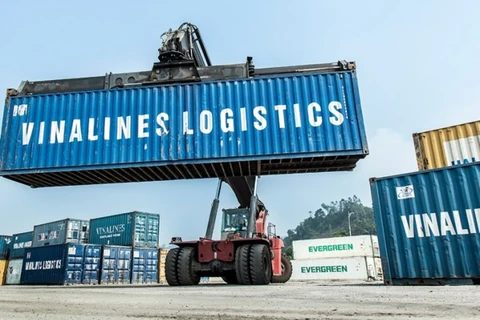
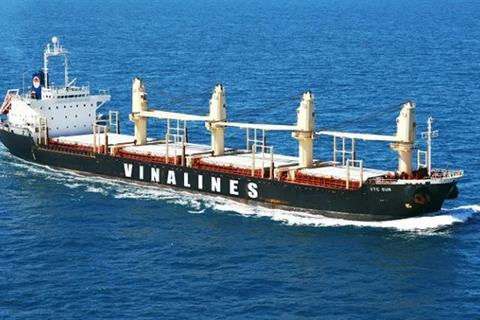
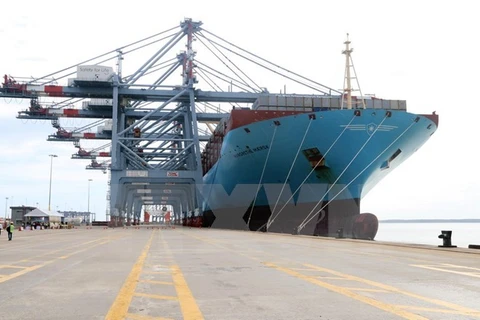
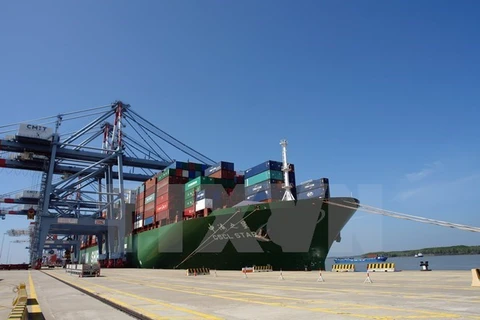
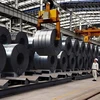
Many investors have shown their keen interest in the equitisation of the Vietnam National Shipping Lines (Vinalines) (Photo: baodautu.vn)
 Hanoi (VNA) – Many investors have shown their keen interest in the equitisation of the Vietnam National Shipping Lines (Vinalines) as the country’s biggest sea transport company plans to hold their initial public offering (IPO) in early September.
According to the firm’s equitisation plan approved by Prime Minister Nguyen Xuan Phuc on June 20, Vinalines has a chartered capital of more than 14.04 trillion VND (618.7 million USD) and over 1.4 billion shares worth 10,000 VND each.
It will sell 20 percent of its chartered capital, equivalent to 280.92 million shares at the IPO, and another 14.8 percent, or 207.89 million shares, to strategic investors through separate sales.
About 0.2 percent of the capital will be sold at preferential prices to Vinalines’ employees and trade union. The State will continue to hold 65 percent of the capital, equivalent to 912.99 million shares.
Acting General Director of Vinalines Nguyen Canh Tinh said many investors have shown their interest in the equitisation. Hyundai Motor of the Republic of Korea has sent an official letter to Vinalines, expressing its wish to participate in the equitisation. Meanwhile, Siam Cement of Thailand is interested in the partnership in operating seaports.
Vinalines’ plan to reduce its ownership in Hai Phong Port from 93 percent to 65 percent, and in Da Nang Port from 75 percent to 65 percent is also attracting investors, he said, adding that the State General Reserve Fund of Oman has hoped to become a strategic shareholder of Hai Phong Port for a long time, and it recently repeated this intention.
Tran Tuan Hai, head of Vinalines’ Development and Communication Strategy Division, said in 2017, his firm and Rent-A-Port NV – a port investment and management company of Belgium’s Ackermans & van Haaren – inked a memorandum of understanding on the possibility of cooperation with a grain terminal, processing area, and logistics system projects. This document also included a provision allowing Rent-A-Port NV to buy 10 percent of Vinalines’ chartered capital when the Vietnamese firm is equitised.
An official of the Ministry of Transport said with its business activities focusing on sea transportation, seaport operation, and maritime services, Vinalines welcomes financial investors and major maritime businesses to help it grasp trade opportunities and add to the growing flow of foreign direct investment into Vietnam.
At present, Vinalines operates 14 seaports nationwide and owns the largest area of maritime storages in Vietnam through nine associated companies and subsidiaries. It also owns a fleet of 84 vessels accounting for 25 percent of the total deadweight tonnage of the domestic sea transport market.
The firm said in recent years, it has been restructured successfully and cut down its debt from 9.1 trillion VND (equivalent to 400.8 million USD) in 2014 to 2.61 trillion VND (114.9 million USD) in 2017.
Last year, it posted 15.79 trillion VND (695.6 million USD) in consolidated revenue and 682 billion VND (30 million USD) in consolidated profit, up 7.8 percent and over 20 times from 2016, respectively. -VNA
VNA