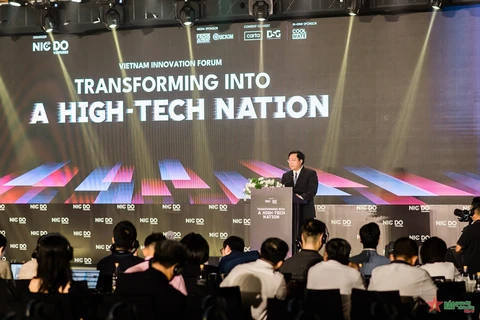
Hanoi (VNS/VNA) - Vietnam is developing a decree to promote innovative start-ups, with the aspiration of building an innovation-driven economy in line with digital transformation and sustainable development.
"Vietnam is one of the most vibrant start-up ecosystems in the region, with the birth of new-generation Vietnamese entrepreneurs and firms based heavily on sci-tech. However, much potential remains untapped due to the shortage of a proper legal framework," Deputy Minister of Science and Technology Hoang Minh, said.
According to the deputy minister there is a shortage of consistent definitions on start-ups and innovation support centres.
Besides this, start-up firms are regulated by the law on supporting small- and medium-sized enterprises (SMEs), causing a misunderstanding that start-ups are SMEs, resulting in inappropriate policy responses.
"Start-ups and SMEs differ in many things, such as development stages, business goals, risk tolerance, capital sources, development strategy and operation, thus requiring separate legal frameworks and policies," Minh said.
The development of a separate decree on innovation and innovative start-ups was underway, he said, adding that the decree would leverage the development of innovation and start-ups to a new height.
According to the Ministry of Science and Technology, Vietnam’s start-up ecosystem has witnessed two investment waves since the early 2000s, and underwent three development stages, with a record investment inflow of 1.4 billion USD in 2021.
The venture capital flow into Vietnam slowed to 634 million USD in 2022 and $529 million in 2023 due to the pandemic. However, the drop was not significant compared to the decrease of 35% in global venture capital in 2023.
The World Intellectual Property Organisation (WIPO) Global Innovation Index released in September last year showed that Vietnam jumped two spots to 46 out of 132 countries and territories in terms of innovation in 2023.
According to the 2024 Technology and Innovation Investment Report released at the Vietnam Innovation Forum 2024 in April, Vietnam maintained its third position in the number of investment deals and regained third place in terms of total investment in startups in Southeast Asia.
There are more than 3,000 start-ups in the country and more than 140 universities and research institutions with innovation-related activities.
The ministry said that after the funding winter caused by the pandemic, a focus had been placed on improving the legal framework to promote the development of innovation and innovative start-ups towards international integration.
It was also necessary to develop a legal framework for the operation of start-up support funds and form a transparent and safe startup environment to accelerate the development of such firms.
There are about 210 venture capital funds operating in Vietnam, nearly 40 of which are domestic, with a total charter capital of more than 100 billion VND.
Pham Tuan Hiep, director of BK Fund, said that there were limitations in the decree in terms of operation mechanisms and incentives, making it difficult for them to compete with foreign funds.
Innovation to national digital transformation
Decision No. 569/QD-TTg from 2022 covers science, technology and innovation development to 2030 as a top national policy, set to play a vital strategic role in the coming years.
Science, technology and innovation are the main driving forces to promote growth, and create breakthroughs in productivity, quality and efficiency, which will be decisive factors in improving national competitiveness amid the ongoing countrywide digital transformation.
According to Trinh Thi Huong, deputy director of the Department of Business Development under the Ministry of Planning and Investment, there are nearly 900,000 enterprises operating in Vietnam, and more than 90% are small and micro scale.
Huong believed that most Vietnamese firms are not ready for digital transformation and still face barriers in terms of implementing innovation and are not well aware of its crucial role in the wider economy.
Investment in R&D remained modest in the country, Huong said, pointing that such investment was estimated at 0.4% of GDP in 2023, compared to 1.3% in Thailand, 2.2% in Singapore, and 1% in Malaysia.
Vo Tri Thanh, director of the Institute for Brand and Competitiveness Strategy, said that innovation, digital transformation and green transition were vital.
"Hardly any other offers will come if Vietnam fails to take these opportunities," he said, stressing the importance of improving the legal framework.
Nguyen Thy Nga, director of the Institute for Policy Management and Development Strategy, said that the existing policies on digital transformation and innovation were fragmented with the involvement of many ministries and agencies while the links between such organisations remained weak.
"This makes it difficult and confusing for businesses to implement innovation activities in the context of digital transformation. There are abundant support policies, but enterprises do not know how to access such support,” she said.
According to Do Tien Thinh, deputy director of the National Innovation Centre, it is necessary to pilot mechanisms to accelerate innovation in important and emerging sectors such as carbon credit exchange.
Solutions to raise resources for innovation should be developed, such as a new legal framework for venture capital funds and crowdfunding.
"Support for innovation and start-ups should be integrated with domestic and international trends, such as emerging technologies, digital economy, personal information security, life balance, ageing populations, and environmental issues. The appropriate path regarding innovation should be chosen depending on the relevant national and local strengths," Thinh said./.