Measures to save Central Highlands from drought

The protection of forests in the Central Highlands from encroachment by hydro power plants, illegal deforestation and unplanned agricultural development would be the key to preserving water.
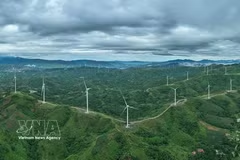
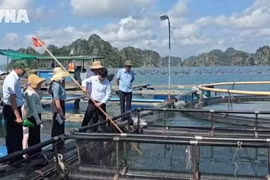
Measures to save Central Highlands from drought ảnh 1Illustrative photo (Source: VNA)


Gia Lai (VNA)
- Intensifying the protection of forests in the Central Highlands from encroachment by hydro power plants, illegal deforestation and unplanned agricultural development would be the key to preserving water in this drought hit region, experts have said.

Assoc. Prof. Le Anh Tuan, an advisor to Vietnam Rivers Network, said the main supply of natural water in the Central Highlands is rainwater due to its high topography.

“Water is abundant in the rainy season but a shortage of water occurs during the dry season. Forests are the only factor that could reserve water from the rainy season for the dry season naturally,” he said.

Originally, the region had the largest proportion of primary forest in the country; 31.9 percent of the country’s total area. However, the forested area in the region has dropped with an average loss of 51,200 hectares each year.

Construction of power plant dams and reservoirs on the region’s main rivers, unplanned plantations of industrial crops, and deforestation due to illegal migration have hastened the decrease of forest area over the decades.

The reclamations of forest land and overexploitation of water for development have reduced the proportion of water in the region. These plus climate change and the El Nino phenomena have resulted in severe droughts in 1983, 1988, 1993, 1998, 2003, 2004, 2005, 2010, 2013, 2015 and 2016.

This year’s drought is the worst in 20 years. A report released by the Ministry of Agriculture and Rural Development in April this year said a total of 160,000ha of plants were in critical shortage of water, creating an approximate economic loss of 100 billion VND (4.5 million USD) for each locality among Gia Lai, Kon Tum, Dac Nong, Dac Lak and Lam Dong.

The drought has dried up rivers, streams and underground water sources. According to Duong Ngoc Duc of the central government’s Steering Committee for the Central Highlands, 35 percent of rivers and 40 percent of streams in the region have dried up.

Duc added that reservoirs in the region were nearly empty as well.

Experts urged urgent and proper action to save water for the region as well as to adapt to the shortage of water due to the human causes and impacts from climate change and El Nino.

Duc and Dr Vu Tien Giang from Hanoi National University came up with a tighter water management policy and sharing mechanism between sectors and localities. Giang said a priority order is needed for the mechanism of sharing.

Tuan continued that power plants near the region’s Cat Tien, Ngoc Linh and Chu Yang Sin national parks, and Nhan Co and Tan Rai bauxite projects consume the most water in the region, so reconsidering these development projects is an urgent request.

He and Dr Ho Minh Tho from the Federation for Planning and Investigation of Water Resources suggested the construction of reservoirs in the region’s low land areas to reserve water.

Assoc. Prof. Vu Nang Dung from the Institute of Agriculture Planning and Engineering suggested that agriculture in the region should return to organic cultivation to reduce dependence on water.

Those experts took part in a workshop held on July 22 in Gia Lai by the Steering Committee for the Central Highlands, Vietnam Rivers Network (VRN) and PanNature. The 150-participant workshop concluded that intensifying the protection of forests and constructing reservoirs in low land zones are the top solutions to save the region from drought.-VNA

VNA

See more

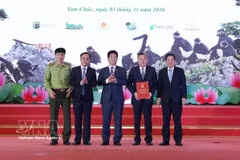
Representatives of the People’s Committee of Ninh Bình province present the decision to establish the Kim Bang Delacour's Langur Species and Habitat Conservation Area. (Photo: VNA)

Ninh Binh establishes world's largest Delacour's langur sanctuary

The establishment of the Kim Bang Delacour's Langur Species and Habitat Conservation Area in Ninh Binh province provides a solid legal and scientific foundation for completing the dossier to seek UNESCO recognition of the Van Long–Kim Bang–Tam Chuc Cultural and Ecological Landscape Complex as a World Heritage Site.

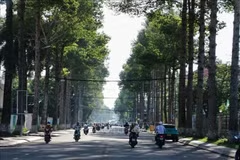
Trees planted along Vo Truong Toan street in Cao Lanh ward, Dong Thap province. Urban tree species capable of reducing fine particulate matter will be planted to reduce air pollution. (Photo: VNA)

Urban trees capable of reducing fine dust to be planted

The Forestry and Forest Protection Department (FFPD) will lead the component on identifying crop and planting structures that help reduce air pollution, while also participating in the design of urban public-space landscapes.

Professor Yucheng Lin, an Assistant Professor at City University of Hong Kong (CityUHK). (Photo: VNA)

Hong Kong expert offers solutions to help Vietnam tackle sea-level rise

In an interview with the Vietnam News Agency’s correspondents in Hong Kong (China), Lin, an expert specialising in sea-level change and climate risk assessment, said Vietnam shared global drivers of sea-level rise with China’s coastal regions, but local conditions could lead to significant differences in the overall risks.

Typhoon Yagi caused severe losses in many provinces in Vietnam in 2024. (Photo: VNA)

Vietnam could face super typhoon like Yagi every seven years

If global average temperatures rise by two degrees Celsius, Vietnam could experience such a super typhoon once every 13 years on average. The frequency would increase to once every nine years under the three-degree warming scenario and once every seven years if temperatures rise by four degrees.

Six of the newly recorded species are of conservation significance, representing four orders and five families. (Photo published by VNA)

Dakrong Nature Reserve records 35 new bird species

Dakrong Nature Reserve in the central province of Quang Tri has recorded 35 bird species not previously documented, including several endangered and rare species listed on the International Union for Conservation of Nature (IUCN) Red List.

An overview of Soc Son waste-to-energy plant in the Nam Son Waste Treatment Complex, in Hanoi (Photo: VNA)

Hanoi targets collection and treatment of all industrial solid waste

Hanoi aims to ensure that all industrial solid waste from its hi-tech parks, industrial parks and industrial clusters is collected and treated in line with regulations under a new plan to strengthen waste management and tighten control on scrap collection, storage and recycling facilities across the capital.

UNICEF Representative in Vietnam Silvia Danailov (first, right) honours first winners of the teaching materials competition. (Photo: VNA)

Deputy minister urges early action on disaster risks

Rapidly shifting climate conditions and increasingly overlapping hazards mean disaster risk reduction can no longer stand alone; it must sit at the heart of sustainable development, tightly integrated with climate response, water security, social welfare and economic growth.

General Secretary of the Communist Party of Vietnam Central Committee and President To Lam speaks at the groundbreaking ceremony for a project to upgrade the Bac Hung Hai irrigation system. (Photo: VNA)

Hung Yen: Project to modernise Bac Hung Hai irrigation system launched

General Secretary of the Communist Party of Vietnam Central Committee and President To Lam stressed that the development of Bac Hung Hai must be integrated into broader efforts to ensure water security, protect the environment and promote sustainable development in the Red River Delta.

Illustrative image (Source: VNA)

Northern region to experience cold spell

The cold air is forecast to reach northeastern Vietnam from the evening and night of October 4 before spreading to other parts of the north and the area from Thanh Hoa to Hue. Winds will shift to the northeast at levels 2-3 inland and levels 3-4 along coastal areas.