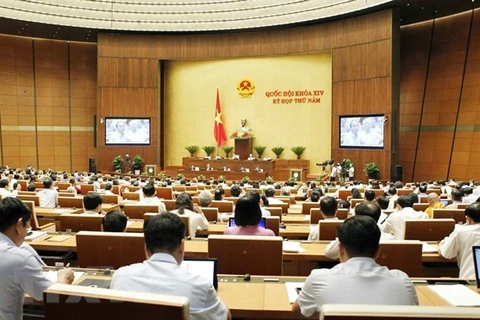
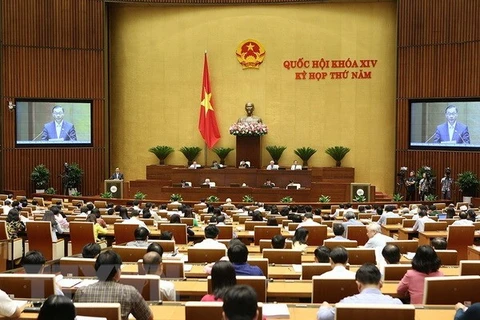
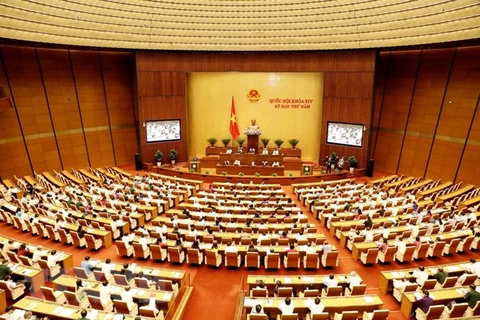
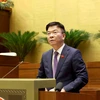
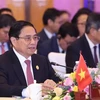
Minister of Industry and Trade Tran Tuan Anh speaks at the session (Source: VNA)
 Hanoi (VNA) - Lawmakers stressed the need to clearly define State management and corporate governance in businesses during the ongoing fifth session of the 14th-tenure National Assembly on May 28.
The discussion session focused on the implementation of policies and laws on State capital and asset management and use in State-owned enterprises (SOEs) and equitisation of SOEs in the 2011-2016 period.
According to NA deputies, ministries are still slow in separating State owner representative function and State management function, while inspection, examination and supervision of SOEs remains ineffective, leading to violations in the management and use of State property.
Some argued that ministries and sectors do not want to leave businesses that are considered their "backyards", stating that this is a manifestation of group interests or a cause that leads to interest groups.
State management agencies at the same time perform the two functions so that conflicts of interest may arise between policy assurance and implementation and supervision, they said, adding that the method of monitoring and evaluation is mainly based on statistic reports of SOEs rather than those on the performance of owners' objectives.
Minister of Industry and Trade Tran Tuan Anh in his explanations on State management and ownership over SOEs in recent times pointed out that the process has divided into two phases.
Accordingly, in 2011-2012, the implementation of State ownership and management for SOEs was governed by the 2003 Law on SOEs, the 2005 Law on Enterprises and a number of subordinate documents. Therefore, the supervision of financial performance of SOEs, representatives of the State-owned capital of businesses was the responsibility of the Ministry of Finance.
The 2013-2016 period witnessed changes in the institution, he said, noting that the Law on Enterprises in 2014, the Law on State capital management and use for investing in production and business in SOEs and other documents stipulated the management of SOEs and the performance of ownership function in SOEs.
He affirmed that in the past time, in recent times, SOEs, including enterprises of the industry and trade sector, have contributed to ensuring assigned objectives and political tasks.
Agreeing with the NA’s supervision report, he said there have remained shortcomings in the management of State capital and State capital ownership representatives in SOEs, including both objective and subjective factors.
He mentioned the fact that conflicts in the institutional system and legal documents have made SOEs’ operation more difficult, adding that the overlap between the State management function and corporate governance role has made SOEs less active and caused the responsibility dodge among business leaders.
The overlapping management also causes deliberate wrongdoings and violations in implementing investment projects.
Among 12 loss-making and ineffective projects reported by the industry and trade sector to the NA recently, many reflect the real situation of capital management and corporate governance, he noted, stressing that not only heads of these enterprises but also managers of relevant ministries and agencies must be responsible for those, including criminal liability.
Expressing his sympathy with solutions stated in the NA’s monitoring report, he said it is necessary to accelerate the completion of institution and legal framework for the State Capital Management Committee.
In the coming time, the industry and trade sector will continue to closely coordinate with ministries and sectors to implement the State's directions, especially in improving the management mechanism and clearly defining the State management and corporate governance; bettering the legal framework to ensure sustainable economic development, and promoting integration so that State-owned and private businesses can take advantage of market opportunities, the minister affirmed.-VNA
The discussion session focused on the implementation of policies and laws on State capital and asset management and use in State-owned enterprises (SOEs) and equitisation of SOEs in the 2011-2016 period.
According to NA deputies, ministries are still slow in separating State owner representative function and State management function, while inspection, examination and supervision of SOEs remains ineffective, leading to violations in the management and use of State property.
Some argued that ministries and sectors do not want to leave businesses that are considered their "backyards", stating that this is a manifestation of group interests or a cause that leads to interest groups.
State management agencies at the same time perform the two functions so that conflicts of interest may arise between policy assurance and implementation and supervision, they said, adding that the method of monitoring and evaluation is mainly based on statistic reports of SOEs rather than those on the performance of owners' objectives.
Minister of Industry and Trade Tran Tuan Anh in his explanations on State management and ownership over SOEs in recent times pointed out that the process has divided into two phases.
Accordingly, in 2011-2012, the implementation of State ownership and management for SOEs was governed by the 2003 Law on SOEs, the 2005 Law on Enterprises and a number of subordinate documents. Therefore, the supervision of financial performance of SOEs, representatives of the State-owned capital of businesses was the responsibility of the Ministry of Finance.
The 2013-2016 period witnessed changes in the institution, he said, noting that the Law on Enterprises in 2014, the Law on State capital management and use for investing in production and business in SOEs and other documents stipulated the management of SOEs and the performance of ownership function in SOEs.
He affirmed that in the past time, in recent times, SOEs, including enterprises of the industry and trade sector, have contributed to ensuring assigned objectives and political tasks.
Agreeing with the NA’s supervision report, he said there have remained shortcomings in the management of State capital and State capital ownership representatives in SOEs, including both objective and subjective factors.
He mentioned the fact that conflicts in the institutional system and legal documents have made SOEs’ operation more difficult, adding that the overlap between the State management function and corporate governance role has made SOEs less active and caused the responsibility dodge among business leaders.
The overlapping management also causes deliberate wrongdoings and violations in implementing investment projects.
Among 12 loss-making and ineffective projects reported by the industry and trade sector to the NA recently, many reflect the real situation of capital management and corporate governance, he noted, stressing that not only heads of these enterprises but also managers of relevant ministries and agencies must be responsible for those, including criminal liability.
Expressing his sympathy with solutions stated in the NA’s monitoring report, he said it is necessary to accelerate the completion of institution and legal framework for the State Capital Management Committee.
In the coming time, the industry and trade sector will continue to closely coordinate with ministries and sectors to implement the State's directions, especially in improving the management mechanism and clearly defining the State management and corporate governance; bettering the legal framework to ensure sustainable economic development, and promoting integration so that State-owned and private businesses can take advantage of market opportunities, the minister affirmed.-VNA
VNA