National treasure Cuu Dinh seeking UNESCO documentary heritage recognition

The Nine Dynastic Urns, built in late 1835 and completed in early 1837, was recognised as a national treasure in 2012, and considered the most valuable bronze works in Vietnam.
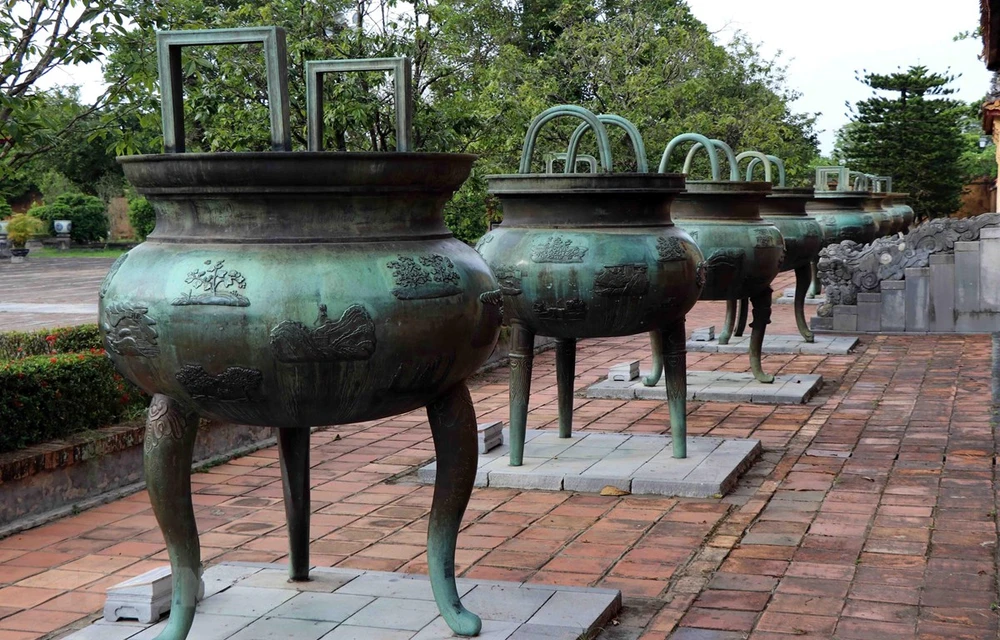
Photo: Cuu dinh” (Nine Dynastic Urns) are placed in front of the Hien Lam Pavilion inside The To Temple in the Hue Imperial Citadel (Dai Noi) for over 200 years. (Photo: VNA)

Hanoi (VNA) – The Nine Dynastic Urns, built in late 1835 and completed in early 1837, was recognised as a national treasure in 2012, and considered the most valuable bronze works in Vietnam.

The Hue Monuments Conservation Centre has completed the compilation of a dossier for the national treasure of “Cuu dinh” (Nine Dynastic Urns) to seek UNESCO recognition as a world documentary heritage.

The dossiers will be submitted to the Ministry of Culture, Sports and Tourism for consideration and recommendations before seeking UNESCO’s recognition, said Dr Le Thi An Hoa from the centre.

Comparative cultural studies in Japan, China, and the Republic of Korea showed that the set of tripod urns currently displayed in the citadel of Hue is the only existing one of its type.

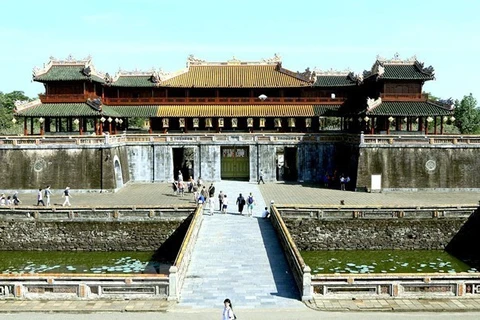
The intact urns are horizontally placed at the yard of the Hue Imperial Citadel (Dai Noi)’s The To Mieu (To Mieu Temple), a place to worship the kings of the Nguyen Dynasty – the last feudal regime of Vietnam which ruled the country from 1802 to 1945.

All cast in bronze, they represent the unity and the beauty of the country as well as sustainable existence of the Nguyen Dynasty.

Also outstanding symbols of the country’s immortal reign and wealth, the urns were built in late 1835 and completed in early 1837, under the reign of King Minh Mang.

The highest urn is 2.5 meters high versus the shortest at 2.3 meters high. Each one, weighing up to 2,600 kg, has a name symbolising an emperor of the Nguyen Dynasty. The central one is dedicated to Gia Long emperor.

Their craftsmanship is remarkable, making the symbolism of power, stability, and continuity even stronger.

The urns can also be considered a “geographic encyclopedia” of Vietnam in the 19th century with 162 carved patterns exquisitely embossed on their surface depicting popular landscapes, like universe, rivers, mountains; and daily activities across the country, including 90 images of typical plants and animals. These create a great combination between carving and bronze casting. Until now, all of them are still in their original position and remain intactly.

Of note, the country’s sea and islands were carved on the three largest and most significant urns. The East Sea is depicted on the “Cao Urn”, the one positioned in the very middle and higher than the others, which is dedicated to King Gia Long, the first king of Nguyen Dynasty. The southern sea appeared on the Nhan Urn, and the western sea on the Chuong Urn.

Alongside various ancient documents, the patterns on the urns serve as a valuable historical source affirming Vietnam’s sovereignty over Hoang Sa (Paracel) and Truong Sa (Spratly) archipelagos.

According to experts, the urns were cast by the best craftsmen at the time. Their molds were destroyed upon the completion to avoid counterfeits, making them the only one of the kind.

The Hue Monuments Conservation Center is confident that the aforementioned factors qualify these urns as world documentary heritage in accordance with the criteria set by the UNESCO’s Memory of the World Programme.

In addition to the set of Nine Dynastic Urns, the Imperial Citadel of Hue boasts many other ancient works and items under the Nguyen Dynasty.

Among those, the woodblocks used to print books of Han characters, or adapted Chinese characters, were recognised as the world’s documentary heritage by the UNESCO in 2009, and the imperial records and literature on the royal architecture were acknowledged with a similar title by the Memory of the World Committee for Asia and the Pacific in 2014 and 2016, respectively./.
VNA

See more

Deputy Minister of Foreign Affairs Le Thi Thu Hang speaks at the cultural event. (Photo: baoquocte.vn)

Cultural event held in Quang Ninh to strengthen Vietnam – EU connection

The event aimed to promote mutual understanding and cooperation between Quang Ninh province, other Vietnamese localities, the EU Delegation, and European embassies in Hanoi, contributing to the comprehensive partnership and cooperation that is moving towards a higher level of cooperation.

“Indochina” (2024), a wood-burning painting by Ngo Van Sac, is nominated among the top three works in the Modern and Contemporary category at Asian Art in London 2025. (Photo: VNA)

Vietnamese art shines at London Asian Art Week

Works by four contemporary Vietnamese painters were showcased at the exhibition themed Vietnam – Enchanting Beauty, held from October 31 to November 5 at Sotheby’s London, attracting strong interest from collectors, auctioneers, and art enthusiasts from the UK and abroad.

A musical performance at the Ok Om Bok Festival celebration in Vinh Long province on November 5 (Photo: VNA)

Vinh Long celebrates Ok Om Bok Festival

The Ok Om Bok Festival, a traditional cultural event of the Khmer ethnic community and a recognised national intangible cultural heritage, was held on November 5 at the Ao Ba Om national historical and scenic site in Vinh Long province.

Illustrative Image (Photo: VFF)

Vietnam drawn in Group B at 2026 AFC Futsal Asian Cup

Vietnam, ranked 26th in the world and seeded in Pot 2 by FIFA’s August 29 rankings, landed in a challenging Group B with familiar rivals: 2022 runners-up Thailand, Kuwait and Lebanon. Vietnam shares Pot 2 with powerhouses Uzbekistan (19th), Afghanistan (33rd) and Iraq (41st), making for competitive group-stage fixtures right from the start.

Central Vietnam’s heritage on path to sustainable development

Central Vietnam’s heritage on path to sustainable development

The enduring appeal of the three world cultural heritage sites in the central region demonstrates that when cultural heritage is cherished and creatively promoted, it becomes a valuable and lasting resource for sustainable tourism, contributing to Vietnam’s global image and sharing the nation’s cultural essence with the world.

Posters of "Red Rain" and "Hijacked" at the Autumn Fair 2025 (Photo: VNA)

Cinema becomes a highlight at Autumn Fair 2025

Located within the cultural industry space, the cinema zone was designed like a mini film studio and offered visitors an immersive experience of Vietnamese cinema, from production and technology to film screenings and merchandise.​

Grandmaster Hoang Thi Bao Tram (right) participates in the 6th ASEAN+ Individual Chess Championship in the Philippines. (Photo: sggp.org.vn)

15 Vietnamese players compete at 6th ASEAN+ Individual Chess Championships

According to the organisers, this year’s tournament offers a total prize pool of 28,100 USD. The winner of the men’s standard chess category will receive 2,000 USD, while the women’s standard champion will take home 1,500 USD. Other prizes will be awarded based on ranking and performance across categories.