Natural disasters cost Ca Mau province over 43 million USD

Drought, rains, inundation and landslides have cost the Mekong Delta province of Ca Mau an estimated over 1 trillion VND (43 million USD) from the outset of the year, according to the provincial steering committee on natural disaster prevention, search and rescue.
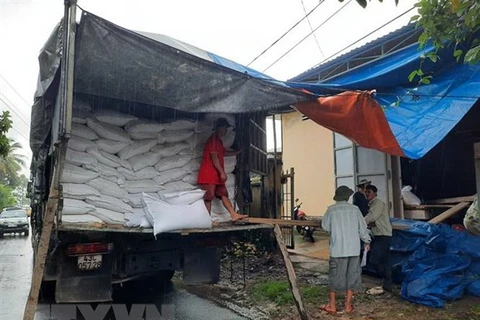
Natural disasters cost Ca Mau province over 43 million USD ảnh 1 More than 20,800 households faced a lack of fresh water due to drought (Photo: VNA)

Ca Mau (VNA) - Drought, rains, inundation and landslides have costthe Mekong Delta province of Ca Mau an estimated over 1 trillion VND (43million USD) from the outset of the year, according to the provincial steeringcommittee on natural disaster prevention, search and rescue.

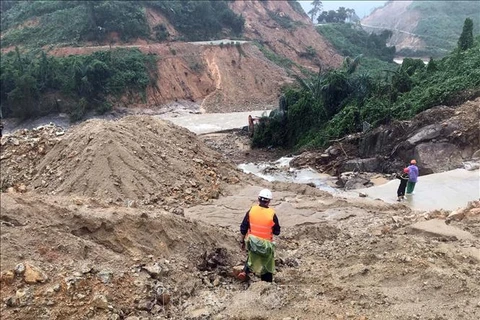
More than 20,800 households faced a lack of fresh water due to drought, while43,583 hectares of forest dried up and carried high risk of forest fire. Heavyrains and thunderstorms damaged 859 houses,35,638 hectares of rice, over 578 hectares of other crops, 408 hectares of orchards,and more than 20,500 hectares of aquaculture.

Hundreds of kilometres of roads were damaged by inundation caused by torrential rains and high tides, while frequent erosions are taking place along 105 km of the coastline, with the most critical sections of Da Bac drainage- Moicanal and Moi canal- Tieu Dua.
Furthermore, five were killed at sea due to naturaldisasters, and two are still missing. 

Chairman of the provincial People’s Committee Le Quan ordered competentauthorities to give timely supportfor locals to recover production, keep close watch on weather developments, and proactively take measures to mitigate impacts of natural disasters.

The provincial steering committee has asked the Government to providefinancial support for the province to settle consequences of erosion, andthe National Committee for Disaster Response and Search and Rescue to help thelocality with search and rescue equipment like long-range communication deviceand power generator./.
VNA

See more

Defendants at the court (Photo: VNA)

Ho Chi Minh City court opens trial over Agribank lending scandal

The investigation revealed that multiple credit files were incomplete or riddled with inaccurate information, while some pledged assets lacked proper legal standing yet were accepted and grossly overvalued. As a result, the loans became high-risk and largely unrecoverable, leading to losses surpassing 1 trillion VND.

Hanoi introduces 53 electric buses from April 18 (Photo: VNA)

Hanoi to add 53 electric buses from April 18

According to the plan, all buses operating within Ring Road 1 will use green energy by July 1, 2026. The requirement will expand to Ring Road 2 by January 1, 2028, and to Ring Road 3 by 2030.

Illustrative image (Photo: VNA)

National, local traffic safety committees to be dissolved from June 1

Under the dicision, ministries and ministerial-level agencies will assume responsibility for tasks previously performed by the committee, in line with their mandates under the Law on Government Organisation, the Law on Road Traffic Order and Safety, the Law on Roads and other relevant legal frameworks, ensuring that traffic safety and order are maintained without disrupiton.

Visitors explore technology showcases at the exhibition held during the Da Nang Startup and Innovation Festival (SURF 2025). (Photo: VNA)

About 10,000 students expected at National Startup Day 2026

This year marks the rollout of the “Student Startup Support Programme for 2026 – 2035”, approved under Decision No. 336/QD-TTg, which places emphasis on practical outcomes, real products, real testing, real partnerships, and measurable impact.

Hong Quang High School pilots teaching mathematics in English starting from the 2025–2026 academic year. (Photo: VNA)

National foreign language proficiency framework issued

The circular establishes a unified benchmark for foreign language proficiency across the national education system, providing a foundation for curriculum design, teaching, testing, assessment, and certification. It is expected to help learners better map out their language development pathways while enabling educational institutions to improve training quality and strengthen articulation between different levels of education.