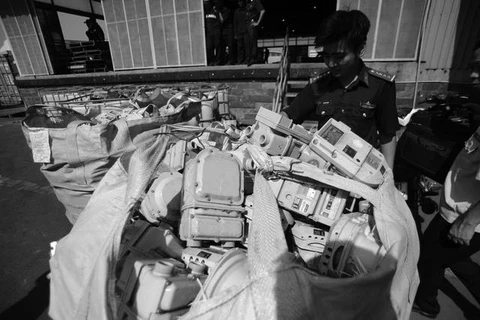
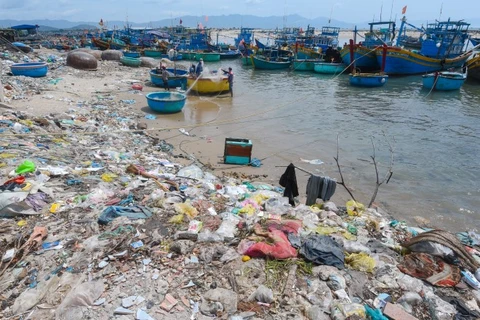
Plastic waste is collected for recycling in the northern province of Lao Cai. (Photo: VNA)
 HCM City (VNS/VNA) - Collective action from the Vietnamese government, the private sector and consumers is essential to combat one of the great environmental challenges facing the world, the excess of plastic waste in oceans and water sources, a United Nations (UN) official said on June 6.
Albert T. Liebeg, chair of the UN-Vietnam Results Group on Climate Change and the Environment, said at an international conference on plastic waste held in Ho Chi Minh City that governments should lead by enacting strong policies to push for circular models of design and production of plastic products.
Lieberg noted that 60 percent of all plastic that ends up in oceans comes from only six countries in Asia, including Vietnam.
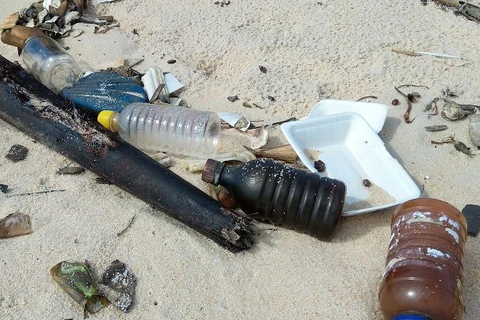
Vietnam is among the top five countries responsible for the estimated 13 million tonnes of plastic dumped in the oceans every year.
“Single-use plastics are widespread and waste management capacity is limited in the country, causing a rising burden from plastic waste to the environment and public health,” he said.
It is estimated that 1.8 million tonnes of plastic waste are generated in Vietnam every year, with plastic consumption rising 16-18 percent annually.
Waste management, recycling facilities and government policies are not in place to sufficiently respond to the increasing needs, he said.
“One major concern is the lack of a system for waste segregation at source,” he noted.
Robust legislation must be enacted to curb the production and use of unnecessary single-use plastics, Lieberg said, adding that the private sector must adopt business models that reduce the downstream impact of their products.
Manufacturers must also take responsibility for the pollution that their products cause and make investments in sustainable product design, he said.
Citizens should demand sustainable products and exercise their buying power by refusing single-use plastics, he added.
Nicolas Audier, Chairman of the European Chamber of Commerce in Vietnam (EuroCham), said that “fully solving the plastic waste problem will require a concerted effort from both public and private sectors, Government and businesses, and households and communities”.
Ramkumar Dhruva, chairman of the Southeast Asia, ASEAN, Australia and New Zealand division at BASF, a German chemical company, said that a circular economy approach could reshape the future of plastics.
He said it was necessary to keep resources in use for as long as possible, minimise disposed residual waste, and extract the maximum value from products, as well as recover and regenerate products and materials at the end of service life.
Nguyen Thanh Phuong, deputy head of the Southern Department of Environmental Protection under the Vietnam Environment Administration, noted that Vietnam’s sustainable development strategy calls for a State-run Environmental Protection Fund to financially support environmental protection projects and activities.
Eligible projects must use environmentally friendly technologies and renewable energy, he said.
“Vietnam aims to diversify investment sources for environmental protection, and develop an economy towards green growth,” he said.
“We have seen a positive sign from the Vietnamese business community lately, especially businesses using rice straws or bamboo straws instead of plastic straws, wrapping vegetables with banana leaves.”
A Vietnamese manufacturer is now making micro-bags, micro-spoons and microbiological paper cups to replace ordinary plastic products, according to Phuong.
Tomaso Andreatta, vice-chairman of EuroCham, and chairman of EuroCham’s Green Growth Sector Committee, said local companies whose business revolves around plastics are starting to “produce fully biodegradable or reusable plastics”.
Business initiatives, especially in the packaging industry, would make a huge impact on plastic waste management, he said.
Consumers, families and organisations, and the companies serving them have to change the way they dispose of things they no longer need, he added.
The ultimate goal is “zero waste”. Reuse as much as possible, and transform plastics into something else, including energy, experts recommended.
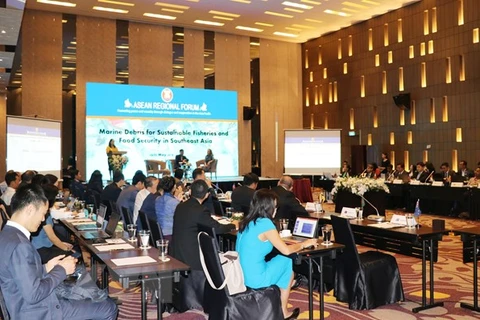
More than 100 representatives from the Government, international organisations, and the business community took part in the conference “Plastic Waste – How Public and Private Sectors Can Help Address the Issue”.
Organised by EuroCham, the event shared the best practices from around the world on dealing with plastic waste and improving the environment for the benefit of all.-VNS/VNA
VNA