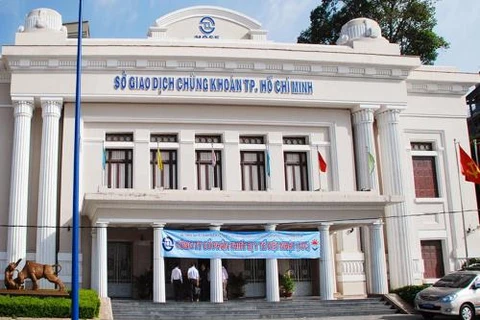
The sign of State Securities Commission (SSC) at its headquarters in Hanoi. SSC, other market regulators, stock exchanges and market members have proposed the National Assembly discuss allowing the sale of non-voting depository receipts as a way for local firms to increase capital without giving too much power to foreign investors. (Photo: vietnamfinance.vn)
 Hanoi (VNS/VNA) - The use of non-voting depository receipts (NVDRs) may help foreign investors buy more shares in Vietnamese companies without raising their power.
According to the Stock Exchange of Thailand (SET), NVDRs are meant for foreign investors who are interested in investing in a company but are prevented from doing so because of foreign ownership restrictions.
Buying NVDRs is an alternative option for foreign investors as they receive the same benefits in terms of dividends and warrants as those investing directly in a company’s ordinary shares.
The difference between those buying ordinary shares and those buying NVDRs is voting rights. NVDR holders cannot be involved in company decision-making.
NVDRs have not been approved in Vietnam, but they may be the solution for Vietnamese companies. They would allow firms to raise more foreign capital without ceding power to foreign shareholders.
The foreign ownership cap is in place to avoid giving foreign interests too much power, so Vietnamese market regulators and companies may want to consider embracing NVDRs to raise capital.
A Vietnamese company can only increase its foreign ownership limit if it is not involved in “sensitive sectors” such as property, transportation or banking – the economic sectors that have a direct impact on Vietnam’s economic safety and security.
The maximum foreign ownership for those companies is 49 percent. In the banking and aviation sectors, the limit is 30 percent.
The issuance of covered warrants allows foreign investors to raise capital in Vietnamese firms, but these purchases are costly and investors can only short covered warrants for now, analysts have said. In addition, covered warrants are issued by securities firms but some foreign-owned brokerage firms cannot buy ordinary shares if a company runs out of room for foreign ownership.
According to Nguyen Thi Viet Ha, commissioner of the Ho Chi Minh Stock Exchange (HoSE), NVDRs are in use in Malaysia and Japan and are treated like ordinary shares. Foreign investors can purchase NVDRs if their ownership in local companies exceeds the foreign ownership limit.
In Malaysia, the foreign ownership limit is regulated by the company charter. It is restricted by market regulators in Japan. But in both markets, foreign investors will receive financial benefits when buying this kind of share but will not have voting rights.
In Japan and Malaysia, foreign investors can trade a company’s shares and market regulators address which of them have voting rights when the company is about to finalise its shareholder list for a meeting.
But in Vietnam, market regulators must supervise the list of foreign shareholders and their ownership as these two factors can change a company’s ownership status from “Vietnamese” to “foreign” if foreign investors hold more than half of the company’s charter capital or a controlling stake.
According to Ta Thi Thanh Binh, director of the Market Development Department at the State Securities Commission (SSC), only 50 listed companies have raised their foreign ownership limit to 100 percent. There are nearly 800 companies trading on the HoSE, HNX and UPCoM.
Most Vietnamese companies were hesitant to lift their foreign ownership limit because they were afraid of being treated as foreign firms, which would restrict them from doing business in some sectors, Binh said.
Tran Thi Hong Ha, deputy director of the Market Development Department, said at a recent SSC meeting that NVDRs were proposed by HoSE six years ago but two main obstacles had prevented the launch of the new product.
There were no specific NVDR regulations in Vietnam, she said, adding that Vietnamese stock exchanges were not allowed to set up their own businesses to issue and manage NVDRs. This policy is different from how NVDRs work in Thailand.
Some experts have suggested the NVDRs issued by a company should account for 15 percent of its total shares and NVDR holders should be able to attend shareholder meetings.
The product is not yet available in Vietnam, but it has been included in the draft amendment to the Law of Securities, which will be discussed at the 14th National Assembly’s seventh meeting on June 6. - VNS/VNA
VNA