October auto sales top to pre-pandemic figures

Sales of automobiles by members of the Vietnam Automobile Manufacturers’ Association (VAMA) in October surged 22 percent against the previous month to reach 33,254 units, indicating consumption is recovering to pre-pandemic levels.
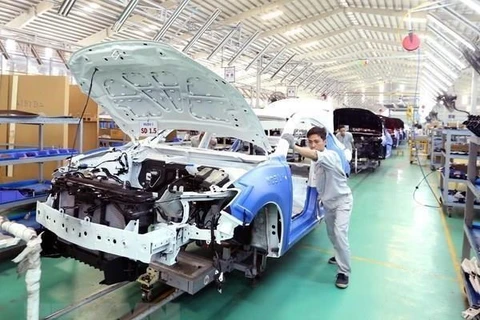
VinFast auto manufacturer in Hai Phong city (Photo: VietnamPlus).

Hanoi (VNA) – Sales of automobiles by members of the Vietnam Automobile Manufacturers’ Association (VAMA) in October surged 22 percent against the previous month to reach 33,254 units, indicating consumption is recovering to pre-pandemic levels.

The association said the figure almost caught up with the record sales of 33,484 units posted in January 2019.

Sales of passenger cars expanded 23 percent to 25,339 units and commercial vehicles, up 17 percent to 7,528 units. Meanwhile, 387 special-use vehicles were sold, up 71 percent month-on-month.

October sales included 20,498 locally-assembled vehicles, up 15 percent, and 12,756 imported ones, up 35 percent.

Experts explained that the domestic automobile market has bounced back as the COVID-19 pandemic has been contained in Vietnam and businesses have offered an array of promotion programmes.

However, the sales do not reflect the country’s entire automobile market as they do not include those of other manufacturers that are not VAMA members, such as Audi, Jaguar Land Rover, Mercedes-Benz, Subaru, Volkswagen, Volvo, and TC MOTOR.

Among the non-VAMA members, TC Motor reported sales of 7,839 automobiles in October, while VinFast sold 2,866 units.

The combined sales of VAMA members, TC Motor, and VinFast reached 43,959 in October.

For the 10-month period, a total of 212,409 vehicles were sold, a drop of 18 percent year-on-year.

Toyota was the best-selling brand in the past month with 8,841 units sold, followed by TC Motor with 7,839 units, and Kia with 4,685.

In anticipation of the traditional Tet holiday which will fall in early February next year, automakers will offer a wide range of promotional programmes to boost purchase.

However, they said, it is hard to raise this year’s sales to 400,000 units as recorded last year since the average monthly sales stood at only 21,000 units during the January-October period, as compared with 33,000 units last year.

The government’s cutting of first-time automobile registration fees by half appears to have lifted the industry out of a slump caused by the Covid-19 pandemic.

According to dealers, the increase was due to customers scrambling to buy cars before the end of 2020 to enjoy the 50 percent reduction in registration fees.

In the higher end, the Mercedes GLC, which is three or four times more expensive than the Vios, was also selling out.

Early this year, when the pandemic began, the auto industry had projected a year of poor business. Sales fell by 31 percent year-on-year in the first half, according to VAMA.

The industry feared full-year sales would be down 15-20 percent, and sought help from the government.

Prime Minister Nguyen Xuan Phuc signed a decree at the end of June stipulating a 50 percent reduction in registration fees for locally made cars until year-end.

Accordingly, the registration fee for passenger cars, trailers or semi-trailers pulled by cars and similar vehicles manufactured and assembled domestically is reduced by 50 percent of the rate specified by Government's Decree No. 20/2019/ NĐ-CP.

Under Decree No. 20, the buyers of cars with nine seats or less have to pay registration fee of 10 percent of the car value in cities and provinces, except for Hanoi which applies a rate of 12 percent.

Meanwhile, buyers of pick-up trucks with transport volume of less than 1,500 kilos and five seats or fewer, and vans with capacity of 1,500 kilos or less will pay an amount equal to 60 percent of the nine-seater car’s registration fee.

The cut in the fee has reduced the cost of car ownership, which the Government hopes will help revive a slumping auto market.

This, along with companies’ promotions, enabled auto firms and dealers to clear out their inventories.

The market took little time to respond, with sales soaring in both July and September. Sales for the first nine months were down only 21 percent year-on-year compared to the 31 percent drop in the first half.

Some companies now even expect sales to be on par with last year./.
VNA

See more

An Giang OCOP product booth at the fair (Photo: VNA)

Vietnam–Cambodia OCOP fair expected to boost cross-border trade

The fair offers an opportunity for Vietnamese and Cambodian enterprises to meet and promote their brands and speciality products to both domestic and international visitors, he added, noting that it also serves as a platform for trade connections, helping businesses seek partners, expand distribution networks and access the promising border market.

Vietnamese Ambassador to Argentina and Paraguay Ngo Minh Nguyet (third from left), Paraguayan Minister of the Secretariat of Linguistic Policies Javier Viveros (second from left), and Vietnam's Honorary Consul in Paraguay María Del Carmen Pérez (C) pose for a photo with delegates. (Photo: VNA)

Ample room remains for Vietnam-Paraguay economic ties: Ambassador

Addressing a ceremony marking the 30th anniversary of the establishment of the bilateral diplomatic ties on December 11, Vietnamese Ambassador to Argentina and Paraguay Ngo Minh Nguyet affirmed that Vietnam, one of the fastest-growing economies in Asia, can become a strategic partner to help Paraguay expand its presence in the regional market.

Workers process frozen shrimp for export at the Coastal Fisheries Development Company (COFIDEC), Ho Chi Minh City. (Photo: nhandan.vn)

Vietnamese aquatic products reach new markets

By exploring new markets, diversifying products and prioritising sustainability standards, Vietnamese aquatic products have laid the groundwork for long-term expansion including early steps to build investment partnerships in emerging markets such as Algeria and Cuba.

Export revenue from wood and wooden products is forecast to exceed 18 billion USD in 2025. (Photo: VNA)

Wood, forestry sector targets 25 billion USD in exports

For the 2025–2030 term, Viforest aims to reinforce its role as a hub for innovation, build long-term development plans and expand cooperation with ministries and international partners to support the sector’s green transition.

Hanoi targets around 1,200 supporting-industry enterprises. (Photo: thoibaonganhang.vn)

Hanoi shapes supporting-industry ecosystem for its 2035 vision

By 2030, Hanoi targets around 1,200 supporting-industry enterprises, with more than 40% meeting international standards and capable of joining global production networks. By 2035, this is projected to rise to around 1,400, with approximately 45% meeting international standards.

Across the CPTPP bloc, Vietnam’s tra fish exports soared 36% year-on-year to 305 million USD during January-October, representing 17% of its global tra fish sales. (Illustrative photo: VNA)

CPTPP drives Vietnam’s agro-fisheries exports

The 12-member CPTPP covering Australia, Brunei, Canada, Chile, Japan, Malaysia, Mexico, New Zealand, Peru, Singapore, the UK and Vietnam saw two-way trade with Vietnam reach 102.8 billion in the first 10 months of 2025, up 20.6% from a year earlier.

A credit officer from the Vietnam Bank for Social Policies (VBSP) in Phu Tho province guides residents on utilising borrowed capital for intended purposes and effective investment. (Photo: VietnamPlus)

Policy credit drives strong transformation in the Ancestral Land

The sharp decline in the poverty rate and the gradual improvement in the livelihoods of ethnic communities reflect decisive leadership, management, and the strong involvement of the entire political system, particularly the synergy created by various organisations, businesses, and social policy credit.

Participants in the Vietnam Impact Investment Forum 2025, held in Hanoi on December 10. (Photo: diendandoanhnghiep.vn)

Vietnam records strong growth in impact investment: forum

A rising number of enterprises are offering practical solutions in key sectors, including sustainable agriculture, climate adaptation, education, health care, renewable energy, women’s economic empowerment, and financial inclusion. They generate clear social and environmental impacts while also bringing financial returns to impact investors.

According to global property consultancy Jones Lang LaSalle, announced M&A deals reached a total value of around 2.4 billion USD in the first 11 months of 2025, signalling a clear recovery in market activity. (Photo: VNA)

Real estate M&A market gathers pace

With expectations of a stronger investment environment and a continued push for transparency in real estate, the 2025-2026 period is viewed as a pivotal window for enterprises to restructure, raise capital and enhance competitiveness through high-quality M&A transactions.