Opening of overseas markets boosts coconut exports

Signed trade agreements are creating favourable conditions for coconut to truly become a key industrial crop. However, this is also a challenge that requires a sustainable development strategy so that coconut products can meet the increasing standard requirements of export markets.

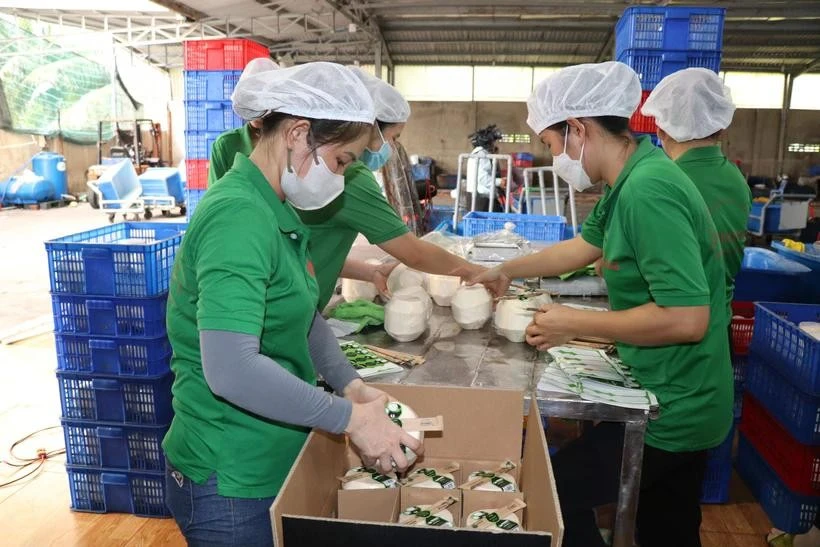
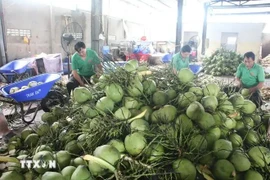
Fresh coconut packaging for export at Mekong Fruit Co. Ltd. in Huu Dinh commune in Chau Thanh district of Ben Tre province. (Photo: VNA)

Hanoi (VNA) - Signed trade agreements are creating favourable conditions for coconut to truly become a key industrial crop. However, this is also a challenge that requires a sustainable development strategy so that coconut products can meet the increasing standard requirements of export markets.

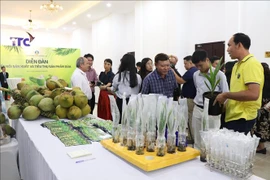
This information was released at a forum on connecting coconut production and consumption held in the Mekong Delta province of Ben Tre on December 13. The event allowed relevant parties to discuss ways to fully tap the potential of both domestic and international markets to develop coconut into a billion-USD industry.

Co-organised by the Vietnam Agriculture Newspaper, the Ministry of Agriculture and Rural Development (MARD)'s Department of Quality, Processing and Market Development, and relevant agencies, the event served as a strategic bridge in the coconut value chain, allowing stakeholders to connect to fully tap cooperation opportunities.

Investing heavily in coconut trees

Nguyen Thi Thanh Thuy, Director of the Department of Science, Technology and Environment under the Ministry of Agriculture and Rural Development, said that coconut is a mainstay according to a project to develop six key industrial crops to 2030, including coffee, rubber, tea, cashew, and pepper.

From a modest figure of 180 million USD in export turnover in 2010, the coconut industry has grown strongly, reaching more than 900 million USD in 2023 and is expected to exceed 1 billion USD in 2024.

Vietnamese coconut is becoming a high-value export commodity, and processed coconut products are expected to increase the value of coconut cultivation and raise incomes for farmers, Thuy said.

According to statistics, 30% of coconut plantations have been certified as meeting VietGAP standards, and 30% have been granted planting area codes.

Thuy said Vietnam aims to have over 200,000 ha of coconut nationwide by 2030 with key coconut-growing regions being the Mekong Delta (about 175,000 ha) and the south-central coastal region.

Deputy Director of the Ben Tre provincial Department of Agriculture and Rural Development Huynh Quang Duc said Ben Tre is known as the "coconut capital" of Vietnam with over 80,000 ha, accounting for 88% of the total coconut area in the Mekong Delta, and nearly 42% of that nationwide. The coconut has been identified as a key crop that brings a major source of income for over 200,000 rural households in the locality.
coconut-exports-2.jpg
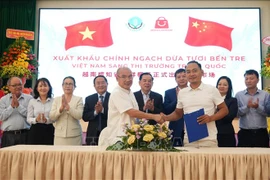
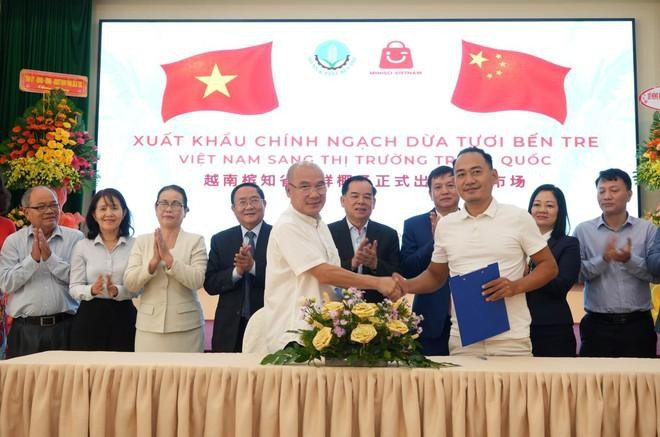
The signing ceremony of coconut trading agreements between Chinese and Vietnamese businesses. (Photo: VNA)

Ben Tre now has 133 coconut cultivation areas that have been granted codes and 14 businesses licensed for packaging fresh coconut products for export to the Chinese market. Each year, the province earns over 350 million USD from exporting coconut.

The provincial Department of Agriculture and Rural Development has collaborated with agencies and local authorities to develop an organic coconut material area of over 20,700 ha. The locality has formed a value chain with eight large enterprises that use modern processing technology to produce and export organic coconut products to markets such as the US, the European Union (EU), Japan, China, Canada, and the Republic of Korea (RoK).

Businesses advised to update and comply with export standards

Coconut is one of the six key industrial crops according to the MARD, which is set to increase coconut plantation areas to about 195,000-210,000 ha by 2030.

Coconut exports helped Vietnam rake in 900 million USD in 2023, and the figure is expected to exceed 1 billion USD this year. Positive advancements, such as the approval of Vietnamese coconuts by the US and Europe, along with ongoing negotiations with China for official export to the country, have laid a strong foundation for expanding markets and promoting sustainable development of the industry.

Among the key markets, China is currently the market with the greatest demand. In August 2024, the Vietnamese Ministry of Agriculture and Rural Development and the General Administration of Customs of China signed a protocol allowing fresh coconut exports through official channels, opening up huge opportunities.

The Government and the MARD have implemented numerous policies to develop the coconut industry, Deputy Director of the Department of Quality, Processing and Market Development Le Thanh Hoa said, adding that localities need to leverage these policies to support the production activities of farmers.

Meanwhile, Vietnamese businesses must have strategies to increase product prices in markets, so that the added value can be used to subsidise farmers, he noted./.
VNA

See more

Vu Thi Thuy, Deputy Consul General and Head of the Vietnam Trade Office in Hong Kong Special Administrative Region (China). (Photo: VNA)

Hong Kong experience offers insights for Vietnam–Hong Kong trade cooperation

At this year’s Spring Fair, the Vietnam Trade Office in Hong Kong facilitated the participation of several Hong Kong enterprises in Vietnam to conduct market surveys, seek import sources and showcase their products. Notably, a company under the Hong Kong Productivity Council presented technological solutions for smart homes and smart manufacturing at the event.

People shop for Tet at a supermarket. (Photo: VNA)

Vietnamese goods dominate Tet market in Mekong Delta

In key retail hubs such as Can Tho, Long Xuyen and My Tho, high-quality Vietnamese goods account for 85–90% of Tet market share. Surveys at major supermarket chains and traditional markets show that consumers this year are prioritising locally-processed foods, confectionery and beverages.

Prime Minister Pham Minh Chinh strikes the gong to inaugurate the Vietnam International Financial Centre in Ho Chi Minh City. (Photo: VNA)

Int’l Financial Centre – A catalyst for Vietnam’s economic breakthrough: Deputy PM

Standing Deputy Prime Minister Nguyen Hoa Binh, who chairs the IFC’s Governing Council, said that the establishment of the centre in Ho Chi Minh City and Da Nang represented the initial realisation of a major task set out in the Resolution of the 13th National Party Congress. While characterising the launch as an early milestone rather than a final achievement, he underscored that it reflected meticulous, methodical and determined preparations at multiple levels of government.

Kobayashi Yosuke, Chief Representative of JICA Vietnam. (Photo: JICA Vietnam)

JICA hails milestones in Vietnam partnership amid green, digital push

In line with Vietnam’s development priorities and its goal of becoming a high-income country by 2045, JICA will continue to work with a wide range of partners in both Vietnam and Japan to mobilise technical and financial resources for more sustainable and inclusive cooperation

Vietnam International Trade Fair for Apparel, Textiles and Textile Technologies (VIATT 2026) is expected to expand its scale by 20% compared to last year's edition. (Photo: bnews.vn)

Int’l trade fair for apparel, textiles, textile technologies to open in Ho Chi Minh City

According to Vietrade, VIATT 2026 aims to promote the development of Vietnam’s textile and garment industry by enhancing production technologies, strengthening sustainability, and expanding technical textile segments. The event is expected to create opportunities for international businesses to tap into the growth potential of Vietnam and ASEAN, while enabling domestic enterprises to connect more effectively with global buyers.

Participants at a conference on digital assets in Hanoi on December 10. (Photo: VNA)

Finance ministry seeks public feedback on minimal tax on digital assets

Under the draft, the transfer and trading of crypto assets would not be subject to value-added tax. Individual investors, regardless of residency status, would be required to pay personal income tax at a rate of 0.1% on the gross value of each transfer. This approach mirrors the current tax method applied to securities transactions.

Steel products of Hoa Phat Group. (Photo: VNA)

Vietnam aims to meet 80–85% of domestic steel demand by 2030

Vietnam aims to meet 80–85% of domestic steel demand by 2030. Crude steel production is targeted at 25–26 million tonnes per year, with annual growth of 7–8%, while finished steel output is expected to reach 32–33 million tonnes per year, growing by 5.5–6.5% annually. Per capita steel consumption is projected at 270–280 kg per year.

One of the products granted Halal certification in 2026. (Photo: moit.gov.vn)

Spring Fair 2026 boosts momentum for Vietnam’s Halal sector

The fair’s greatest value for Halal products lies less in immediate revenue than in building trust and standardising business practices. In a market where certification determines entry, it highlights that expansion must begin with fundamentals, standards, raw materials, production processes and readiness.

Prime Minister Pham Minh Chinh speaks at the fifth meeting of the Steering Committee for Nuclear Power Plant Construction. (Photo: VNA)

PM calls for more vigorous implementation of nuclear power projects

Describing nuclear power plants as nationally significant, strategic projects with a century-long vision, PM Chinh called for urgent and responsible implementation of tasks within assigned authority, with any outstanding issues promptly reported to higher authorities.