Party chief chairs 1st meeting of steering committee for science, technology development

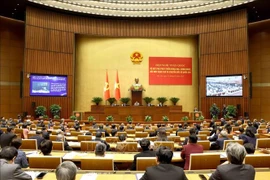
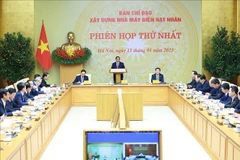
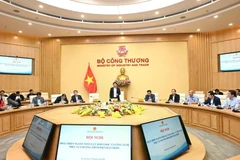
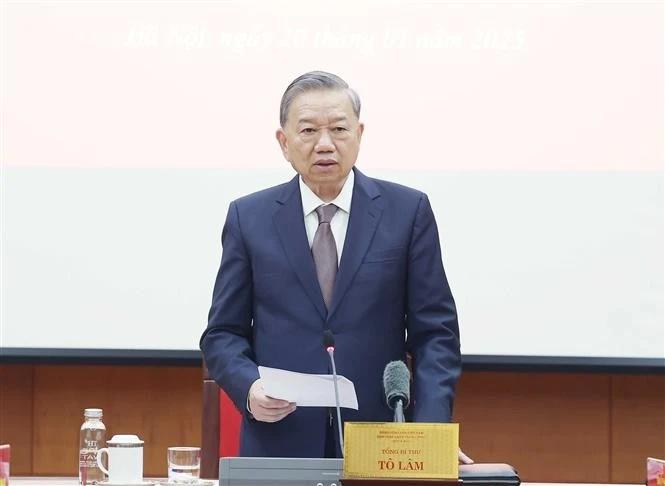
Party General Secretary To Lam chaired the first meeting of the Central Steering Committee for the Development of Science, Technology, Innovation and Digital Transformation in Hanoi on January 20.

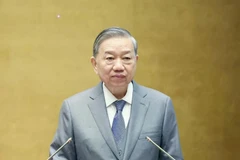
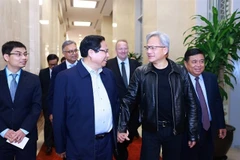
Party General Secretary To Lam (Photo: VNA)

Hanoi (VNA) – Party General Secretary To Lam chaired the first meeting of the Central Steering Committee for the Development of Science, Technology, Innovation and Digital Transformation in Hanoi on January 20.

Addressing the event, Lam, who is head of the steering committee, stressed that the implementation of tasks should focus on and prioritise the core issues outlined in the Politburo's Resolution No.57-NQ/TW, dated on December 22, 2024, on breakthroughs in science and technology development, innovation, and national digital transformation, with emphasis placed on removing institutional barriers to the development of science and technology.

The steering committee must ensure effective operations, avoid formalities and not perform the responsibilities of functional agencies, he said, adding that it should promote the role of each member and listen to ideas and opinions from leading experts and feedback from the grassroots level to identify urgent, fundamental, and breakthrough issues to focus on.

Tasks should be carried out with determination and urgency; and each must be specifically assigned, with measurable indicators and clear timelines, Lam noted.

Regarding a national advisory council, the General Secretary emphasised that the council’s structure should ensure a balanced representation of leading scientists and experts in various fields, with priority given to those who are reputable and have outstanding achievements. The council should also include representatives from businesses and managers to ensure practical effectiveness.

He appreciated the proposal to develop an index for monitoring, supervising, and evaluating the implementation of Resolution No. 57-NQ/TW, and requested that it be urgently completed and put into use in the second quarter of 2025 to accurately assess results and promptly address bottlenecks.

He asked the Prime Minister, who is a deputy head of the steering committee, to direct relevant agencies to launch an emulation movement across the political system to implement the resolution; research and propose reforms to the financial management mechanism for carrying out science, technology, innovation, and digital transformation tasks; simplify administrative procedures as much as possible; and grant autonomy in the use of funding for science and technology research and development.

The Government should also have a specific plan to develop a high-quality workforce, especially scientific and technological talent, and create a draft special mechanism to attract highly skilled Vietnamese expatriates and foreigners to work and live in Vietnam, thus contributing to the country’s science and technology development, said Lam.

For the steering committee’s members, the Party leader asked the Minister of Public Security to coordinate the development of an ecosystem for Project 06 on developing applications of residents data and electronic identification and authentication to serve digital transformation, and the National Data Centre to put these services into use soon.

The Minister of Information and Communications was tasked with overseeing the nationwide rollout of the 5G broadband mobile network, while the Minister of Science and Technology was required to lead the development and submission of a strategic technology and industry development programme for approval by competent authorities.

Lam also requested the Minister of Finance to allocate state budget funding for the scientific mission to support strategic technologies, in line with the requirements of Resolution No. 57, and the Minister of Planning and Investment to order drafting and submitting a public-private partnership policy for the development of science, technology, innovation, and national digital transformation to competent authorities for approval./.
VNA

See more

Vice Chairman of the Gia Lai provincial People’s Committee Lam Hai Giang speaks at the event. (Photo: VNA)

Int’l scientists gather at 2nd advanced school on topological quantum matters in Gia Lai

Jointly organised by the Rencontres du Vietnam (Meeting Vietnam) association and the International Centre for Interdisciplinary Science and Education (ICISE), the five-day event features lectures by leading professors and scientists in quantum physics and materials science, providing participants with a solid theoretical foundation. They are also updated on the latest research advances in quantum topological materials.

The survey found that mobile phones, particularly smartphones, have become an essential part of daily life in Vietnam. (Photo: VietnamPlus)

More than 80% of Vietnam's population uses smartphones

The 2025 household living standards survey showed that 87.3% of the population used mobile phones, up 2.5 percentage points from 84.8% in 2024. Of those, 80.3% used smartphones, while the proportion of people using feature phones fell to 8.5%.

An overview of the inaugural Vietnam RWA Summit 2026 in Hanoi on July 18 (Photo: VNA)

Vietnam seeks safe, regulated development of tokenised asset market

The two-day event, organised by the Vietnam Blockchain Association in partnership with the National Cybersecurity Association and the Vietnam National Real Estate Association, aims to foster policy dialogue, attract investment and position Vietnam as a regional hub for real-world asset (RWA) tokenisation during 2026-2030.

Scientists conduct experiments in the cleaning room at the Institute of Materials Science under the Vietnam Academy of Science and Technology. (Photo: VNA)

Vietnam pushes stronger basic research to drive innovation, self-reliance

Prof. Dr. Nguyen Van Minh, former rector of the Hanoi National University of Education, said basic research not only generates new knowledge but also fosters innovation and improves the quality of economic growth. Vietnam's growing research capacity has enhanced its regional and international standing while contributing to sustainable development, strategic autonomy, national defence and governance.

Deputy Prime Minister Ho Quoc Dung speaks at the forum on building a cooperation ecosystem for AI development in Hanoi on July 17, 2026. (Photo: chinhphu.vn)

Deputy PM outlines five strategic pillars for AI development

Deputy PM Ho Quoc Dung said the current priority is to change the mindset. AI should not be developed in isolation by individual agencies or organisations but through an interconnected ecosystem linking the State, universities and research institutes, and businesses.

A site for constructing Ninh Thuan 2 Nuclear Power Plant in Thai An village, Vinh Hai commune, Khanh Hoa province. (Photo: VNA)

Vietnam, IAEA expand cooperation in peaceful nuclear applications

Vietnam is implementing 19 cooperation projects with the IAEA in different areas, including agriculture, healthcare, nuclear safety and security, and physical and chemical sciences. The initiatives demonstrate how nuclear technologies can contribute to socio-economic development.

At the BCEC headquarters (Photo: VNA)

Vietnam, RoK deepen startup ecosystem connectivity

Both sides agreed that Vietnam-RoK startup cooperation must pivot from fact-finding tours, trade shows and short-term networking towards a hard-nosed partnership model that delivers concrete market access, business partner matchmaking, product validation, technology piloting and investor connectivity.

Chairman of the National Assembly Tran Thanh Man presents VinFuture awards 2025 to scientists. (Photo: VNA)

VinFuture's global science network delivers lasting value for Vietnam

Via conferences, expert dialogues, networking and inspirational talks, VinFuture has brought many of the world's leading scientists to Vietnam not just to share knowledge, but to co-design research, advise on talent pipelines, and build practical solutions for the country’s most urgent problems.

Plant breeding research at Tra Vinh University (Photo: VNA)

PM orders faster implementation of science, technology, digital transformation agenda

Under Directive No. 29/CT-TTg, the Prime Minister instructed ministers, heads of ministerial-level agencies and provincial and municipal leaders to treat science, technology, innovation and digital transformation as a top political priority, stressing that faster disbursement must go hand in hand with efficiency, transparency and the prevention of waste and corruption.

The conference highlights emerging technologies shaping the future of stroke treatment. (Photo: VNA)

Robot- and AI-driven advances in stroke care introduced at Can Tho conference

Experts are introducing six-dimensional (6D) cerebral vascular imaging for treatment planning, AI-assisted stroke imaging, and robotic intervention and rehabilitation. They are also presenting next-generation neurointerventional devices and personalised treatment strategies to shorten treatment times, improve survival rates, and reduce long-term disability.

A product is showcased at the exhibition area during AI Day 2026. (Photo: VNA)

Vietnam strengthens position in Asia’s AI trade landscape

HSBC (Hongkong and Shanghai Banking Corporation Limited) identifies Vietnam as the economy that has recorded the fastest improvement in its position within the AI supply chain. The country’s share of global trade in AI-related equipment surged from 1.2% in 2015 to 12.4% in 2025, the strongest increase worldwide during the period.

The Nam Dai Duong youth cooperative, based in Nghia Hung commune of Ninh Binh province, uses unmanned aerial vehicles for rice seeding. (Illustrative photo: VNA)

Expert proposes 3 strategies for Vietnam to develop strategic technology products

Dr Ta Anh Phuong, CEO of Seinetime, a French technology start-up specialising in data personalisation and artificial intelligence (AI) solutions, said Vietnam's strategic technology goods should pass a global relevance test and strive to achieve strategic indispensability, making them products that international corporations actively seek to incorporate into their operations.

Deputy Prime Minister Ho Quoc Dung (right) receives Professor Tran Thanh Van, President of the Rencontres du Vietnam Association and Director of the International Centre for Interdisciplinary Science and Education (ICISE), in Hanoi on July 15. (Photo published by VNA)

ICISE urged to strengthen role in advancing Vietnam's science

Deputy Prime Minister Ho Quoc Dung expressed his hope that Professor Tran Thanh Van, the Rencontres du Vietnam Association and ICISE would continue serving as bridges between Vietnam and the international scientific community, attracting leading researchers and making practical contributions to the country's scientific and technological progress.