PM calls for concerted actions to implement resolution on science, technology

Prime Minister Pham Minh Chinh has stressed the need to carry out the Politburo’s Resolution No. 57-NQ/TW on breakthroughs in the development of science, technology, innovation, and national digital transformation with strong, systematic and concerted actions, and close coordination among authorities at all levels, sectors, and society.

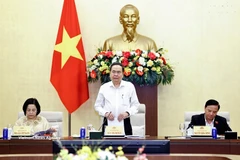
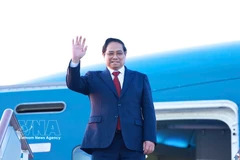
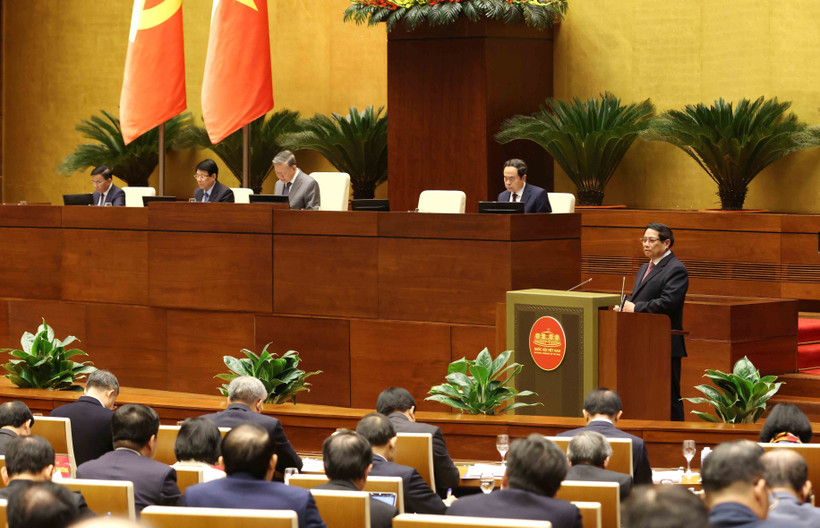
Prime Minister Pham Minh Chinh speaks at the national conference. (Photo: VNA)

Hanoi (VNA) - Prime Minister Pham Minh Chinh has stressed the need to carry out the Politburo’s Resolution No. 57-NQ/TW on breakthroughs in the development of science, technology, innovation, and national digital transformation with strong, systematic and concerted actions, and close coordination among authorities at all levels, sectors, and society.

Addressing a national conference held by the Party Central Committee’s Politburo and Secretariat on January 13, PM Chinh affirmed that the Government has clearly defined the implementation of the resolution as a key political task.

He said that the resolution, issued on December 22, 2024, is a strategic document that marks an important turning point for the country in the fields of science, technology, innovation, and digital transformation. It is of special significance, serving as a guiding principle for the development in the new era of strong development, civilisation and prosperity. The resolution also serves as a powerful call to action for the entire Party, people, and armed forces to work together to transform Vietnam into a developed, high-income country with global competitiveness.

On January 9, 2025, the Government issued Resolution No. 03/NQ-CP, which outlines the Government's Action Programme to implement the Politburo’s resolution, ensuring quality and compliance with the prescribed timeline, PM Chinh stated, adding that this is a comprehensive and overall action programme, designed with a long-term vision, clear objectives, and highly feasible solutions, aimed at translating the Party's major orientations and policies into practical, real-world actions.

Therefore, key tasks such as perfecting the legal framework, developing high-quality human resources, building modern digital infrastructure, promoting scientific research and advanced technology application, and accelerating innovation are incorporated into the Government’s action programme with specific timelines and clear responsibilities, he said.

The Government has instructed ministries, sectors, and localities to urgently build and issue plans to implement the action programme; focus on widespread communication to raise public awareness about science, technology, innovation, and digital transformation; and launch a nationwide emulation movement to harness the collective strength of the entire political system and the active participation of entrepreneurs, businesses, and the people in carrying out the revolution in science, technology, innovation, and digital transformation, the PM stressed.

The Government has also emphasised the importance of urgently perfecting the legal framework; eliminating any ideologies, perceptions, and barriers hindering development; and turning the legal system into a competitive advantage in the development of science, technology, innovation, and digital transformation, he added.

In this regard, PM Chinh stated that the Government will focus on building the draft Law on Science, Technology, and Innovation, and the draft Law on Digital Technology Industry, which will be presented to the National Assembly for approval in 2025./.
VNA

See more

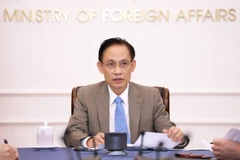
Vietnamese Minister of Foreign Affairs Le Hoai Trung (Photo: VNA)

Vietnamese, Lao foreign ministers hold online talks

The two ministers agreed to maintain close coordination in the time ahead and to expand cooperation under the new framework and orientation, underscoring the significance of the two countries’ “great friendship, special solidarity, comprehensive cooperation, strategic cohesion”.

State President Luong Cuong (fourth from left, first row) and newly-appointed foreign ambassadors in Hanoi on December 12, 2025. (Photo: VNA)

State President receives newly-appointed foreign ambassadors

Receiving Egyptian Ambassador Hany Mostafa Mohamed Mostafa Hassan, President Cuong affirmed that Vietnam highly evaluates Egypt’s role, position, and contributions to regional peace and stability. He also congratulated the African country on its achievements in implementing the 2030 Vision.

An overview of the seminar on the Party’s leadership in ensuring macroeconomic stability, renewing the growth model, restructuring the economy and promoting international integration (Photo: VNA)

Vietnam, Cuba exchange theoretical views on Party’s leadership in macroeconomic stability

The two sides explored in depth the Party’s role in leadership, orientation, oversight and strategic coordination in economic management; approaches to implementing economic restructuring programmes alongside the renewal of the growth model; measures to respond to global economic volatility, inflationary pressures and shifts in global trade; and the building of effective strategic advisory bodies to ensure the Party’s comprehensive leadership in a changing context.

Vietnam’s Ambassador to Australia Pham Hung Tam (Photo: VNA)

Australia–Vietnam Policy Institute serves as bridge for bilateral relations

Established in 2022, AVPI serves as a forum for exchanging ideas among businesses, government agencies, non-profits, universities, and scholars in Australia on Vietnam. The institute acts as a platform for policy dialogue, focusing on research and insights on strategic relations and bilateral economic ties.

General Secretary and Chairman of the NA Office Le Quang Minh chairs the press conference announcing the results of the NA's 10th session (Photo: VNA)

10th session helps strengthen public trust in personnel work, NA’s supreme oversight

Personnel consolidation carried out at the NA's 10th session helps ensure continuous, unified, effective, and efficient leadership of the state apparatus; guarantee smooth and uninterrupted direction and governance; and prevent any leadership gaps in critical areas. All positions elected or approved by the legislature meet the key criteria required within the organisational structure.