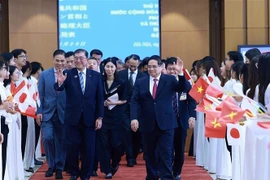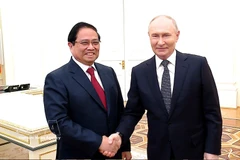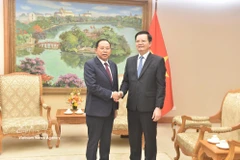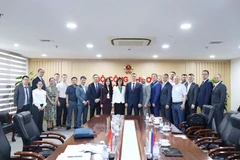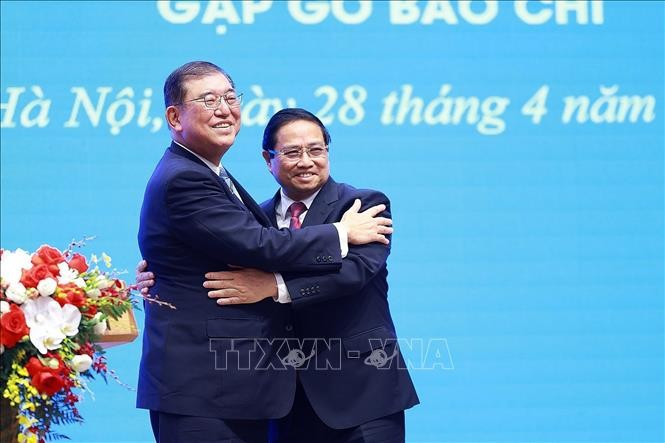
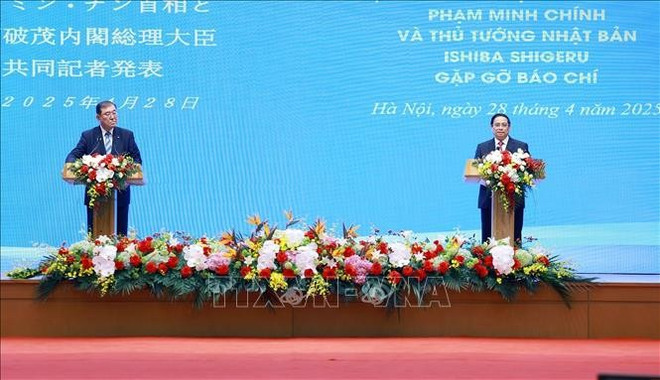
Hanoi (VNA) – Prime Minister Pham Minh Chinh and his Japanese counterpart Ishiba Shigeru announced in a joint press briefing in Hanoi on April 28 that they had productive talks earlier the same day.
Chinh welcomed Ishiba Shigeru and his spouse to Vietnam, highly evaluating Japan as well as the Japanese PM and his spouse’s sentiments towards Vietnam in a sincere, trustworthy, practical, and mutually beneficial spirit.
Emphasising that the two countries have much work to do, many shared achievements to be proud of, and many things to share and support each other, the Vietnamese Government leader hailed the visit as a significant milestone in Vietnam–Japan relations, which is expected to inject new momentum and inspiration to deepen cooperation in a more substantive and effective manner.
Among the key priorities agreed upon were efforts to facilitate a future state visit to Vietnam by the Emperor and Empress of Japan and a visit to Japan by Party General Secretary To Lam. Both sides also addressed ongoing challenges in current bilateral projects and agreed on major directions for strengthening ties in the years ahead.
Chinh said that at the talks, he and his Japanese counterpart agreed on key measures to elevate the comprehensive strategic partnership between Vietnam and Japan to a new height, advancing to a new era. They identified new pillars of cooperation including science and technology, innovation, digital transformation, high-quality workforce training, agriculture, labour, locality-to-locality partnerships, people-to-people exchange, and tourism.
He noted that both countries were committed to enhancing political trust and improving the effectiveness of dialogue mechanisms. They will foster engagement across all Party, State, and parliamentary channels in flexible formats, and institutionalise regular meetings between the two PMs. Additionally, they concurred to upgrade the current Strategic Partnership Dialogue at deputy foreign minister level to a 2+2 dialogue format, including deputy foreign and defence ministers, with the inaugural session set for 2025.
The two sides also agreed to deepen economic, investment, and trade cooperation, particularly through promoting new-generation ODA for strategic infrastructure projects and fast-tracking symbolic joint ventures.
Recognising today’s complex global economic landscape, the two leaders stressed the importance of multilateralism and international cooperation. Both committed to supporting each other’s development and facilitating mutual economic growth.
Ishiba reaffirmed Japan’s commitment to supporting Vietnam’s goals of industrialisation, modernisation, and building an independent, self-reliant economy. He pledged to continue opening the Japanese market to Vietnamese goods. PM Chinh, in turn, outlined Vietnam’s strong determination for high growth, economic sustainability, and aggressive reforms to improve the investment climate, particularly for Japanese investors.
The two leaders also committed to greater cooperation in digital transformation, semiconductors, quantum technology, nuclear energy, AI, IoT, and cloud computing. They agreed to convene the 5th meeting of the Joint Committee on Science and Technology Cooperation in Japan in 2026 and explore the creation of a new public-private cooperation mechanism for science and technology.
Ishiba announced support for joint research projects and a plan to train 250 Vietnamese PhD students in semiconductors under the Japan-ASEAN Science, Technology and Innovation Cooperation Project (NEXUS). Chinh requested Japan’s support for Vietnam’s tech community in Japan, including 70 companies and around 5,000 IT engineers, to be more deeply involved in Japan’s digital supply chain and transformation efforts.
The two PMs reached consensus on expanding green transition cooperation. Vietnam welcomed Japan’s support for 15 green energy transition projects worth over 20 billion USD as part of the Asia Zero Emission Community (AZEC) initiative proposed by Japan.
In agriculture, both sides committed to maximising the potential of high-tech farming in tandem with securing stable food supply chains and food security. They also agreed to strengthen human resources mobility, locality-to-locality partnerships, cultural and people-to-people exchanges, and tourism. Both sides will work together to organise the Vietnam–Japan Local Cooperation Forum in Vietnam by the end of 2025. PM Ishiba praised the significant contributions of the more than 600,000 Vietnamese people living in Japan; and positively acknowledged the proposal to simplify procedures and expand the issuance of Japanese visas for Vietnamese citizens, aiming to reach the goal of 2 million mutual tourist visits per year.
Both sides agreed to begin negotiations for the Vietnam-Japan Social Insurance Agreement, and push ahead with the building of a Memorandum of Understanding (MoU) on a new labour programme "Employment for Skill Development" within this year.
They affirmed the importance of maintaining international order and a free, open trading system based on rules, in accordance with the fundamental principles of international law and the United Nations Charter. They pledged to coordinate closely and effectively on international and regional issues of mutual interest to maintain peace, stability, cooperation, and development. Both also emphasised the importance of preserving peace and stability in the East Sea, addressing disputes through peaceful measures, based on international law and the 1982 United Nations Convention on the Law of the Sea, fully implementing the Declaration on the Conduct of Parties in the East Sea (DOC), and working towards an efficient and effective Code of Conduct (COC) that harmonises the interests of all parties involved.
Japan pledged to support Vietnam to successfully host the Asia-Pacific Economic Cooperation (APEC) Year 2027, while Vietnam vowed to send a delegation to attend Vietnam Day activities at the Expo 2025 Osaka, Kansai.
The Japanese leader affirmed that, with Vietnam's position and role in the region and the world, its remarkable development in recent times, as well as its development orientations for the coming time, Japan prioritises and attaches importance to cooperation with the Southeast Asian nation, for the development of each country and for peace, cooperation and development in the region.
PM Ishiba said he and PM Chinh had very successful talks, during which they agreed to promote upgrading cooperation in the fields of politics, diplomacy, economy, defence, security, education and training, and people-to-people exchange.
In the context of world uncertainties presenting difficulties and challenges that affect the Southeast Asian region in general and Vietnam in particular, Japan welcomes Vietnam to enter a new era of prosperity and civilisation, and supports the nation in developing semiconductor technology and green transformation.
In particular, Japan supports investments in Vietnam, and assists the country in training semiconductor human resources, and accepts graduate students in this field, he stated, sharing that Japan spends about 20 billion USD to help Vietnam in energy transition through the Asian Zero Emission Community (AZEC) mechanism.
Showing his hope that Vietnam will continue to improve its investment and business environment, listen to the voices of businesses, and create conditions for Japanese businesses to invest and operate effectively in the country, PM Ishiba affirmed that Japan will support Vietnam to develop infrastructure, especially transport infrastructure, with metro projects; to respond to natural disasters; and to narrow the development gap between regions and areas.
According to him, the two sides also exchanged views on regional and international issues of mutual concern; and agreed to solve differences on the basis of respect for international law. He affirmed that Japan will accompany Mekong countries, including Vietnam, in the new era of development.
Previously, the two PMs witnessed the handover of four cooperation documents, namely an MoU on research and development cooperation in the semiconductor field; another on human resources development cooperation in this field; a framework agreement on Japanese language teaching in Vietnamese high schools; and an MoU on promoting bilateral cooperation projects in energy transition./.