Party mass mobilisation delegation visits Japan

A delegation from the Party Central Committee’s Mass Mobilisation Commission led by its Deputy Chairman Trieu Tai Vinh has held working sessions with representatives of the ruling Liberal Democratic Party (LDP) of Japan and the Japanese Communist Party (JCP), as well as Party committee of the Vietnamese Embassy in Japan on mass mobilisation work, as part of their working trip to Japan from July 21-31.

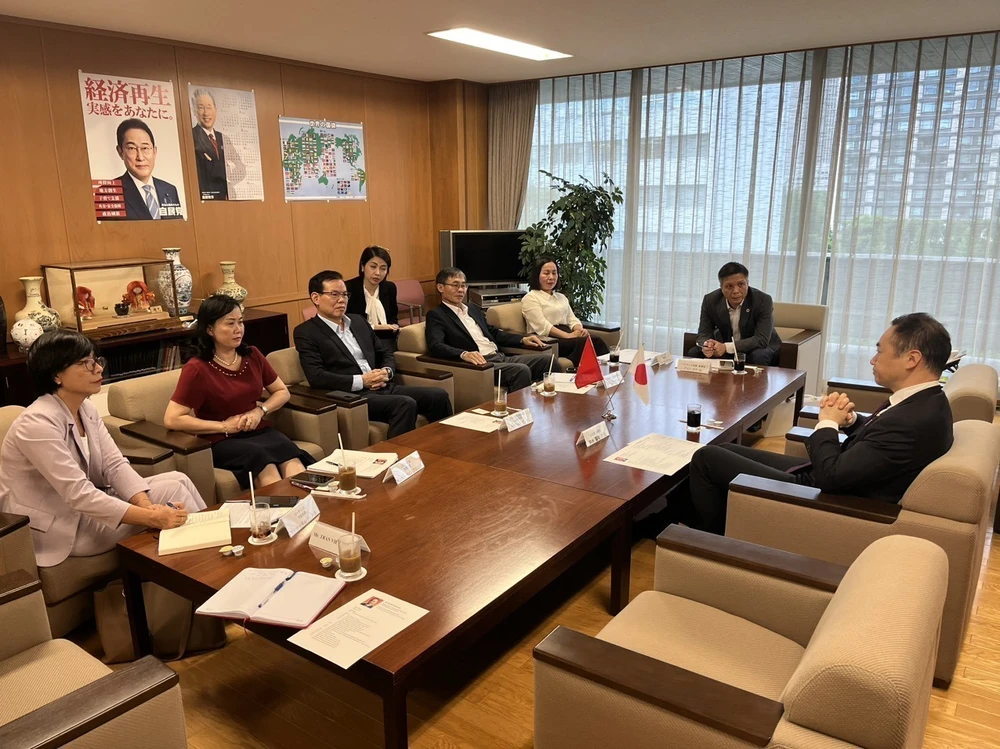
A delegation from the Party Central Committee’s Mass Mobilisation Commission met with representatives of ruling Liberal Democratic Party (LDP) of Japan. (Photo: VNA)

Tokyo (VNA) - A delegation from the Party Central Committee’s Mass Mobilisation Commission led by its Deputy Chairman Trieu Tai Vinh has held working sessions with representatives of the ruling Liberal Democratic Party (LDP) of Japan and the Japanese Communist Party (JCP), as well as Party committee of the Vietnamese Embassy in Japan on mass mobilisation work, as part of their working trip to Japan from July 21-31.

During the working session with Suzuki Keisuke, Deputy Chairperson of the LDP's Policy Research Council, Vinh briefed the host about the Party and State's policies towards the Vietnamese community abroad in general and the Vietnamese community in Japan in particular.

The two sides also discussed the LDP's experience in devising solutions to social security issues such as coping with aging population and declining birthrate in Japan, and ways to enhance the contribution of the Vietnamese community in the host country.

For his part, Suzuki spoke highly of contributions of the Vietnamese community to the socio-economic development in Japan, not only in recent years but also in the medium and long term, especially in the context of Japan's labour shortage in various fields.

More Japanese enterprises are choosing Vietnam as an investment destination, he said, also noting the development trend of Vietnamese enterprises in Japan. Therefore, it is necessary for the two Parties and governments of the two countries to strengthen coordination in both policy making and promoting people-to-people exchanges, Suzuki said.

The Vietnamese Party delegation also visited the JCP’s headquarters and held working session with JCP's International Peace Movement Committee to exchange research and experiences in grasping the needs and aspirations of the people as well as promoting collaboration between the two parties in cultural, ethnic and religious affairs.

At the delegation's working session with the embassy, Vinh appreciated the establishment of a union of Vietnamese association in Japan, saying it has become an umbrella organisation that helps strengthen the solidarity of the Vietnamese community in Japan. He also underlined that mass mobilisation work for overseas Vietnamese should focus on creating a favourable environment for Vietnamese people in Japan to access positive information, clearly understand the policies of the Party and State, strictly comply with local regulations, unite and support each other, especially in difficult circumstances.

The number of Vietnamese people in Japan topped 560,000 as of March 22, according to the Japanese Ministry of Justice. Vietnamese continued to be the second biggest foreign community in Japan after China./.
VNA

See more

The national flags of Vietnam and the Philippines. Photo: VNA

Vietnam congratulates Philippines on Independence Day

General Secretary of the Communist Party of Vietnam and State President To Lam and Prime Minister Le Minh Hung on June 12 sent congratulatory messages to Philippine President Ferdinand Romualdez Marcos Jr on the occasion of the 128th anniversary of the Declaration of Independence of the Republic of the Philippines (June 12, 1898 – 2026).

Former Deputy Minister of Foreign Affairs Ambassador Pham Quang Vinh. (Photo: VNA)

AFF 2026 marks Vietnam’s transition from participant to regional agenda-setter

With sharp strategic mindset and a proven capacity for practical action at both bilateral and multilateral levels, Vietnam has demonstrated its role as a builder and agenda-setter, contributing to a robust platform for dialogue and cooperation in pursuit of a resilient, peaceful, and truly people-centred ASEAN Community by 2045

Party General Secretary and State President To Lam addresses the national conference disseminating and implementing Politburo Resolution No. 06-NQ/TW (Photo: VNA)

📝OP-ED: When foreign affairs pioneer in shaping nation's future

Resolution No. 06-NQ/TW represents both a continuation and a development of the Party’s comprehensive foreign policy and President Ho Chi Minh’s thought. If international integration helped create a favourable environment for development, diplomacy today is tasked with protecting and expanding that space.

An overview of the 4th session of the 17th Hanoi People’s Council for the 2026–2031 term. (Photo: VNA)

Capital Law 2026 paves way for Hanoi’s new development model

One of the key breakthroughs of the new resolutions is the shift from a traditional management-oriented approach to a development-enabling model. The proposed policies are designed not only to address current issues but also to establish the foundation for a more modern, proactive and flexible system of urban governance.

Vietnamese Ambassador to Algeria Tran Quoc Khanh (seventh from left) poses for a group photo with the leaders and staff of the University of Skikda. (Photo: VNA)

Vietnam, Algeria strengthen agricultural trade connectivity

Vietnam’s main exports to Algeria include coffee, cashew nuts, pepper, textiles and garments, steel and selected industrial products, while the North African country sells animal feed, chemicals, dates and other agricultural products to Vietnam.

Vietnamese Deputy Minister of Foreign Affairs Le Thi Thu Hang speaks at the forum. (Photo: VNA)

Vietnam, Switzerland eye stronger economic connectivity

Vietnamese Deputy Minister of Foreign Affairs Le Thi Thu Hang expressed Vietnam’s desire to see Swiss enterprises expand their long-term presence and investment in the country, particularly in high technology, innovation, renewable energy, pharmaceuticals, healthcare and digital transformation. She also emphasised cooperation in talent development, high-end tourism and international financial centre development.

Chairman of the People’s Committee of Hue city Nguyen Khac Toan (right) presents a souvenir to Karl Wilfing, President of the State Parliament of Lower Austria. (Photo: People’s Committee of Hue city)

Hue city moves to deepen multifaceted cooperation with Austrian partners

Toan proposed Lower Austria consider establishing an official cooperation mechanism with Hue to facilitate investment collaboration in tourism, education and training, healthcare, information technology, green and smart urban development, heritage conservation, hi-tech agriculture and sustainable development.

Prime Minister Le Minh Hung chairs the working session with the Standing Board of the Hanoi Party Committee on June 11. (Photo: VNA)

Prime Minister urges Hanoi to target higher growth, become leading innovation hub

The PM emphasised that Hanoi must achieve its 11% growth target for 2026 through comprehensive solutions and regular reviews of growth scenarios. He called on the city to unlock growth potential in processing, manufacturing, trade, services, finance, banking, insurance, transport, logistics, construction and real estate, while controlling inflation and market stability.

Party General Secretary and State President To Lam addresses the conference. (Photo: VNA)

Top leader calls for better quality of institutional development

Party General Secretary and State President Lam underscored the need for a new mindset that places judicial reforms within a unified rule-of-law framework: good law-making, strict law enforcement, an honest judiciary, safeguarded justice, controlled power, protected human and citizens’ rights, and national development supported by a transparent, effective and coherent institutional system.