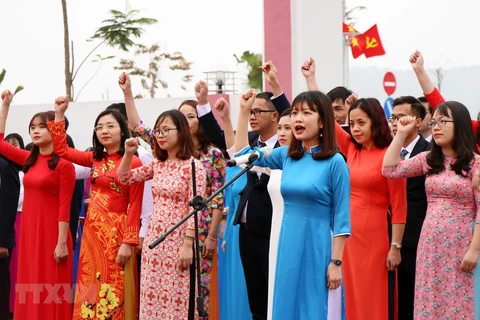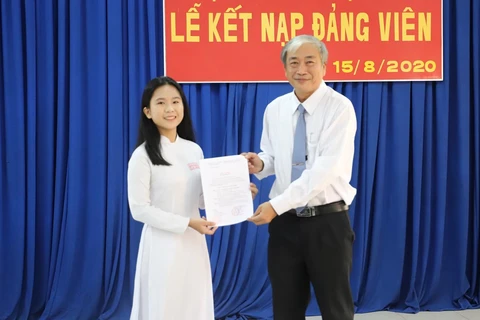
Hanoi (VNA) - Party membership development at universities plays an even more important role when it is a source of high-quality successors who are important for strengthening the Party leadership.
The admission of new Party members from universities, which gather thousands of students and lecturers, focuses on capacity building for potential candidates, as they are ambitious, dynamic, enthusiastic and creative, and need correct guidance to develop further.
As such, Party committees of universities and colleges regularly pay attention to the work. To be selected, a student must attain good academic results, actively join social activities, have strong political firmness, and volunteer to be a member of the Communist Party of Vietnam (CPV).
Via promoting a series of movements by their youth unions and student associations, universities have created favourable conditions for students to have the opportunity to practice and develop themselves. They constitute the excellent human resources for the future Party membership expansion. Party members who are students are therefore carefully selected and trained.
However, because the training period at universities only lasts from 4 to 6 years, many of them face difficulty in changing the party organisation where they join after graduation. Most of them cannot secure their jobs right away, and some work in a place where there is no Party organisation while working away from home. They cannot move to the Party organisation in their hometown, while their constant changing of accommodations make it complicated to switch to new Party organisations from their previous ones at the universities. Therefore, many young members have been excluded from the membership after graduating. It is a loss to both the students themselves and the Party.
The Vietnam News Agency’s series of articles on Party membership development at universities will give you an insight into the mission.
Part 1: Searching for and horning 'jewel' in the forest of knowledge
Do Duc Thang is a student of the renowned Hanoi University of Science and Technology (HUST) and a young member of the CPV.
“I once felt overloaded, unable to arrange everything. I had to stay up all night at the office of the HUST’s student association, while the next morning I still had to go to class as usual. However, those days trained me to become more mature, know how to assign work instead of holding on to it, and know when to drastically speed up,” Thang said remembering his early time taking office as vice president of the association.
Diamonds in the Gold Mine
Bui Duc Hung, Standing Deputy Secretary of the HUST Party Committee and Chairman of the university’s Trade Union said that assigning responsibilities to young Party members like Thang is a way to train them nd create favourable conditions for them to develop and improve themselves.
 Bui Duc Hung, Standing Deputy Secretary of the HUST Party Committee and Chairman of the university’s Trade Union (Photo: VNA)
 According to Hung, the HUST has about 30,000 students, but each year only between about 50 to 70 students are admitted to the CPV, about 0.2 percent – an extremely low ratio
The university’s Party organisation realises that such low figure is not commensurate with its potential but it cannot lower the admission standards, Hung noted.
 Chu Manh Hung, Secretary of the Hanoi Law University’s Party Committee (Photo: VietnamPlus)
 A similar situation took place at the Hanoi Law University, where about 100 out of nearly 10,000 students attained the Party membership annually.
Chu Manh Hung, Secretary of the Hanoi Law University’s Party Committee, the standard admission criteria require students to achieve medium academic results, but the university set higher standards that ask for good or higher academic results and a record of scientific research.
Nurturing red seeds
Universities’ youth unions and student associations are two effective units in introducing typical elements to the Party. This is also an environment for the educational establishments’ Party committees to incubate and develop young members by assigning tasks and responsibilities to each student to support their growth.
 Do Duc Thang was once an active member of the youth union. (Photo: Do Duc Thang)
 Thang said university-level youth activities are a real challenge, as students are both the organisers and the implementers and the size of the youth union is up to dozens of thousands. Finding a balance to study was also an issue, he added.
Thang had been assigned to different important posts such as vice president of the HUST’s student association. Each task helped him become more mature and perfect his leadership capacity, particularly in work-related organisation and delegation.
 With his capacity fostered via different tasks assigned, Thang becomes a member of the Party. (Photo: Do Duc Thang)
 Through his efforts, Thang was admitted by the HUST’s Party Committee. “It is an honour for me and my family,” he said with delight.
Bui Duc Hung said for each student, striving to be a member of the Party is an arduous process but with the maximum support from the university./.