Philippine President allows army’s attack plan in Marawi

Philippine President Rodrigo Duterte on August 30 has allowed the government army to decide suitable measures to take back areas that under insurgents’ control in the southern city of Marawi on Mindanao Island.
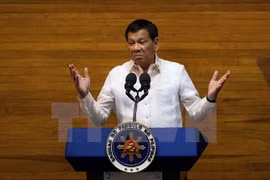
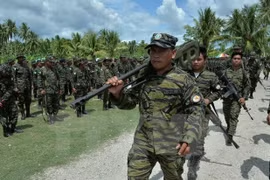
Philippine President allows army’s attack plan in Marawi ảnh 1Philippine President Rodrigo Duterte (Photo: EPA/VNA)

Hanoi (VNA) – PhilippinePresident Rodrigo Duterte on August 30 has allowed the government army todecide suitable measures to take back areas that under insurgents’ control in thesouthern city of Marawi on Mindanao Island.

In a speech, Duterte stressed that the 100-dayfight could not last forever, adding that situation in Marawi was beyondcontrol and in a stalemate.

The Philippine President said he has approvedthe government army’s plan to attack local mosques, where militants are holdinghostages, although he had rejected it at first. He explained that the stalematecould not prolong for more than one year. Meanwhile, some people have been sentto persuade the militants to release hostages without hurting them.

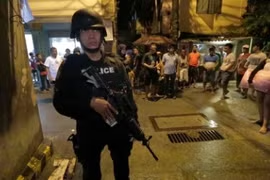
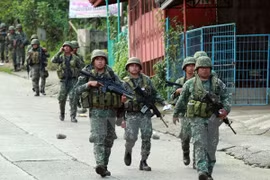
Gunmen who had pledged allegiance to theself-claimed Islamic State (IS) have occupied Marawi, a big city of Muslim insouthern Philippines since May. Clashes between Philippine security forces andthe insurgents have claimed more than 600 lives. 

The martial law which imposed on Mindanao hasbeen extended till this year’s end to make it easier for security forces tosweep terrorists out of the south.-VNA
VNA

See more

Thailand pushes for establishment of ASEAN emergency public health centre

Thailand pushes for establishment of ASEAN emergency public health centre

The draft agreement stipulates that ACPHEED will comprise three specialised centres based in three ASEAN member states. Vietnam will oversee the centre for prevention and preparedness; Indonesia will host the centre for detection and risk assessment; and Thailand will be responsible for the centre for response and risk communication.

Indonesia designates 31 mln ha of waters as conservation areas

Indonesia designates 31 mln ha of waters as conservation areas

Head of the Convention and Marine Resource Balance working team at the ministry’s Directorate of Ecosystem Conservation Ahmad Sofiullah said this week that it is a strategic effort to ensure the sustainability of Indonesia’s marine ecosystems.

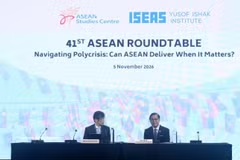
Thai Deputy Prime Minister and Minister of Foreign Affairs Sihasak Phuangketkeow (R) takes part in the Q&A session at the 41st ASEAN Roundtable. (Photo: VNA)

Thailand calls on ASEAN to proactively address polycrisis

Thai Deputy Prime Minister and Minister of Foreign Affairs Sihasak Phuangketkeow noted that no single member state could tackle challenges ranging from major-power competition and economic fragmentation to climate change and energy and food security on its own. Regional cooperation is therefore a strategic imperative, enabling ASEAN not only to overcome crises but also to sustain its development momentum.

Palm oil and palm oil-based products are among Indonesia’s promising export commodities. (Photo: VNA)

Indonesia to launch commodity export monitoring platform next year

DSI will draw on data from customs authorities, trade activities and the financial system, alongside contracts and documents uploaded by exporting companies. The platform will monitor the volume, quality, prices and destination markets of various commodities, as well as transactions between related parties.

Philippines increases rice imports from Cambodia

Philippines increases rice imports from Cambodia

Cambodia has contracted to supply a further 87,344 tonnes to the Philippines between September and December. If all orders are fulfilled, its rice exports to the market could reach around 209,000 tonnes in 2026.

Students get free meals under the national school feeding programme at Hun Sen Svay Cek Primary School (Photo: khmertimeskh)

Cambodia expands school meal programme

Cambodian Prime Minister Hun Manet stressed that his Government would proactively allocate budget and strengthen management capacity, with the aim of expanding the school meal programme to more than 7,000 primary schools nationwide. The move is expected to improve students' nutrition and learning conditions.